

The Framework and Its Horizon
For more than two decades, Partha Chatterjee’s (2004) distinction between civil society and political society has done more to clarify the actual texture of democracy in postcolonial societies than almost any other conceptual contribution in South Asian political thought. Its genius lay in a refusal to condescend. Where liberal political theory saw only citizens behaving irrationally - voting for the wrong reasons, organizing around the wrong identities, refusing to perform the frictionless calculations of the rational-choice voter - Chatterjee saw communities negotiating their survival. They came to the state not as abstract individuals bearing rights, but as populations: jute workers, slum-dwellers, sharecroppers, fishing communities, those without titles to land they had occupied for generations. They petitioned, bargained, defied eviction orders, assembled outside local party offices, struck deals with ward councillors, cultivated relationships with district-level administrators. They were not citizens in the thin juridical sense. They were the governed, and they had developed an extraordinarily sophisticated politics of the governed.
The concept was, in the deepest sense, an act of democratic generosity toward those whom liberal theory had failed to recognize. It said: look again, this is also politics, this is also rationality, this too is an exercise of agency within the conditions actually available.
But frameworks, however capacious, have horizons. And the horizon of political society has always been, in some measure, the boundary of distribution. The governed seek entitlements. They negotiate material accommodation. The state remains the source of benefits, and political participation is organized largely around securing a better position within the distributional order that the state maintains. The framework is, structurally speaking, a framework of claimants.
What happens when the governed cease to be claimants and become, instead, custodians: not of what the state owes them, but of what the nation itself must remain?
The 2026 West Bengal election does not merely stress-test that framework. It ruptures it. And the rupture is worth understanding with the seriousness it demands.
The Asymmetry of Granted Agency
There is an asymmetry embedded deep within much progressive political theory, rarely stated explicitly but always operative, that must be named before it can be examined. It runs approximately as follows: subaltern political agency is authentic when it takes the form of demands for welfare, reservations, land rights, wages, recognition, or local negotiation. It becomes suspect - manufactured, mobilized, deluded - when it takes the form of nationalism, civilizational concern, anxiety about borders, or claims of collective identity under threat.
Under this asymmetry, a landless agricultural laborer who demands fair wages is exercising genuine democratic agency. The same laborer, if he votes on the basis of concern about illegal immigration from Bangladesh transforming the demographic character of his district, is suddenly the object of elite manipulation rather than a subject of political judgment. His economic calculation is credited; his civilizational anxiety is pathologized.
The intellectual difficulty with this position is not minor. It is, at its root, self-contradictory. If citizens possess the rational capacity to evaluate their material interests in complex distributional environment, that is, to navigate patronage networks, calculate the value of different electoral promises, compare the performance of successive governments on welfare delivery, then on what conceivable basis should they be presumed incapable of forming judgments about what they perceive as national interests? If democratic agency is real, it cannot be selectively switched on when voters produce outcomes approved by academics and switched off when they do not.
The masses are deemed intelligent enough to calculate subsidies but not intelligent enough to form judgments about the nation. A democracy cannot operate on such selective recognition of agency.
Chatterjee himself saw this danger. His entire enterprise was a rescue of subaltern political rationality from the condescension of elite liberalism. The irony, and it is a rich one, is that subsequent readings of political society have in many instances reproduced a different form of condescension: they validate popular agency only when it conforms to categories the theorist finds acceptable. The subaltern may speak, but only certain things. He may act, but only in certain registers. When he speaks in a register the theorist finds uncomfortable, the theorist reaches for the language of false consciousness, communal passion, or elite manipulation.
This is not political theory. It is gatekeeping dressed as political theory.
Bengal as a Problem of Political Sociology
West Bengal is not an abstract site for testing theoretical propositions. It is a place with a specific and turbulent political history that makes the 2026 result all the more remarkable.
It is the site of one of the longest-running communist governments in democratic history: thirty-four years of Left Front rule that transformed the countryside through Operation Barga and the panchayati raj reforms, built a machinery of rural organization that was in its heyday one of the most formidable electoral apparatuses in the country, and created a political culture in which the Left’s conceptual vocabulary, which is, class struggle, peasant rights, anti-imperialism, was the common language of mobilization.
It is also a state with a Muslim population approaching thirty percent, a significant proportion concentrated in border districts, and a border with Bangladesh through which illegal immigration has been an acknowledged social reality for decades, transforming demographic compositions in ways that even governments not prone to communal politics have found politically unmanageable.
Historical context
The districts of Murshidabad, Malda, Birbhum, and the 24-Parganas have seen some of the most dramatic demographic transformations in post-independence Bengal. Local Hindu communities, including peasants, small traders, and agricultural laborers, many of them Scheduled Castes and Other Backward Classes, have reported pressures ranging from land acquisition to cultural displacement. These are not the complaints of elites. They are the complaints of precisely the populations that political society theory was constructed to take seriously.
The Trinamool Congress government of Mamata Banerjee understood border districts as its core electoral base and governed accordingly. The structural bargain it offered was essentially this: in exchange for Muslim electoral consolidation, the government would provide administrative protection, patronage access, and symbolic recognition, while treating the concerns of Hindu communities, particularly those of lower castes and non-elite groups who bore the most proximate costs of demographic transformation, as either marginal or implicitly majoritarian and therefore illegitimate.
This is where the theory of political society becomes most illuminating, and most limited simultaneously. The TMC was practicing a recognizable form of political society politics: community-level bargaining, patronage distribution, electoral accommodation of specific populations. By the internal logic of the framework, it was doing exactly what the theory predicts and even valorizes. It was negotiating with populations, not addressing them as abstract individuals.
But here is the crucial question the framework could not adequately process: what happens when those negotiations systematically exclude some populations, and when those excluded populations happen to be the Hindu communities of Bengal’s border districts, river plains, and urban peripheries?
The answer, it turns out, is not that those populations continue to negotiate individually for better terms. The answer is that they aggregate into something the theory does not easily name: a national political community that begins to assert claims not about what the state owes them, but about what the nation itself must preserve.
The Direction Reversal: From Petitioner to Constituent
Consider what Chatterjee’s political society assumes about the direction of political action. The governed approach the state. They make claims. They seek exceptions to general rules. They leverage their electoral significance to extract accommodation from governmental power. The initiative moves from below (population) upward to the state, and the state responds by calibrating its policies, programs, and patronage to manage and contain the governed.
Nationalism reverses this directional logic.
When a voter approaches politics through the lens of national preservation, the structure of his political claim changes fundamentally. He is no longer a petitioner approaching the state for a benefit. He is a constituent of sovereignty: someone who co-owns the political community and whose voice in its composition is inherent, not granted. Questions of borders, citizenship, demographic change, and cultural continuity are not requests addressed to the state. They are assertions of what the nation must be, addressed through the state, by its constituent members, to those who would govern it.
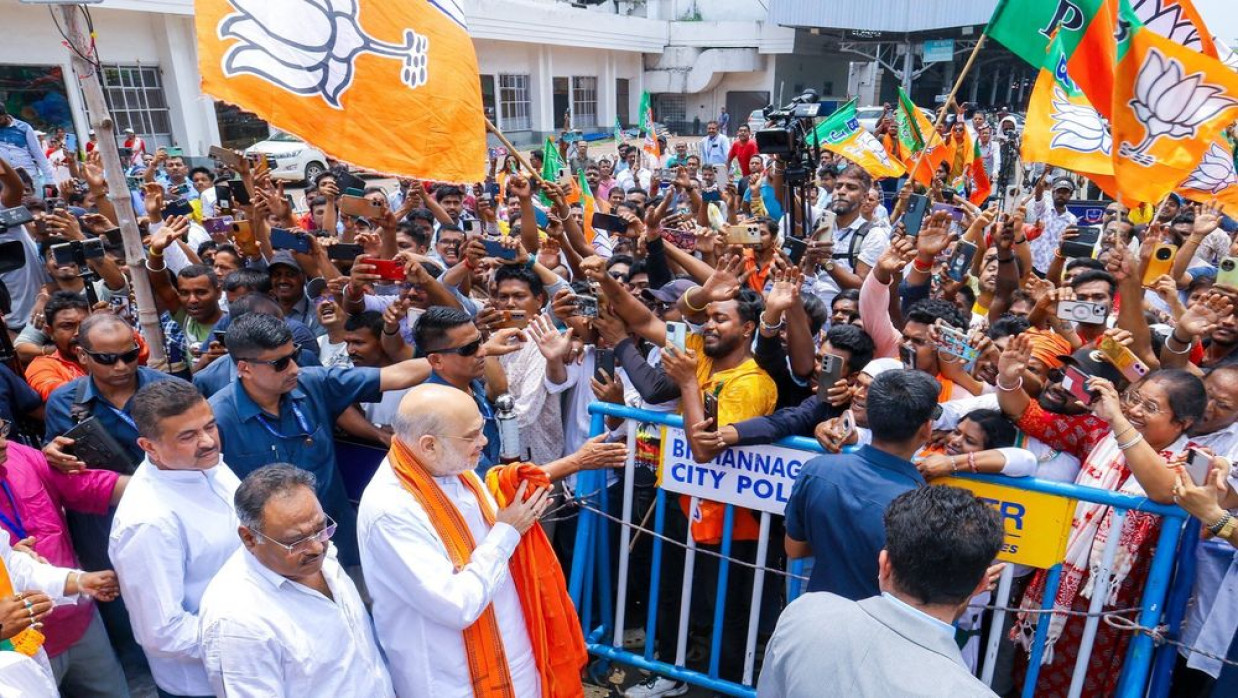
This is not a minor shift. It is the difference between the governed and the governing, between a subject seeking accommodation and a citizen exercising foundational political authority. The Hindu voter of rural Nadia, Murshidabad, or Coochbehar who cast his ballot in May 2026 was not asking for a larger subsidy. He was making a claim about the permissible boundaries of political community. He was saying, in the language available to him, that is, the language of the ballot, that a certain arrangement of political power had made his nation unrecognizable and that he wished to reclaim it.
The governed have moved from bargaining within the nation to arguing about the nation. This distinction is not rhetorical; it marks the outermost limit of political society as a theoretical frame.
And here, precisely, is where elite theory fails most catastrophically. It cannot register this claim as legitimate because doing so would require granting that ordinary Hindus, lower-caste peasants, non-elite Bengalis, women in border villages who have watched their neighbourhoods change within a generation, possess the political authority to define the nation. That grant is uncomfortable because it disrupts the preferred narrative in which the nation is defined by constitutions, courts, and cosmopolitan elites, not by the unglamorous electoral choices of people who have never attended a seminar on nationalism studies.
The Historical Record That Theory Keeps Forgetting
The amnesia is deliberate in some quarters, inadvertent in others, but it is consistent. Theory repeatedly forgets what history repeatedly shows: ordinary people are capable of acting on civilizational commitments that exceed immediate material calculation, and when they do so, they are not acting irrationally. They are acting on a different and larger rationality.
The great nationalist movements of the nineteenth and twentieth centuries, in Europe, Asia, Africa, the Americas, were not produced exclusively by elite intellectual work. They were sustained by the investment of ordinary people in a collective identity whose preservation they experienced as more urgent than the maximization of individual material payoffs. Bengali partition in 1905 produced mass resistance not from the educated bhadralok alone but from the peasantry, the bazaar communities, and the artisans. The anti-colonial movement in its mature phase could not have been sustained without the willing participation of people who had far more immediate material concerns than independence and who chose national liberation anyway. When Emergency was imposed in 1975, it was the subaltern Patna, that became the heart of the eruption against the suppression of the rights and liberties of the Indian citizens.
What this suggests is not that material interests disappear when nationalist commitments activate. It is that human beings are capable of holding multiple political registers simultaneously, and that the decision about which register is primary in any given historical moment is itself a political judgment, one that cannot be made for the voter by the theorist, and one that the theorist must be willing to respect even when it produces outcomes he finds ideologically unwelcome.
The voter of 2026 Bengal was not irrational. He was making a judgment, eminently rational within his own epistemic horizon, that the governance of the previous decade had treated certain questions as permanently off the table, that those questions concerned his security and his sense of belonging in his own homeland, and that the available mechanism for reopening those questions was the ballot. He used it accordingly.
The Warning to Those Who Play with Words
There is a recurring intellectual temptation in political sociology to aestheticize marginality. The subaltern becomes most interesting, most theoretically productive, when he is in a state of negotiation, resistance, or survival. He is the object of respectful scholarly attention so long as he remains legible within the categories the scholar has constructed. The moment he becomes a Hindu nationalist voter, he is expelled from the community of the theoretically interesting and reclassified as a communal actor, a manipulated subject, or an example of democratic backsliding.
This expulsion has a price. It produces theories that cannot predict the electoral behavior they claim to explain. It produces analyses that describe outcomes as unexpected, shocking, or irrational when they are, from within the voter’s own political horizon, nothing of the sort. It produces a political science that is more comfortable with the subaltern it has theorized than with the subaltern who actually exists and votes.
More dangerously, it produces public discourse that systematically delegitimizes the political choices of precisely the communities - lower-caste Hindus, non-elite Bangali Hindus, those most directly exposed to the consequences of vote-bank driven demographic politics - that political society theory was ostensibly designed to empower. The theory becomes a weapon against the people it was built to honor.
A theory that grants agency to citizens only when they speak the language preferred by elites is ultimately less democratic than the electorate it seeks to explain. It is not a theory of democracy; it is a theory of permitted democracy.
The BJP’s 207-seat supermajority in West Bengal is not a verdict that admits of easy ideological appropriation in either direction. It is a democratic fact of extraordinary magnitude, produced by millions of voters exercising the most fundamental political right available to them. Understanding it requires neither celebration nor horror, but the intellectual honesty to ask: what were these voters saying, and why had so much theory made it impossible to hear them?
Coda: What Comes After Chatterjee
Partha Chatterjee’s political society remains an indispensable analytical tool. It describes something real and important about how democracy functions in postcolonial conditions. It should not be abandoned, but it must be extended, extended into the territory it could not originally see, which is the territory of popular national self-assertion.
The extension requires a theoretical move that is simple to state and difficult to accept: that the right of a people to define the political community they inhabit - its borders, its membership, its cultural character, its sense of civilizational continuity - belongs not to intellectuals, courts, or constitutions alone, but to the people themselves, including and especially those people who have never had the luxury of thinking about these questions in the abstract because they have been living with their concrete consequences.
The West Bengal voter of 2026 was not abandoning political society. He was graduating from it, from claimant to constituent, from petitioner to co-sovereign, from negotiator of entitlements to author of the national imagination. That graduation is the political event that demands theoretical accounting.
History belongs to those who make it. Theory, if it is worth anything, must be capable of recognizing them.

0 Comments
LEAVE A COMMENT
Your email address will not be published