

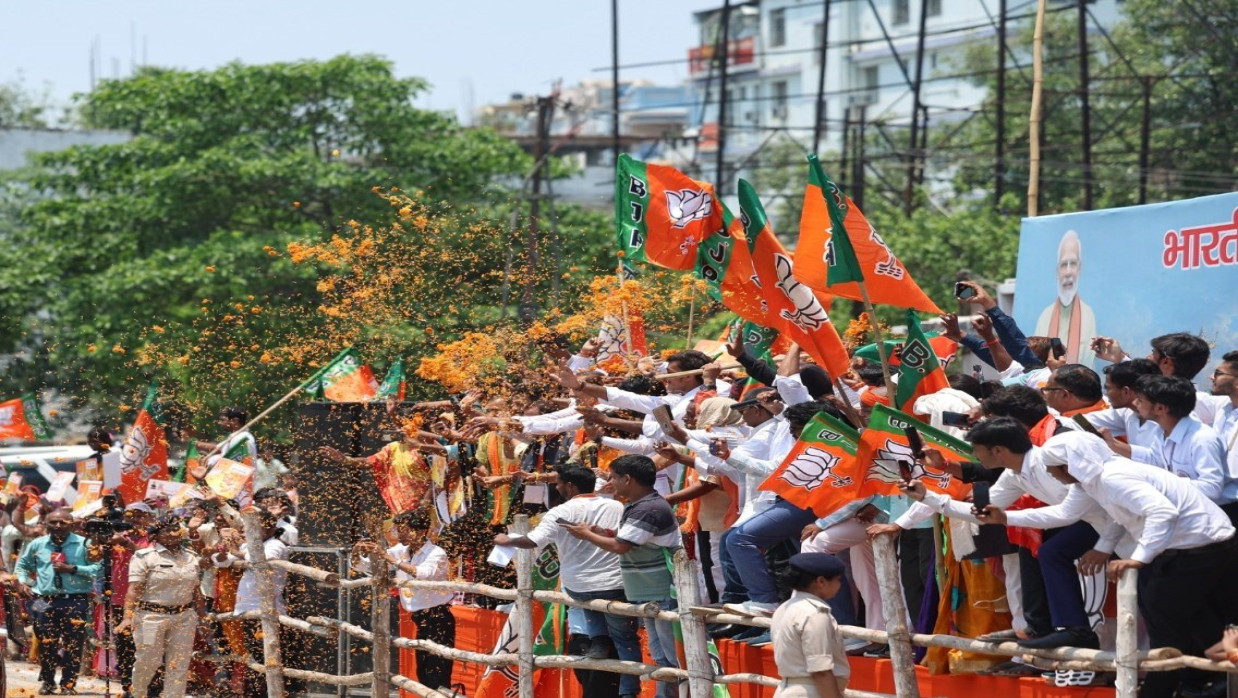
Politics in Bengal has changed drastically with the emergence of the Bharatiya Janata Party (BJP) as a serious contender to the hitherto dominant All India Trinamool Congress (TMC) hegemony. West Bengal is different from most states in India in that it borders another nation, Bangladesh. With over 2,000 kilometers of border separating the two Bengals, West Bengal has been a bastion of cultural, linguistic, and economic exchange between India and Bangladesh. The BJP has ushered in unabashed political rhetoric characterized by hyper-nationalism, Hindutva majoritarianism, and chants of "anti-Muslim Muslim" that seek to brand Bengali Muslims as "Bangladeshis" or illegal immigrants.
Running under the flag of Narendra Modi and Amit Shah, the BJP weaponized immigration and citizenship as a campaign to galvanize votes. In Bengal, these conversations are precarious in nature since illegal immigration metaphorically, and sometimes literally, criminalizes someone who ethnically, linguistically, and often has family ties across the border in Bangladesh.
The Politics of Fear and Identity
A major theme of the BJP was seeking votes based on projecting Muslims as invaders who threaten Bengal's safety, prosperity, and way of life. Speakers from the party raised the bogey of illegal immigration from Bangladesh during their speeches, suggesting that this problem amounted to nothing less than an existential threat to Bengalis. Bengali Muslims were portrayed as Bangladeshis posing a threat to national security.
Bangladeshis aside, BJP leaders, including Suvendu Adhikari, have made inflammatory comments about Bengali Muslims at rallies and through speeches. Comparing Bangladesh with Gaza and calling for those he accused of infiltrating India illegally to be shot "on streets and in jungles" has drawn condemnation from human rights activists and South Asia analysts alike. Opponents have accused BJP leaders of whipping up communal tensions to try to win votes.
BJP has also been accused of systematically excluding Muslims, and candidates like Sabyasachi Dawn believed thousands of people were excluded from voting lists on citizenship grounds alone. While numbers thrown around in political debates have ranged from six lakh to one crore individuals being excluded or marked for further scrutiny, what many of these excluded voters have in common is their Muslim faith and membership in communities such as the Matua community, which votes overwhelmingly for the TMC.
NRC, CAA, and the Weaponization of Citizenship
The CAA and the NRC shifted the political tone in Bengal and across India as a whole. The NRC process involves sorting individuals by their lineage and documentation, which may prove disastrous for poor, marginalized groups who lack documentation. NRC was camouflaged as a secular process of sorting citizens from illegal migrants, when, at the end of the day, it sought to single out Muslims, Bengali-speaking Muslims in bordering towns predominantly. As CAA offered citizenship to refugees of non-Muslim communities from Bangladesh, Pakistan, and Afghanistan, the message was clear: citizenship will be determined on religious lines. Bengali Muslims across India feared that if citizenship is tested based on the NRC, then they'll be declared stateless and sent to detention camps or deported. However, what most people didn't account for was that CAA and NRC would impact Hindu refugees like Matuas who had crossed borders from Bangladesh several decades ago. Seen as a traditional BJP vote bank, the party found sections of the Matua community fearing that they might face the same fate as Muslims if they aren't properly documented.
Selective Enforcement and Cultural Suppression
Beyond attacking citizenship rights, the BJP supporters in Bengal have been accused of only targeting Muslim festivals and prayers. Conflicts over banning qurbani, loudspeakers broadcasting Azaan (prayer call), and limiting namaz-e-jamaat on streets are brewing.
While those in favor of such steps claim it is an issue of enforcing law and order, those against it say that such a law is applied selectively. Questions were raised: if loudspeakers could be banned for mosques, why not for puja pandals, kumbha melas, religious events, or even political rallies? If namaz-e-jamaat on roads was illegal, why was Rathyatra with millions of supporters at the same stretch allowed? Selective law is said to run counter to the secularism promised by our Constitution and to brew mistrust among communities.
Worryingly enough, even these debates have religion as the rallying point for political agitation. When will our political rhetoric focus on unemployment, price rise, agrarian crisis, or factory closures instead of identity politics?
Economic Blowback and Social Consequences
Muslims are not the only ones affected economically by anti-Muslim politics. Restricting Qurbani and cattle trading/transport affected cattle traders, cattle transporters, leatherworkers, farmers, among others. Bengal reported losses to its leather industry because it depends on trade during Eid.
Anti-Bangladesh rhetoric damaged trade between the two countries. Many Bangladeshis started boycotting Indian products after comments by BJP politicians were perceived as hostile. Bangladesh is a key trading partner for India in the region, so Indian companies also rely on strong public sentiment there.
Farmers have also been economically affected by political tensions. Farmers who sold their goods along regional trade routes and used transport corridors have seen profits decline due to increased uncertainty. Some critics say that targeting Muslims for political gain might help win elections, but it hurts the economy in the long run.
India–Bangladesh Relations Under Strain
India-Bangladesh ties and West Bengal's politics are inexorably linked. Bangladesh is one of India's most crucial neighborhood partners. With Bangladesh, India seeks greater trade cooperation, counterterrorism collaboration, and connectivity with India's "Seven Sisters" region in the northeast.
Nonetheless, political statements regularly dehumanizing Bangladeshis as "illegal infiltrators" and termites risk alienating this vital partner. News that Indian border forces were "pushing back" Bangladesh migrants at the border has provoked condemnation within Bangladesh.
India's border with Bangladesh is already controversial. Allegations of human rights abuses by India's Border Security Force (BSF), which border Indians allege has shot and used unjustified force against civilians, have fueled anti-India sentiment within Bangladesh. Inflammatory rhetoric can easily exacerbate these issues.
The Teesta Dispute and Water Politics
Water-sharing remains another highly contentious issue. Bangladesh is dependent on Indian-fed rivers, particularly the Teesta River. Negotiations for a Teesta water-sharing agreement have been delayed for years because of local political opposition in West Bengal.
Now that Bengal has a BJP-led government, only time will tell whether things become more cooperative or go from bad to worse. Water-sharing is a matter of life and death for Bangladesh, particularly in its agriculturally important northern regions. Any backsliding in this relationship will further erode trust between the two countries.
Political Engineering and Democratic Concerns
Analysts are now increasingly dubbing the BJP's Bengal blueprint as vote-bank politics based on polarization tactics. Attempting to portray Muslims as 'foreigners', the saffron party aims to woo Hindu votes, cutting across caste and class. This has been the BJP's strategy across several states earlier too, think of Assam and the much-opposed NRC exercise.
Citizenship should never be communalized. Normalizing the politicization of religion over the Constitution equals democracy.
BJP's ascendancy changes geopolitical equations in East South Asia
Hatred against Muslims, the citizenship debate, and anti-Bangladesh slogans may create vote banks but can lead to permanent divisiveness and instability in the region
Communal politics can boomerang anytime. Attempts to ostracize a religious community can have grave consequences on economic health, social fabric, and bilateral relations. Bengal has seen age-old coexistence among communities, but today it stands threatened like never before.
Bangladesh-India conflict isn't inevitable.
Wars don't break out when nations are tied through intricate economic and strategic bonds. Political choices would determine the future course of action. Will politicians push their countries towards hostilities or collaboration? Marginalization or inclusion? Diplomacy or communal fear?
Bangladesh needs to stay cautious and take measured diplomatic steps
Bangladesh needs to invest more in public resilience-building, foster international alliances, and continue its humane approach to border management. India too needs to stand up for its Constitutional values of secular democracy and treat every community with equal respect if it wants to outscore political opponents in the long run.
The only thing that would decide Bengal's future is if politics chooses bigotry over coexistence.

0 Comments
LEAVE A COMMENT
Your email address will not be published