

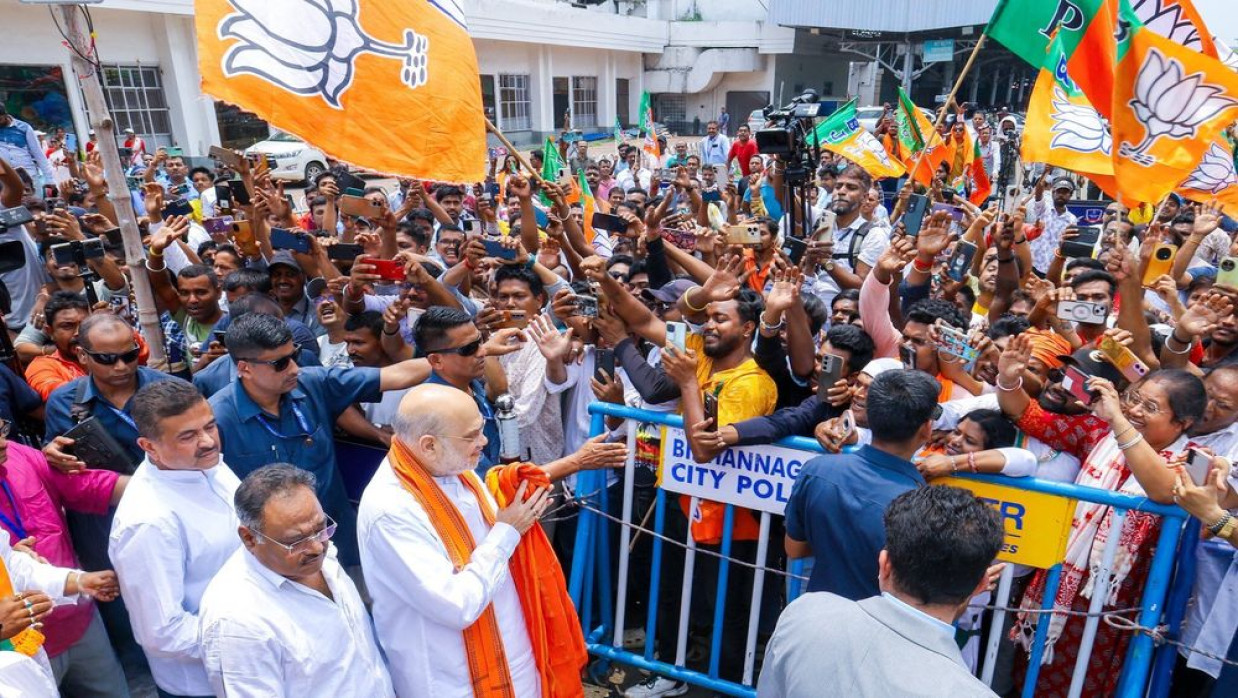
Bengal has once again emerged as one of the most crucial political battlegrounds in India. Remember, Bengal was the seat of the Indian Renaissance. Bengal was where modern Indian nationalism was born. Bengal gave India Rabindranath Tagore, Subhas Chandra Bose, Kazi Nazrul Islam, Bankim Chandra Chattopadhyay, Ishwar Chandra Vidyasagar, Bipin Chandra Pal, and countless others. Bengal has always been a seat of pluralistic culture with literary refinement, social reform movements, and secular humanist ideals. Hindutva nationalists want majoritarian nationalism built on aggression, but Bengal's history could not be more different.
Increasingly, voices from Bengal's intellectuals are crying foul, saying there is an agenda against Bengal. They say that the BJP-RSS establishment wants to control more than the seats of power in West Bengal. They say this establishment wants to control Bengali minds. They accuse the Sangh Parivar of trying to erase Bengal's history, trying to sideline the Bengali language, trying to drive a wedge between Hindus and Muslims in Bengal, and trying to absorb Bengali culture into a monolithic Hindi-Hindu nationalist superculture. They point to the erasure of hundreds of Bengali revolutionaries' names as further proof.
Bengal's discord with the ideology represented by Narendra Modi and the RSS dates back nearly a century. Founded in 1925, the RSS imagined India as a Hindu nation unified by culture and religion. Bengal has never been so uniform. For centuries, Bengal absorbed and grew with Hindu, Muslim, Buddhist, and foreign colonial ideas. The Bangla language and literary tradition helped Bengal take the lead in Indian anti-colonialism and social reforms. Even then, the Bengali mindset has traditionally favored pluralism over rigid ideology. For these reasons and more, Bengal has often eluded ideological dictates from New Delhi.
After his party's landslide victory in the 2019 Lok Sabha elections, BJP president Amit Shah said that it would be incomplete if it did not win in Bengal. BJP critics saw this statement as validation of Bengal's status as a symbolic capital that needed to be wrested from the left for the BJP's national project. Like Tamil Nadu and Punjab, Bengal was being identified by this project as a state that fell short of accepting Hindutva as its North Star.
Intellectuals and political commentators have accused the BJP-RSS of attempting to create a hierarchical "Manuvadi" social order. The word "Manuvadi" has been used by BJP's critics to refer to an upper caste agenda pushing for social structures based on Manusmriti. Accusations about the BJP wielding communal polarization as its primary political weapon in Bengal have accompanied claims that the party was relying on upper caste fears to win votes, while painting Muslims as either invaders or foreigners, and amplifying negative narratives about the Mughal rule as a "foreign occupation" to override the atrocities committed by the British Raj.
Revisionist history becomes a potent political weapon. Nuanced history is erased and replaced with binary narratives calculated to inflame popular sentiment. Polarization of Hindu and Muslim societies is seen as an existential threat to Bengal, where the two communities have lived alongside each other for generations, and syncretic practices still form an integral part of rural life. Revisionist history is cynically weaponized at the cost of endangering Bengal's pluralist legacy to win votes.
Language too becomes a battlefield. Increasing numbers of Bengalis believe in the aggressive encroachment of Hindi on public spaces, schools, media, and job markets. Hindi is fast becoming the "language of mobility" throughout urban India. As young Bengalis seek employment outside West Bengal, many feel they must learn Hindi to improve their economic prospects. While the opportunity cost was previously dismissed, critics say we are now fast approaching cultural capitulation.
It is not just linguistic subversion. More psychological. Many Bengali thinkers fear that Bengal has grown or is growing increasingly ashamed of speaking Bengali or being Bengali. Middle-class and upper-class Bengali spaces are becoming dominated by English or Hindi. Bengali has almost become a language you speak to your mother and/or when you want to churn nostalgia. Shame about your own language can only come from colonization. Sure. But it is also driven by job insecurity today. Bengalis as a state have been extremely weak on the development front. Neither the Left Front in its 34 years, nor the Trinamool Congress in its 15 years, has tried to build heavy industry or even fast-developing light-manufacturing sectors. The state's economy has been fragile for far too long. Millions of Bengalis have left the state in search of jobs. They learn a new language. They become 'more Fachcha' to fit in at their workplaces. And this fragility has made us the perfect breeding ground for all this fake development, Hindutva, and nationalist talk of "New India".
Not so much the linguistic part, but rather the psychology. Complaints abound about Bengali intellectuals and academics, and there is growing shame among some Bengali middle- and upper-class people about speaking Bengali, being Bengali. Increasingly, English and Hindi can be heard among elites in spaces where, once, you would hear only Bengali. Bengali, some say derisively, is only heard when mama [mom's brother] and amma [mom's sister] start romanticizing about the old times. Internally inflicted cultural cringe is how some characterize it. Lingering shadows of empire combined with neoliberal job anxieties.
Economic stagnation has no doubt played a part in Bengal's susceptibility. Bengal hasn't industrialized successfully under the Left Front's 34 years in power or the Trinamool Congress's 15 years, and as a result, Bengal lacks economic bravado. Tens of thousands of young Bengalis leave the state to find work elsewhere. Many change the way they speak and act to secure jobs in often hostile work environments. Such economic insecurity leaves room for ideologies from the outside promising us development, nationalism, and inclusion into a so-called "New India".
But critics say the BJP too has politicized immigration and refugee woes. Memories of Partition, of East Pakistani refugee influx, and later Bangladeshi migration are still quite potent in Bengal. Rhetoric of citizenship, infiltration, and refugeeness is often deployed to sharpen the wedge between Bengali Hindus and Muslims. Opponents have alleged schemes like dubious Special Inclusion/Exclusion Review (SIR) as ways to disenfranchise large swathes of Bengali Muslims and lower-caste Hindus.
But Bengal can surprise you. While the BJP has certainly strengthened its network impressively over the last couple of years, many would argue that Bengal's grassroots self still pulls against divisive majoritarianism. Rural Bengal, the lower-caste populations, and Bengali Muslims are important demographic stakeholders. Bengal does not forget. Literary and intellectual legacies and centuries of rebellious spirit run deep here.
However, others criticize the BJP's politics as seeking to mobilize refugee politics and the fear of migration. Memories of partition, displacement from East Pakistan, and subsequent influx from Bangladesh still evoke strong sentiments in Bengal. Mobilization over questions of citizenship, infiltration, and being a refugee are often deployed to further polarize Bengali Hindus and Muslims. Administrative efforts like the contentious Special Inclusion/Exclusion Review (SIR) initiative are often criticized by opponents as serving political ends that disenfranchise marginalized sections of Bengalis, especially Muslims and lower-caste Hindus. However, Bengal remains a wild card. Many think that Bengal's social instincts have not yet been entirely throttled by attempts at communal polarization. Rural Bengal, Bengali subalterns, and Bengali Muslims can still make a difference to political equations. Memories of Bengal live on. Her literati, her bardic tradition, and her long history of anti-authoritarian dissent can still reach out and move the mind.
Simultaneously, the BJP is often charged with attempting to politicize refugee policy and migration fears for political gain. Partition-era memories of East Pakistani migration, as well as subsequent influxes from Bangladesh, continue to evoke strong emotions in Bengal. Invoking themes of citizenship, infiltration, and refugee-hood have often been utilized politically to drive wedges between Bengali Hindus and Muslims. Detractors have criticized government policies like the recently discredited Special Inclusion/Exclusion Review process as tools intended to unfairly exclude vulnerable Bengali groups, especially Muslims and those from lower castes.


0 Comments
LEAVE A COMMENT
Your email address will not be published