

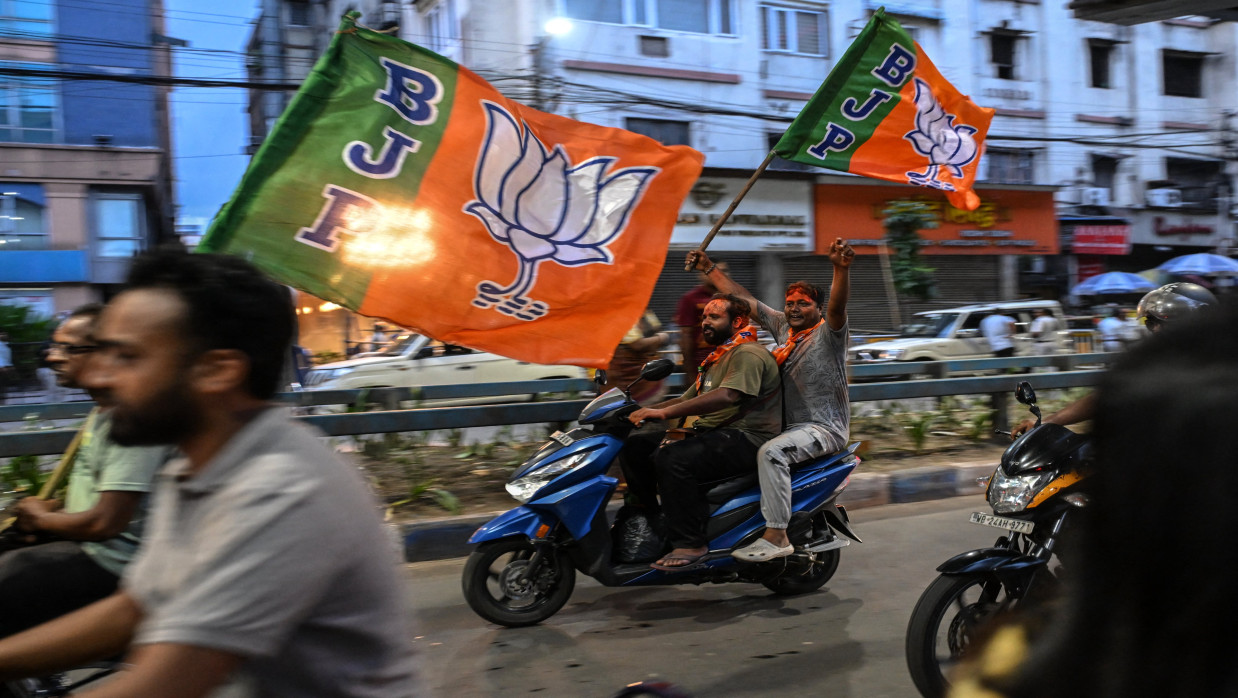
The electoral victory of the Bharatiya Janata Party (BJP) in the recently concluded state election in West Bengal has surprised many. The ascendancy of Hindutva politics in Bengal is not accidental. Rather, the mandate for Hindutva politics is neither a momentary political shift nor simply a change in allegiance from the Trinamool Congress (TMC) to the BJP. The victory is not merely about the BJP’s rise in Bengal driven by money and muscle power or the momentum of its electoral juggernaut machine. Instead, the electoral outcome reveals three things i.e. (i) a historic revival and consolidation of Hindu political consciousness led by Hindutva politics; (ii) the myth of radical and progressive Bengali consciousness; and (iii) the failure of the Left to dismantle the Brahminical social order and to develop class consciousness and organization in Bengal—factors that have contributed to the contemporary resurgence of Hindutva politics in the state.
Historically, Bengali intellectuals provided the groundwork for Hindutva politics in Bengal. The Bengali essayist Chandranath Basu, who coined the word “Hindutva” in his work Hindur Prakrita Itihas (Real History of Hinduism) in 1892, was an early figure in this Hindutva trajectory. The nativist idea of defending Hindu identity was further amplified in the work of economist U.N. Mukherji, who wrote a pamphlet titled Hindus: A Dying Race (1910) using census reports. He argued that Bengal’s demography would come to be dominated by the Muslim population, overtaking the Hindu population—an argument based largely on the report of the colonial Bengal census commissioner Mr C.J. O’Donnell. This colonial argument was taken up by many Hindutva ideologues—from V. D. Savarkar, K. B. Hedgewar, and M. S. Golwalkar to Syama Prasad Mukherjee—in shaping the Hindutva political project. The political leadership of the BJP, from Atal Bihari Vajpayee and L. K. Advani to Narendra Modi, has drawn on these fradulent colonial ideas and predictions to mobilise and consolidate Hindu votes, with the aim of transforming India’s secular democracy into a Hindu Rashtra.
In reality, the Muslim population did not overtake the Hindu population neither in Bengal nor in India. However, this fradulent colonial myth has continued to be perpetuated by the Hindutva politics. This erroneous colonial argument has remained at the forefront of Hindutva political campaigns, including in the recently concluded Bengal election. Drawing on colonial reports and Mukherji’s Hindus: A Dying Race, the claim of an impending Hindu extinction became a rallying point and played a major role in shaping the consolidation of Hindu revivalist traditions in Bengal. In this process, the notion of a “Muslim other” was constructed and further amplified by the colonial partition of Bengal along religious lines. These colonial arguments and this pseudo-intellectual template continue to form a core element of Hindutva politics in India today.
With colonial patronage, the Hindu Mahasabha, under the leadership of the Hindutva ideologue Mr Syama Prasad Mookerjee, formed a government in Bengal in alliance with the Muslim League which opposed and weakened the Quit India movement against British colonialism. From Bengal to the North-West Frontier Province and Sind, Hindu Mahasabha entered into similar alliances with the Muslim League. These collaborations weakened the anti-colonial struggle for a united India and instead advanced the idea of separate Hindu and Muslim states, with the support of British colonial rulers. Hindutva politics was further amplified by the colonial partition of India. The wounds of Partition, along with colonial narratives, continue to serve as the lifeblood of Hindutva politics in contemporary India. The Bengali upper-class intelligentsia and upper-caste political leaders were not only collaborators with colonial rule but also the lifeblood of the Hindu Mahasabha. These groups remain central to the BJP’s victory in Bengal today.
There was a minimal hope that a radical Bengali political consciousness would halt the forward march of reactionary Hindutva politics in the country. However, given the volume, scale, and spread of votes for Hindutva politics in Bengal, this idea of radical politics appears more myth than reality. The rise of the BJP not only exposes the limits of that perception but also revives the historical and ideological foundations of Hindutva politics in Bengal. It is not a momentary shift for historical revival.
The radical and progressive politics inherited from the anti-colonial struggles had more than three decades under the seven Left Front governments to dismantle the Brahminical social order, challenge conservative Hindutva thought, and develop class politics grounded in class consciousness led by class organisation. The seven Left Front governments and left parties in Bengal have failed to undertake this political and ideological task, falling short of transforming the social, political, intellectual, ideological, and economic foundations that sustain Hindutva politics in the state. This failure has contributed to the rise of the BJP and its victory in the recent election.
However, the recent election results show a rise in the percentage of votes for Left politics, and its popularity among young Bengali voters provides hope that the Hindutva juggernaut can be stopped. This can only be achieved through the mobilisation of working people, who suffer the most under Hindutva crony capitalism and its divisive politics. The revival of radical Left politics united with all demcoratic and progressive struggles can only defeat Hindutva politics and root out its ideological foundations in Bengal and across the country.


0 Comments
LEAVE A COMMENT
Your email address will not be published