

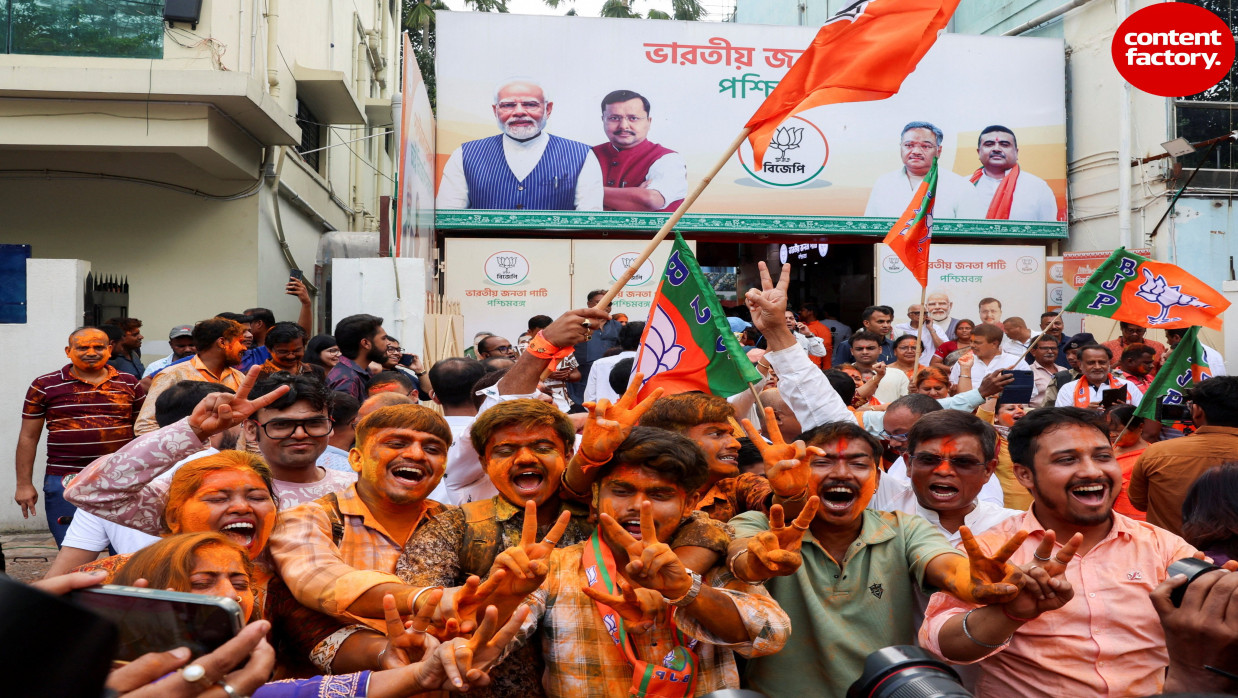
The 2026 West Bengal Assembly election was one of the most remarkable regime changes in recent Indian history. The All India Trinamool Congress's (TMC) defeat ended their nearly 15-year political reign. It also ended the Left-Congress hegemony that had been over for a while now, but lasted overall for decades. BJP did not just topple an incumbent government; they altered the political psychology of Bengal. Election 2026 has brought in multiple questions about electoral malpractice, voter list revision, religion-based polarization, and the direction of Indian democracy.
Soon after the announcement of the results, two broad lines of argument became popular. Hindustan Times's argument centered on anti-incumbency as the primary reason for the BJP's win, with polarization and voter fatigue also playing a role. On the other hand, Mint and The Wire believed that the deletion of nearly 9 crore names during the Special Intensive Revision (SIR) of the electoral rolls might have been the game-changer in West Bengal.
As with most things in life, reality likely fell somewhere in the middle of these arguments. BJP's win was not merely a voter-list exercise, nor can the voter-list exercise be dismissed as meaningless in BJP's win. Anti-incumbency, organizational churn, politicization of identity, and governance fatigue were all factors that went into making Election 2026 what it was.
The Erosion of the TMC's Political Dominance
IndiaBriefing Analytics wrote: Mamata Banerjee-led TMC had been running West Bengal for 13 years. She had successfully positioned herself as a 'khady ra chabi' (street-fighter) politician who took power from the mighty Left through the sheer force of her populist politics and restored Bengalis' regional pride in 2011. TMC represented hope. It represented change. It gave voice to resistance.
But years in power meant that TMC slowly morphed from a movement to a government. Corruption charges started surfacing. Govt job scams, teacher appointments scams, syndicate politics, and charges of local-level extortion all started alienating the middle-class/urban vote base of TMC. Many who had supported TMC saw them as "just another mafia."
This is exactly what the BJP played on. Corruption. Nepotism. Arrogance of power. Mamata Banerjee had herself used the slogan of change (paribartan) for years. But this time, the BJP successfully owned the narrative of change.
Our Hindustan Times exit poll analysis had forcefully argued that this election was determined by "an extremely powerful anti-incumbency wave with communal polarization tailwinds". BJP successfully positioned itself as the opposition to TMC.
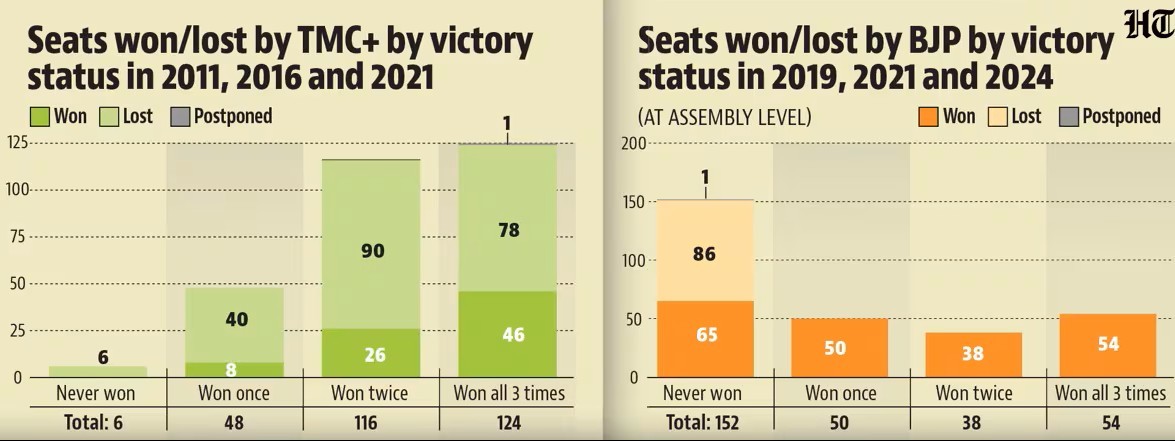
Image source: Hindistan Times
BJP's Long-Term Organizational Strategy
BJP's win wasn't accidental. It was built over years of groundwork. As recently as 2014, the BJP was a fringe party. It made significant parliamentary gains in 2019 and by 2026, had developed into a mass organization with reach at the booth level. For years, RSS had laid the groundwork across Bengal, gradually expanding its ideological and social influence. Hindu nationalist tropes that were considered too far-right for Bengal's political ecology became normalized.
BJP concentrated on organizational work: social media campaigning, ground work, and ideological building. The saffron party targeted TMC and Left rebels for poaching, conducted cadre-training, and expanded booth-level outreach. BJP had better organization, while TMC was torn by factionalism.
The Hindustan Times reports that the BJP had "won all the seats it had contested in previously and added several it had never won before," signaling not just a shift in vote but an organizational shift.
Communal Polarization and Identity Politics
Hardening of communal polarization further influenced the electoral dynamics in Bengal. BJP tried to polarize the electorate on issues related to identity, border, infiltration, and illegal immigration. Border districts adjoining Bangladesh were sensitive points of mobilization on these issues.
BJP tried to project TMC as a minority vote bank party appeasing minorities. Hindu votes started consolidating against TMC as this began taking root among many Hindus.
In many ways, economic issues took a back seat to questions of identity and the politics of civilization in this election. The consolidation of Hindu votes proved to be the BJP's trump card.
Simultaneously, minority consolidation in support of TMC was another factor at play. Overall, polarization sharpened communal lines across Bengal, turning many seats into hard-fought identity battles.
BJP also successfully capitalized on anti-incumbency by coupling it with identity politics, especially in rural and semi-urban areas.
The Special Intensive Revision (SIR) Controversy
But even with these larger political developments, no issue still stokes election fires like the Special Intensive Revision of electoral rolls done by the Election Commission of India before polls.
In WB, during the SIR process, about 9.1 million names were deleted from the electoral rolls. Some names belonged to ASDD (Absent, Shifted, Dead, Duplicate) categories. Many of the deleted names were "Under Adjudication" (UA) deletions.
It was alleged that these names belonged largely to Muslims, migrant workers, voters from urban poor demographics, and areas that were considered TMC bastions. The deletions were so high that they raised the question of whether the revision of electoral rolls had stopped being routine housekeeping and had become something more ominous.
The Wire conducted multiple detailed statistical breakdowns that seemed to indicate these deletions changed the outcome of the election. The website calculated that, across nearly 150 seats, the number of deleted voters exceeded the margin of victory. BJP candidates would go on to win close to 100 of these seats.
The political ramifications of such statistics were seismic.
Minority Areas and the UA Deletions
The UA deletions were especially contentious. To a large extent, they seemed to have clustered in Muslim-majority areas. For instance, on Wire's dataset, 49 constituencies had more UA deletions than the winning margin. The Muslim population in these constituencies averaged over 33 percent. Murshidabad, North 24 Parganas, South 24 Parganas, and parts of Hooghly and Purba Bardhaman districts were at the heart of this storm. BJP had swept the majority of these seats in the previous assembly elections but was wiped out in 2026. Stories were plentiful. Rajarhat New Town is one example, where BJP won by a few hundred votes, despite deletions topping 60,000. Satgachhia had six times as many deletions as votes won. And so on. Similar anecdotes could be repeated for Jangipur, Raina, and Samserganj. We cannot say categorically that deletions altered the outcome, but few will deny that the SIR process crossed the threshold of Contention.
The Counterargument: Anti-Incumbency Was Still Decisive
The Hindustan Times did not subscribe to the theory that SIR swung the election. The paper's post-mortem focused on how the BJP massively increased its vote share while the TMC faced a steep decline in popular vote.
The HT stated there was little correlation statewide between percentage (%) voter deletions and percentage (%) BJP gains. BJP growth spread well beyond a small cluster of marginal seats.
So they concluded that even if SIR helped the BJP win close contests, the BJP's political momentum would likely carry it to victory. Anti-incumbency, polarization along communal lines, organizational prowess, and popular desire for change would have provided the stronger scaffolding for the BJP's triumph.
In fact, some predictions by revisionist teams themselves indicate that the BJP would likely still have been the single largest party, albeit with a smaller margin.
There's a difference. SIR may have accelerated BJP growth, but it did not cause it.
Collapse of TMC Strongholds
Another significant feature of this election was the desertion of traditional TMC strongholds. Seats that voted TMC for several terms in a row have now turned to the BJP.
"In fact, as many as 78 of the TMC's 124 most dependable seats slipped out of its hands," reported The Hindustan Times. Electoral arithmetic alone can't account for such a sweeping defeat.
Among the reasons for this was the TMC's grassroots network running on fumes. Factionalism within the party grew. Longtime voters grew tired of corruption scandals and party bosses. The TMC began to seem complacent in urban areas.
Against this, the BJP appeared to be an organized national alternative that promised a new era of strong central leadership.
Urban Bengal and the Middle-Class Shift
Urban Bengal changed dramatically as well. BJP had some traction with the anti-incumbency factor among sections of the urban middle class, professionals, and the younger population, who were disillusioned by unemployment, corruption, and poor governance.
Fearmongering over jobs and the economy merged with cultural nationalism. BJP found significant support, aided by social media propaganda about mis-governance, patriotism, and population politics.
Seats that were considered Mamata Banerjee's bastions turned bloody neck. There was a visible change in voters' psychology as well.
Slowly, it became apparent that TMC's populist welfare politics might not be enough to stem the BJP's ideological tide.
Conclusion
The results of the 2026 West Bengal election weren't due to a single factor. Several trends aligned themselves at the same time.
The BJP won because there was a genuine anti-incumbency wave against the TMC, which had ruled Bengal for 15 years. BJP won because it had an unprecedented organizational spread, unparalleled communal polarization, and excellent groundwork that capitalized on every possible governance deficit.
It would also be remiss to ignore the impact of the Special Intensive Revision of electoral rolls, though. The data compiled by Mint and by The Wire paint a compelling picture of how deletions might have swung some marginals, specifically in seats with heavy minority populations where deletions exceeded the margin of victory. The larger picture painted by the data shows that the BJP won because of broader political and social currents that had already taken hold of Bengal.
What really stood out in this election, however, was indicative of Indian democracy itself. Processes meant to administer elections are becoming increasingly political. Identity, demographics, majoritarianism, faith in institutions, and politicization itself are now so deeply intertwined that one can't really talk about the mechanics of an election without discussing its politics.
As such, Bengal did not fall to the BJP simply because voters wanted a change in government. Bengal changed.


0 Comments
LEAVE A COMMENT
Your email address will not be published