

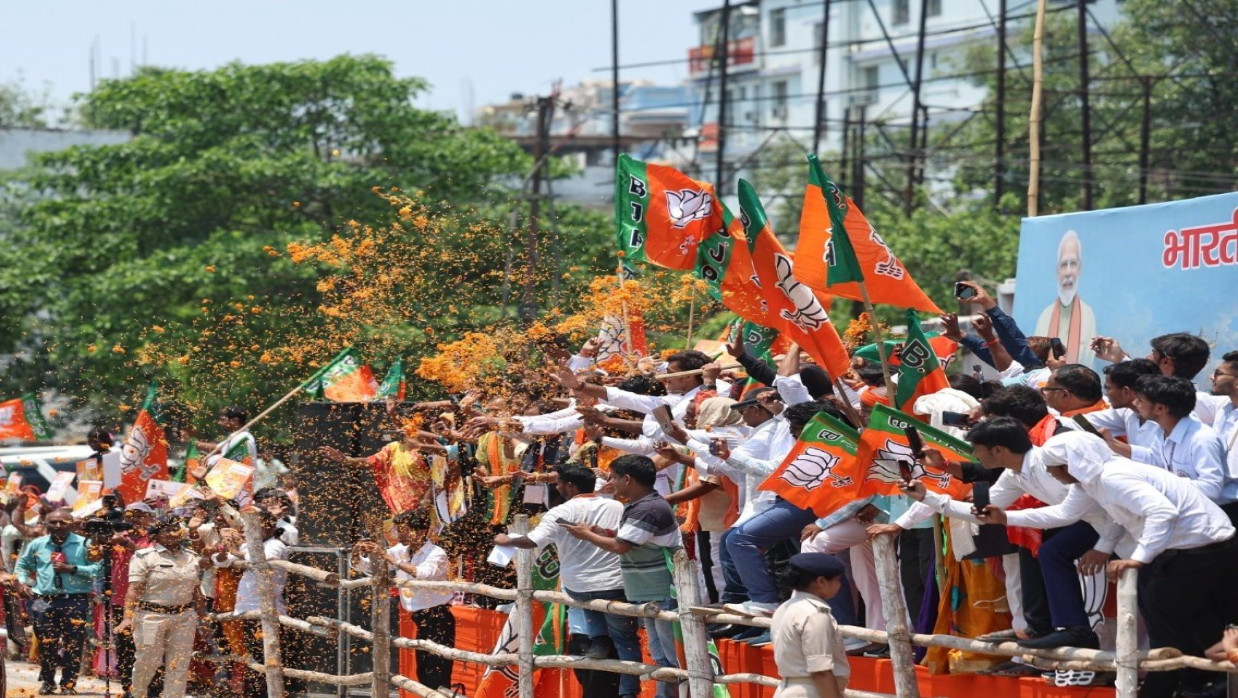
Elections were won and lost, states were won and lost. Although India remains the largest democracy in the world, questions are now being raised about electoral democracy, representative institutions, and political pluralism. Opinion polls were conducted, analyses were made, and predictions were made. Post-election, everyone is talking about the BJP's increasing hegemony in Indian politics. But why BJP?
BJP has established electoral hegemony, enabling it to convert favorable electoral verdicts into favorable political structures. An institutional juggernaut that owes its existence to meticulous organization, institutional engineering, and the weakening of political opponents. The consequences of this political shift will be felt not only in India but also in regional geopolitics, minority rights, and pluralism for years to come.
The Rise of Electoral Dominance
BJP's dominance is arguably one of the most remarkable phenomena of Indian politics today. It has not always enjoyed an absolute majority at the parliamentary level, but made up for the lack by winning landslides at the state level and thereby created a hegemonic presence in regions as varied as the Hindi heartland, the Northeast, and even those states that had long been historically and ideologically uncongenial to the BJP.
The party has managed to do this by organizing politically at the grassroots while pursuing astute electoral strategies. Through its penetration into states with distinct linguistic, cultural, and political identities, the BJP has demonstrated the kind of organizational unity that its opponents lack. But this dominance begs an important question. Does the politics of such overwhelming dominance leave any room for dissent or alternative imaginations?
Institutional Reforms and Structural Advantage
The outcome of the recently held elections can be mainly attributed to several institutional reforms undertaken before the elections. Delimitation is one such reform that has impacted India in many ways. Delimitation in itself is not unfair, but has been politicized by targeting minority votes.
Delimitation exercise in Assam has cut into a fashion where the minority community's votes will hardly matter. This strategically hit the opposition parties, such as Congress, which has the backing of minorities. The political game plan has severely brought down multi-cornered fights, benefiting the ruling party.
The inclusion of the Systematic Identification of Returns (SIR) exercise has also proved to be dubious. Millions of names being deleted from electoral rolls and large numbers of new voters being registered in West Bengal have led many political commentators to question whether the government truly reflects the people's will.
This shows that institutional tools are increasingly being used as weapons to win elections. So when the rules of the game are fixed, who can question the results?
The Crisis of Electoral Integrity
Free and fair elections are the foundation of democracy. While the Indians have relied on institutions like the Election Commission and the Judiciary to ensure this, of late, they seem to be struggling like never before. The Election Commission is now perceived as biased by many, especially after disregarding violations in states where elections were closely fought.
The inconsistencies in enforcing the rulebook, the politicization of the deployment of polling personnel, and the tepid enforcement of hate speech laws have led many to question the EC's impartiality. On more than one occasion, courts have dithered or pulled up their socks in hearing petitions regarding crucial aspects of elections as well. People must be confident that our systems function without fear or favor, or else voting itself becomes a farce.
Opposition Fragmentation and Political Marginalization
However, while the ruling party's dominance explains much, the opposition's weakness has also contributed to the current situation. Indian opposition is becoming increasingly fragmented, both ideologically and organizationally. Earlier parties were large enough to accommodate multiple ideologies. But today, the opposition is split across many parties.
Opposition parties have failed to offer an ideological challenge to the BJP-led NDA governments. The fragmentations have led to multiple drawbacks. It weakens electoral challenge, allowing the incumbent to win with lower vote shares. Opposition parties are unable to present viable alternative policies and agendas for the future. It also underrepresents minorities and marginal groups that tend to lean towards opposition parties.
In West Bengal, too, the disintegration of prior political establishments has led to newer players entering the political arena. But they lack proper party organization and ideological foundation.
Communal Polarization and the Challenge to Secularism
One negative trend I observed was the increasing polarization of politics. Campaigns often used religion, identity, and national security issues to polarize voters.
Politicians found success by using communal polarization to build vote banks. However, this approach compromised India's secular and inclusive democracy. Minority groups, especially Muslims, felt targeted by allegations of voter list purges, hate speech, and appeasement policies. Opposition parties failed to offer an alternative narrative that resonated with minority voters.
Communal polarization harms India's diverse society and democratic values.
Regional Implications and Geopolitical Context
India's Political transitions will also create geopolitical shocks. Neighbors of India are keeping a close eye on how politics play out in the country. Particularly for Bangladesh, internal politics in India matters.
Migration, Minorities, and issues with bordering countries are now major talking points for political parties in states like West Bengal and Assam. India does not want illegal migration and activities that they think may threaten the national security on which they pride themselves.
So where does Bangladesh fit into all of this? As a neighbor, Bangladesh both stands to lose and benefit from how things go in India. As mentioned above, internal rifts between political parties widen when issues such as migration and relations with neighboring countries are at stake.
For Bangladesh, India must continue to practice democratic stability. When India polarizes, the region feels the aftershocks.
Taken together, these trends force us to ask whether Indian democracy is transforming itself or cracking up.
Yes, elections are being held, and millions of Indians continue to vote. But what meaning is there in a democracy if the institutions are weak, the elections are unfair, and the politics is not pluralistic?
India is not alone in facing these questions. Democratic institutions worldwide are under pressure. But India is big. India is diverse. And India matters. What happens to Indian democracy will have significant implications for democracy worldwide.
If these trends continue, Indian democracy will witness the slow death of its institutions and fair competition. But if we act now to reverse these trends by strengthening the institutions, fighting for opposition politics, and committing ourselves to a pluralistic democracy, India can pull through this democratic slowdown.
The Path Forward
Restoring credibility to Indian democracy calls for several measures.
First, there should be a reaffirmation of institutional autonomy. The Election Commission, the civil service, and the judiciary should be strong enough to take tough decisions whenever necessary.
Second, electoral reforms should be fair, open, and easily visible to everyone. Delimitation or revision of electoral rolls should not further discredit democracy.
Third, political parties in power and in opposition should realize that governance means catering to the aspirations of all sections of the people, especially minorities.
Lastly, civil society organizations and the media can play an important role in ensuring institutional accountability. Freedom of information has sparked unprecedented debates among people.
Conclusion
It’s an important time for Indian democracy. Votes matter, but elections aren’t the whole story. Here’s how democracy has concentrated power, weakened institutions, and further divided our country.
Democracy in India has changed irreversibly with the rise of a single political party, riding on conducive forces and weak resistance. Heightened communal polarization and democratic backsliding are dangerous trends emerging in India.
The story isn’t over for Indian democracy, though. India has faced tough challenges before and has come out stronger. But we'd better stay woke, look inwards, and strive to do better.
India will show the world that it can practice true democracy if we stand up for what democracy stands for- equity, diversity, and justice under the rule of law. The India of tomorrow is shaped by what we do today.

0 Comments
LEAVE A COMMENT
Your email address will not be published