

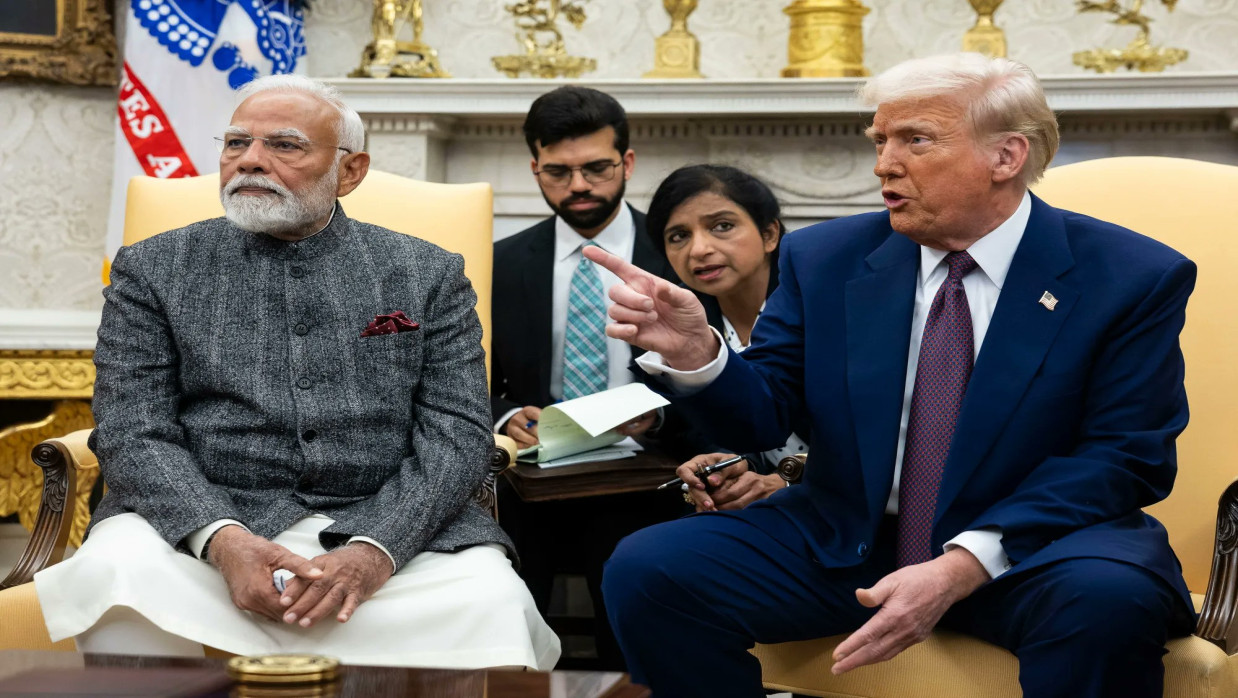
The controversy triggered by remarks shared by Donald Trump, in which India was described using the term “hellhole” has not only sparked outrage but also exposed an uncomfortable diplomatic reality: silence at a time when leadership demands clarity.
Officials in India were quick to label the comments as “inappropriate” and “uninformed.” Yet beyond these formal statements, the response from the government of Narendra Modi has remained largely muted. In a region already facing complex geopolitical tensions, this limited reaction raises questions about India’s willingness or ability to assert itself diplomatically when it matters most.
India today positions itself as a so called leading global power. With a GDP exceeding $3.5 trillion and ambitions of becoming a $5 trillion economy, it should play a central role in shaping global conversations. It is also a key member of strategic groupings and maintains strong ties with major powers, particularly the United States. However, moments like this test not economic strength, but diplomatic maturity in which India has failed clearly.
The timing of the controversy is significant. It comes ahead of high-level diplomatic engagements and during a period when global alliances are under strain. Historically, India has relied on carefully managed diplomacy to maintain its international image. But the current approach limited to brief rebuttals appears reactive rather than strategic.
Critics argue that this reflects a broader pattern under the Modi government: a preference for strong domestic messaging combined with cautious, sometimes restrained, responses on the international stage. While assertive rhetoric is often used internally, external criticism, epecially from influential global figures has not always been met with equally firm diplomatic engagement.
This perceived silence becomes more striking when viewed alongside India’s internal challenges. Despite being one of the fastest-growing major economies, India continues to grapple with inequality and development gaps. According to global estimates, over 200 million people remain in multidimensional poverty, while the top 10% control a significant share of national wealth. Urban overcrowding, unemployment pressures, and environmental concerns continue to shape everyday realities for millions.
In such a context, global perception matters. When controversial narratives emerge, governments are expected not only to reject them but to actively reshape the discourse. This requires more than a formal statement it demands sustained diplomatic engagement, clear messaging, and visible leadership.
The Modi government’s approach also raises concerns about regional responsibility. South Asia remains a fragile region, marked by political tensions and security risks. As one of its largest and most influential countries, India is often expected to play a stabilizing role. Yet, in moments of international controversy, the absence of a proactive stance can create uncertainty.
Moreover, the broader diplomatic relationship between the United States and India adds another layer of complexity. Bilateral trade has crossed $190 billion annually, and cooperation in defense and technology continues to grow. These ties are built on mutual interests, but they also require mutual respect. When that balance is disrupted, silence can be interpreted as acceptance or at least as a lack of urgency.
Another dimension of the controversy lies in the narrative around immigration and skilled labor. Indian professionals form a significant portion of the global tech workforce, particularly in the United States. Data shows that a majority of H-1B visas are granted to Indian nationals, highlighting both opportunity and dependence. When such communities are targeted in political rhetoric, it becomes even more important for leadership to respond decisively.
The current situation therefore raises a critical question: is India leveraging its global position effectively, or is it allowing key moments to pass without meaningful engagement?
Supporters of the Modi government may argue that restraint is a strategic choice that avoiding escalation helps preserve long-term relationships. However, critics counter that consistent restraint, without visible assertion, risks weakening a country’s diplomatic voice.
In today’s fast-moving information environment, perception can quickly become reality. A strong and timely response is not just about defending national image; it is about shaping international narratives. Countries that fail to do so risk being defined by others.
Ultimately, the “hellhole” remark is more than a passing controversy. It is a test of leadership, diplomacy, and global positioning. For India, it highlights a gap between ambition and action between the image of a so called rising power and the responsibilities that come with it. As global dynamics continue to shift, the expectation from major players is clear: leadership must be visible, vocal, and proactive. Silence, in such moments is not neutrality its weakness.

0 Comments
LEAVE A COMMENT
Your email address will not be published