

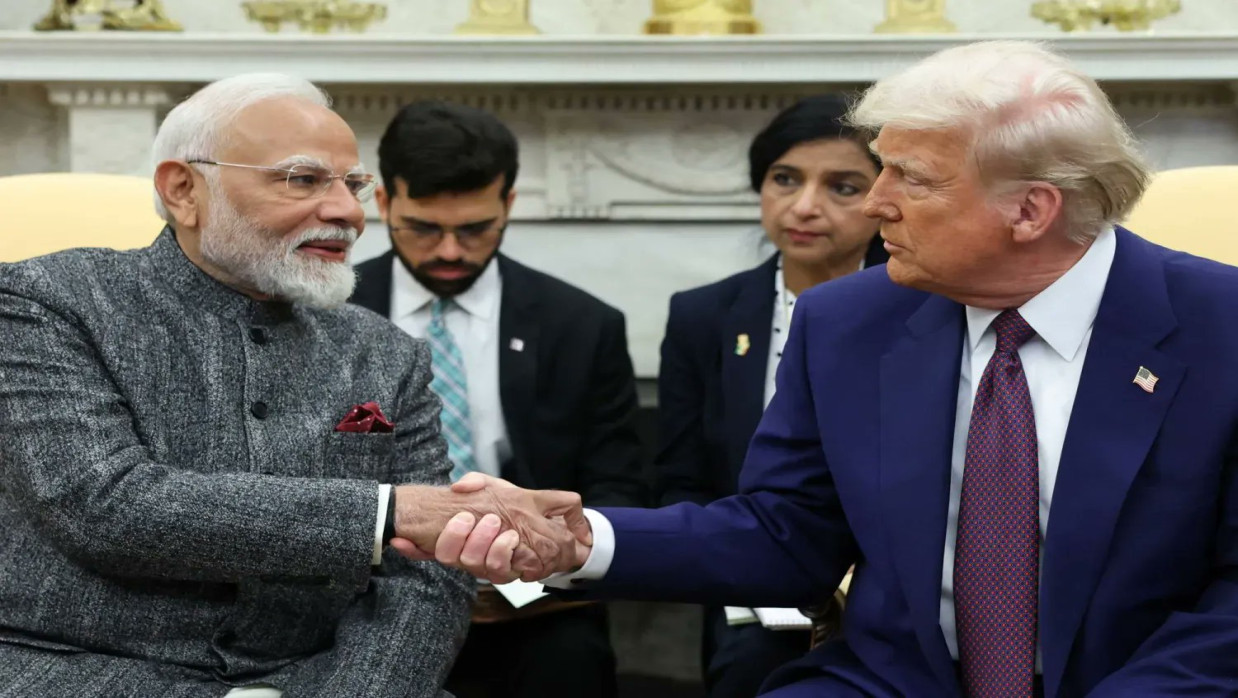
President Donald Trump's decision to share a Twitter post disparaging India and China as "hellholes on the planet" was no ordinary instance of America's highly charged political rhetoric. At stake were issues far larger than language and politics: diplomacy, culture, and strategy. As Washington and New Delhi scale up cooperation on defense, technology, and commerce, such offhand comments damage trust between the world's two largest democracies and dent American credibility abroad.
Posting remarks made by radio host Michael Savage without qualification or distancing himself from Savage's comment, Trump lent the weight of the presidency to remarks critics call racist and xenophobic toward entire societies. New Delhi had politely called the statement "uninformed, inappropriate, and in poor taste," but the implications of Trump's tweet run much deeper. They touch on immigration politics and racial signaling in American domestic politics, as well as whether the India–U.S. relationship will prove sturdy enough to withstand nationalism for patriotism's sake.
Amplifying Rhetoric, Not Just Sharing It
Tweeting by a president has symbolism. If a leader reposts a tweet, they cannot say they were liking content. They are signaling approval or at least acceptance of the tweet.
The reposted commentary attacked birthright citizenship by claiming immigrants from India and China exploit U.S. laws and later bring extended family members into the country. It went further by characterizing Asian immigrants as technologically sophisticated "gangsters" and questioning their loyalty to the United States. Such language echoes older tropes historically used against immigrant communities, from Irish laborers in the nineteenth century to Japanese Americans during World War II.
What made this episode particularly striking was not the existence of such rhetoric on fringe platforms, but its amplification from the highest political office in the United States. The presidency traditionally functions as a stabilizing institution capable of moderating political extremes. When it magnifies them instead, the consequences extend internationally.
Immigration Politics and the Racial Subtext
Trump's post must also be understood within the domestic American debate over birthright citizenship. The issue has become central to a broader argument about immigration control and national identity. However, the framing of immigrants from India and China as threats reflects a shift from policy critique to cultural exclusion.
Asian immigrants occupy a paradoxical position in U.S. political discourse. On one hand, they are frequently cited as examples of educational and professional success. On the other hand, they are portrayed as economic competitors who undermine opportunities for native-born workers. This tension has produced recurring waves of suspicion toward immigrant professionals, particularly those in technology sectors.
Indian-origin workers in the United States, many of whom are employed through H-1B visas, have been especially vulnerable to such narratives.
Indian-Americans who work in the United States (many on H-1B visas) have been another easy target of such messages. The tweet sought to link them to broader attacks against abuse of visa programs. By casting skilled immigrants as leeches on the system instead of job creators, it fueled divisiveness.
The impact on political discourse cannot be understated. Rather than focusing on needed immigration reform, the conversation moves to who gets to belong.
India's Measured but Calculated Response
India's Ministry of External Affairs decried the remarks with diplomatic understatement: "These comments are uninformed, inappropriate, and in poor taste."
Yet restraint does not equal indifference. Indian policymakers understand that rhetoric originating from Washington carries domestic consequences in India. Public opinion in India is highly attentive to signals of respect or disrespect from major global partners. Statements perceived as racially dismissive can influence how the Indian electorate interprets bilateral cooperation.
Opposition figures within India reacted more strongly, arguing that the government should lodge a formal protest. Their response reflected a broader concern that silence might be interpreted as acceptance.
The challenge for New Delhi lies in balancing long-term strategic interests with immediate reputational considerations. India's expanding role in the Indo-Pacific security architecture makes cooperation with the United States indispensable. At the same time, domestic political legitimacy requires demonstrating that national dignity is not negotiable.
The Limits of Leader-to-Leader Diplomacy
Promoting the special personal relationship between Trump and Narendra Modi has been central to how India-US ties have been viewed over the last few years. Monumental joint rallies and carefully curated optics created the illusion of a partnership powered by warm interpersonal dynamics.
Relationships between nations, though, cannot be based solely on personal relationships. State-to-state ties require reliability, predictability, and respect. When statements like those Trump made about India become public, this lack of dependability undermines the positive symbolism.
Referring to a strategic partner as a "hellhole", even indirectly, weakens the illusion of affinity. Indian leaders will now wonder if calls to grow the India-US relationship can be upended by domestic political rhetoric in Washington.
Does loose rhetoric during a political campaign signal temporary shifts in sentiment, or are these indicative of deeper nationalist currents when it comes to immigration?
The Indian Diaspora and the Politics of Perception
Perhaps the most immediate consequences of the episode are felt not in New Delhi but among Indian Americans. The Indian diaspora is among the most successful immigrant communities in the United States, with high levels of educational attainment and professional achievement.
Statements portraying Indians as exploiters of immigration laws or culturally disloyal risk eroding the sense of belonging that underpins diaspora engagement. They also affect prospective students and professionals considering the United States as a destination.
Higher education is one of the strongest pillars of India–U.S. relations. Hundreds of thousands of Indian students attend college in the United States every year, sending billions of dollars to the American economy. When U.S. presidential candidates question whether those students are welcome, it affects longer-term decisions about mobility. Canada, Australia, and the United Kingdom are watching these trends closely and often reap the rewards of Americans souring on openness to immigration.
Strategic Partnership Versus Political Messaging
The larger U.S.–India relationship is one of deepening engagement. Shared defense purchases, technology agreements, and regional concerns about China will continue to cement the relationship.
But alliances cannot work if newspaper headlines demean trust. Foreign policy is not just about agreements. It's about words.
If we start throwing around phrases about civilizational differences or implying that others are culturally inferior, it makes it harder to work together, even in areas of mutual benefit. Allies should be able to count on each other's consistency - in substance and in style.
This incident thus reflects a dichotomy inherent in modern American foreign policy: strategic engagement abroad paired with populist bluster at home.
Racism, Populism, and the Global Audience
Trump's tweet is not unique. Politicians around the world use immigration controversies to rally support at home. Politicians often speak about other countries using crude stereotypes of dangerous foreigners.
The difference now is that these messages are shared immediately. Politicians say something at home, and minutes later, the entire world hears it.
That changes the incentives. Leaders can no longer say inflammatory things to their domestic audiences and assume they will not be heard abroad.
For the United States, whose global influence depends heavily on perceptions of openness and diversity, the reputational stakes are particularly high.
A Test of Diplomatic Maturity
More important than Trump's choice of words is what it reveals about American politics and foreign policy. India knows how to respond to such statements with a stiff upper lip. It shows that they aren't weak-kneed. At the same time, it underscores the expectation that major partnerships require mutual respect at all levels, not only in official agreements but also in public discourse.
For Washington, the episode serves as a reminder that presidential communication shapes global perceptions of American values. For New Delhi, it highlights the importance of maintaining strategic autonomy even within close partnerships.
The future of the India–U.S. relationship will depend not on a single report or controversy, but on whether both countries can sustain cooperation despite the pressures of nationalist politics.

0 Comments
LEAVE A COMMENT
Your email address will not be published