

Security Narratives, Democratic Institutions, and the India–Bangladesh Factor in a High-Stakes Regional Contest
"The infiltrators should start packing their bags": political rhetoric aside, when PM Narendra Modi uttered these words during his campaign speech in Purba Bardhaman recently, he may not have realized that he had summed up the focal point of India's electoral battles of 2026 just as succinctly as he could have. With the politically contentious issue of "Bangladeshi infiltration" back in the electoral limelight during the Assembly polls of West Bengal earlier this year, India finds itself staring once again at migration both as a security paradigm and political tool of mobilization. However, reality is seldom so simple. Immigration also straddles debates over history, demography, diplomacy, institutional credibility, and regional geopolitics; unpacking all of this makes it one of the most nuanced topics to dominate India's elections in recent years.
Partition-era migrations and memory politics in Bengal
Migration isn't just about illegal immigrants. Migration also involves history, demographics, foreign policy, and questions about institutional legitimacy and the politics surrounding the porous border. Migration isn't a one-dimensional election topic. Solving infiltration or understanding migration patterns in West Bengal might be the most multifaceted election topic of them all.
Migration isn't going away as the central political discourse in India's East. If anything, the BJP's campaign has succinctly tied together three key pillars on which its government thrives – nationalism and border security, welfare schemes, and demography. They proved this electoral hypothesis in Assam, but Bengal is a different beast altogether.
For one, Bengal did not see the politics of migration, fueled by linguistic nationalism and indigenous peoples' politics, that we witnessed in Assam. West Bengal has strong memories of the Partition and the Bangladesh Liberation War. Migration from East Pakistan (later Bangladesh) across the Bengal border occurred in several phases. Multiple communities, Hindus and Muslims, different tribal groups, and economic migrants crisscrossed the border. Some families are linguistically and ethnically similar, spread across the border, and have historically considered themselves one.
Migrant voters in Bengal
Migration is an electoral issue best suited as a mobilizing tool, rather than part of a larger ideological canvas. Electorates in North Bengal feel demographic shifts more viscerally than those in the south of the State do. Migration will impact border districts like Cooch Behar and Malda much more than it will, say Burdwan or even Kolkata. But even voters here are wary of one-dimensional rhetoric, seeking answers in welfare, governance, and identity politics when casting votes on economic issues.
Bengal's Social Complexity and the Limits of Polarization
Politically mobilizing Bengal's electorate against migrants is harder than it sounds because Bengal's social demographics are complex. There are Gorkhas in the hills, Rajbanshis in North Bengal, tribal populations along the forested belt, and vast communities of Bengali-speaking Hindus and Muslims in the plains. Bengali-speaking populations across Bengal and some communities along Bengal's northern border even share familial networks that extend beyond the international border into Bangladesh.
Demographics aside, migration cannot easily be clubbed into neat categories. There is internal migration driven by labor needs, displacement due to river erosion, and the movement of historically settled refugees, among other causes. Politicians might club these varied demographics into broad-stroke 'vote bank' categories of infiltrators, but that doesn't necessarily make it any easier to address.
Security Concerns vs Political Messaging
Border management is a genuine security issue, no question there. India has a 4,000-km-long porous border with Bangladesh. There will be smuggling, trafficking, and illegal migration, like at any other border worldwide.
But politicizing migration is also as much a political calculation as a governance imperative. Invoking the bogey of demographic invasion sounds emotive, even if it can't be proven with data. Perception often trumps reality among voters.
That's why talk about migrants is loudest around election time but seldom in governance. At both the center and state levels, the government can't do much about migration due to legal constraints, humanitarian concerns, and foreign policy considerations that prevent overdelivering on poll promises.
Diplomatic Realities: India Cannot Ignore Bangladesh
One aspect of the infiltration debate that has received relatively little attention is the diplomatic one. Currently, Bangladesh is one of New Delhi's most stable bilateral relationships in South Asia. Bangladesh and India cooperate on trade, energy connectivity, counterterrorism coordination, and even river-water disputes.
India does not want to jeopardize these successes with bombastic rhetoric against Bangladesh-sponsored migration.
The fact that India continues to send seasoned diplomats as envoys to Dhaka suggests that New Delhi wants to maintain strong relations with Bangladesh's young leadership. If India seems antagonistic on the issue of migration, cooperation on border security itself could suffer.
India has much more to gain strategically from a stable Bangladesh than from posturing. India-Bangladesh initiatives, ranging from economic corridors connecting northeast India to Bangladeshi ports to regional connectivity projects to counterinsurgency efforts, rely on a certain level of trust between the governments.
So far, campaign rhetoric has fallen within these diplomatic lines.
The Institutional Debate: Election Commission and Security Deployment
Another has shadowed the migration controversy: charges of misuse of central institutions in the electoral exercise. Senior leaders like Rajya Sabha MP Kapil Sibal have criticized the central government for using administrative and security muscle to tip the election scales in its favor.
The mobilization of nearly 2.4 lakh CAPF personnel, along with the transfer of hundreds of officers, has led the opposition to question the impartiality of institutions. While the opposition has called the hyper use of force "an emergency outside the Constitution," the ruling party says this intervention will help people vote peacefully in constituencies where voting had been marred by violence in the past.
The misuse of the institutions' angle in this debate is worrying because it diverts the discussion from migration to the democratic procedures themselves. In an election where contests are too close to call, questions around institutional favor will drive voters as much as vote narratives.
Murshidabad and the Politics of Demography
Murshidabad district captures the diversity of Bengal's electoral geography. It has a sizeable minority population and has historically witnessed competition between the TMC, Congress, and Left. Therefore, Murshidabad cannot be reduced to a BJP–TMC battleground.
Of the 22 seats in Murshidabad district, the TMC won 20 seats in 2021. However, shifting vote shares and ongoing electoral roll updates have created uncertainty about who will win in Murshidabad come 2026. Migration also resonates differently in Murshidabad than in districts along the northern border, where fear over changing demographics is palpable.
Murshidabad shows how micro-local factors often trump national messaging.
The "Double-Engine Government" Argument
Promises of coordination between the Center and the State under a BJP-led "double-engine government" to accelerate development initiatives have also been another plank of the BJP narrative. This plank seems to have struck a chord in certain pockets where infrastructure development and the synergizing of welfare schemes are big asks.
But Bengal has long been known to have maintained a culture of ideological rift between the Center and State governments, right from the days of the Left Front to Mamata Banerjee leveraging regional autonomy as a vote-winning card.
Whether the electorate sees merit in the argument that administrative synchronization trumps regional political sentiments remains to be seen.
AAP Factor and Fragmentation of Opposition Space
Even if the battle eventually comes down to BJP vs TMC alone, smaller forces joining the fray have made the State's electoral landscape harder to predict. With AAP having a presence to begin with and the Congress-Left still retaining some influence in select districts, there are additional X factors at play when estimating vote shares. Smaller margins will decide lots of constituencies that are too close to call. So the migrant voter issue is only one of several strategies in play.
Voter Turnout and Democratic Assertion
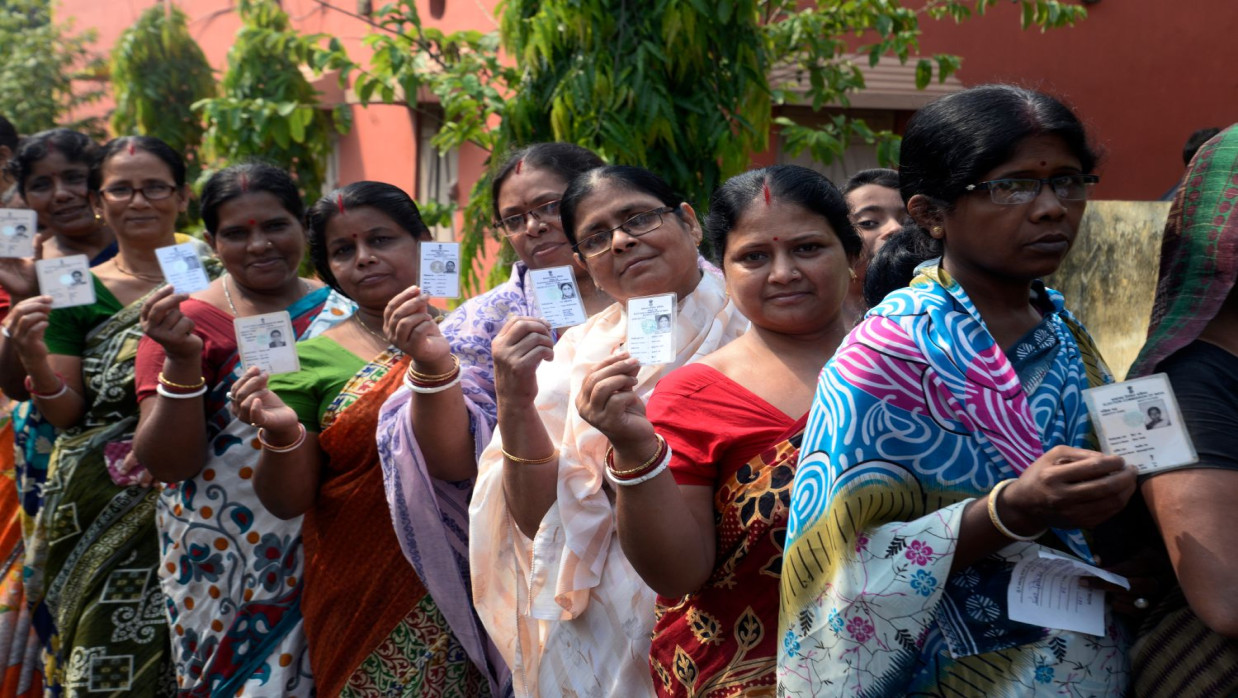
High voter turnout has been the most notable trend emerging from election 2026 so far. Voting participation has already topped 90 percent in many constituencies across India.
This turnout indicates that people are reacting not just to political messages being circulated but also to deeper issues of credibility, governance, and leadership. Whenever there is high voter turnout, it results from both enthusiasm and fear. It shows that citizens see the stakes of that particular election as being higher than usual.
Moreover, there has been significant female voter turnout, pointing to the success of welfare politics and booth-level worker outreach networks beyond identity politics.
Migration, Perception, and Electoral Psychology
Arguments over infiltration are fought not at the level of policy nuance but solely at the level of perception. The rhetoric around migration works because it speaks to insecurities about livelihoods and identity. Such arguments find fertile ground when there is unemployment or fear of competition for welfare benefits.
But Bengal's history is also one in which ideas of identity were negotiated alongside economic and social concerns. Welfare programs, networks of local leadership, and regional pride all influence how people vote, along with fears about security.
Hence, the complex psychology of why migration can be such an effective campaign issue without being a decisive factor statewide.
Implications for India–Bangladesh Relations
India's migration debate also has wider strategic significance for those watching from Bangladesh, and for policymakers in South Asia more broadly. Debates about migration in Indian domestic politics often cause alarm in Dhaka, even if policies don't change.
Bangladesh is not the weak neighbor it was during previous waves of migration. It's now one of South Asia's fastest-growing economies, and an important regional partner for India. Bilateral trade is booming, and Indian connectivity initiatives with Bangladeshi ports are helping open up New Delhi's crucial landlocked northeast.
Heightened migration talk needlessly risks bilateral tension without any practical policy payoff.
Dialogue and cooperation between the neighbors make much more sense.
A Contest Beyond Migration
The battle of the Bengal polls is not just about infiltration. Statesmanship is also at stake. The fundamental question is: Which vision of governance, institutional faith, regional pride, and federal India will triumph in 2026?
A calculated projection of Bangladeshi migration may appeal to political opportunism, but this issue alone cannot be decided at the ballot box based on emotive majoritarianism. Economic compulsions, societal harmony, and foreign policy pragmatism must also factor into the decision-making calculus of the average Bengali voter. Three factors indicate that Bengal has digested elections on a deeper intellectual plane: through regional aspiration, institutional discourse, and an all-time high voter turnout.
When newsrooms start parsing data on election day, the people of Bengal will have already spoken. Beyond the politics of infiltration lies a much bigger story about power consolidation in eastern India. For Delhi and Dhaka, here's one thing they can take away: Fight election battles, but don't bite the bureaucratic hand that feeds you.


0 Comments
LEAVE A COMMENT
Your email address will not be published