

Anuradha Bhasin
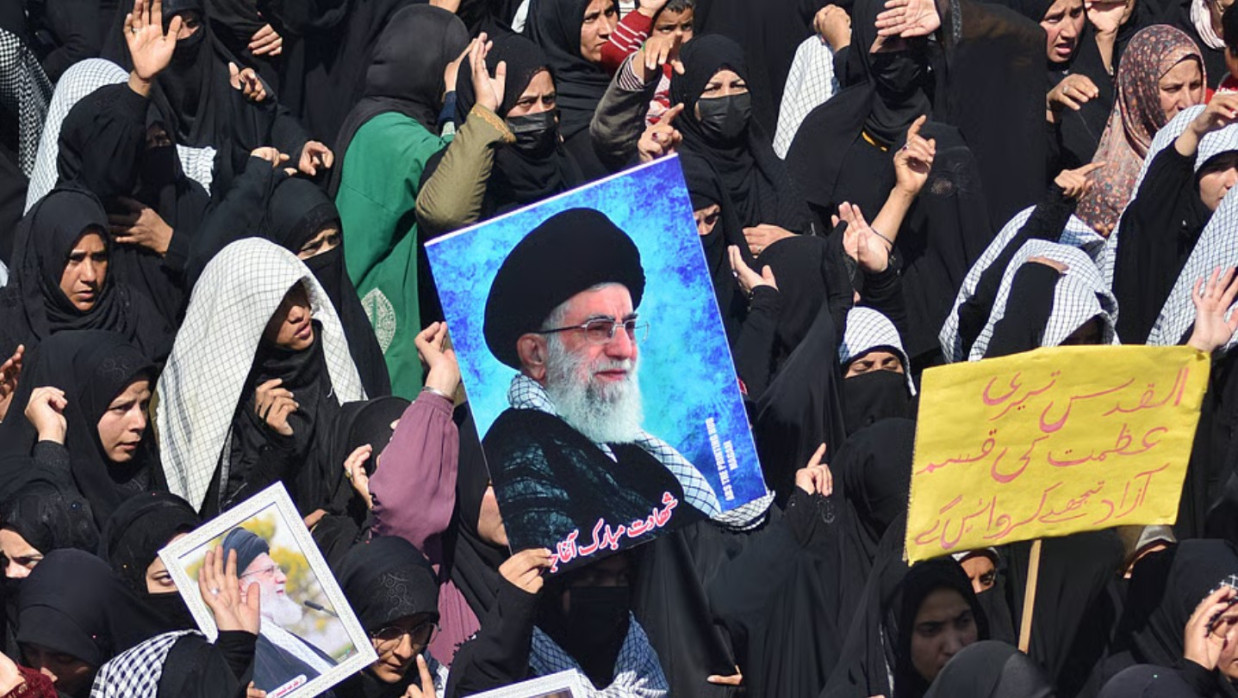
When news broke that Iran’s Supreme Leader, Ali Khamenei, had been killed in a US-Israeli airstrike on 28 February, thousands of Kashmiris poured into Lal Chowk in the heart of Srinagar, scaling its iconic clock tower to drape it with his portrait and Palestinian flags. The authorities responded with criminal cases, sweeping detentions, and the shutting of Srinagar’s Jamia Masjid for Friday and Eid prayers. Kashmiri women offered their gold, and young children happily sacrificed their piggy banks to send relief for victims in Iran.
In the last six years, such spontaneous eruptions of outrage and grief are not just a rarity in India-administered Kashmir, they are almost unheard of.
Yet in June 2025, too, during Muharram – which marks the start of the Islamic lunar calendar, and, for Shia Muslims, the commemoration of the Battle of Karbala – Kashmir hummed with defiant energy. The flags of Iran and Palestine, and also of the Iran-backed Lebanese Shia group Hezbollah, emerged during protests. Police summoned Shia elders and asked them to keep their community from waving Palestine flags or raising slogans against Israel, and an order prohibited acts that disturbed “communal, ethnic or religious harmony”. Muharram processions were held under tight security, with several protesters detained for defying the order.
The outrage over the US-Israeli attack on Iran and the killing of Khamenei dissolved Indian authorities’ manufactured narrative of “normalcy” and “progress”, in Kashmir. The protests were born of genuine solidarity with Palestine in the face of Israel’s ongoing war in Gaza, mirroring similar feelings across the Islamic world, and Khamenei, while he was an iconic Shia leader, was for many also a wider symbol of resistance against imperial powers. For Kashimiri Shias especially, what is happening in Palestine – children being ruthlessly killed and maimed, blockades cutting off water and food, an innocent population massacred by the powerful – finds parallels with the battlefield of Karbala. Yet Kashmiris’ outrage is not a reaction to the events in Palestine and Iran alone; it is also an expression of pent-up anger at the situation in Kashmir itself following years of repression by the Indian government, including lockdowns, mass detentions and a clampdown against local media and civil society. While the risks of direct opposition to India’s policies in Kashmir remain dire, the protesters seized upon the Gaza and Iran crises, especially in a context where the Indian government under Narendra Modi has broadly aligned with the United States and Israel, as an outlet for expressing defiance of the Indian state.
It is significant that Shias have been at the forefront of the recent protests, even if the attack on Iran and the assault on Gaza provoke anger across the board in India-administered Kashmir. Shias comprise between 10 and 15 percent of Kashmir’s overwhelmingly Muslim population, and have historically been perceived as closer to the Indian state than the territory’s Sunni majority. This owes to a mix of factors, including the community distancing itself from Kashmir’s Sunni-led pro-freedom movement as a survival strategy amid state repression, its engagement with India’s mainstream political parties, as well as long-standing Sunni-Shia sectarian conflicts and the marginalisation of Shias in Pakistan, India’s main antagonist in the tug-of-war over Kashmir. The fact that Shias have now become a prominent voice of dissent is a telling sign of the depth of Kashmiri frustration with the order of things since 2019, when the Modi government unilaterally revoked Article 370 of the Indian constitution and dissolved the state of Jammu and Kashmir and its elected government.
A journalist who did not want to be named for fear of reprisal reasoned that although Shias live under the same apparatus of surveillance and repression as everyone in Kashmir, the authorities may be softer on them because of the communities’ relative position vis-à-vis the Indian state. Shia protests can also pass as expressions of the theological beliefs that tie the community to Shia-dominated Iran – though the appearance of the flags of Palestine and Hezbollah also suggest a political dimension. The conflicts in Palestine and Iran have allowed the community that maintained some distance from the armed struggle in Kashmir to participate in the broader expression of Kashmiri political identity.
Since 2024, Aga Syed Ruhullah Mehdi, a fiery Shia parliamentarian from Srinagar, has emerged as one of the most critical voices in Kashmir. His public denunciations of the US-Israeli strikes on Iran and the killing of Khamenei recently resulted in a criminal First Information Report being filed against him for allegedly circulating “misleading content” online – a charge he has rejected – and at least one more FIR filed against him for “inflammatory speech” during a pro-Iran protest.
Mehdi is a rare dissenting voice within his own party – the Jammu & Kashmir National Conference. While his party’s leadership has largely maintained a cautious, cordial posture towards New Delhi, Mehdi has consistently challenged the political establishment on issues that most of his colleagues remain silent on – including arbitrary demolitions to punish opponents – whether real or perceived – of the Indian government, unlawful detentions, and lack of accountability in governance.
Through decades of repression by the Indian state, Kashmiris have learnt to be creative in their resistance to New Delhi’s policies even when they cannot show it directly. Now, while New Delhi and the mainstream Indian media push a narrative that Kashmir has arrived at “normalcy”, the conflicts in West Asia are providing a platform for new forms of resistance even among Kashmiris who were earlier less inclined to dissent.
SINCE AUGUST 2019, when the Modi government revoked Article 370 and cleaved Jammu and Kashmir into two union territories under the direct rule of New Delhi, the region, and particularly the Kashmir Valley, has been systematically silenced through sometimes subtle but still relentless mechanisms of coercion, intimidation and surveillance. This has stifled almost all protest – even meaningful dissent over less political issues such as unemployment, water and electricity – in a region that, for decades, has been characterised by volatility and violence. The protests over Iran and Palestine are indirect expressions of local politics because every direct avenue for its expression has been almost completely sealed off.
Long before the present moment, international solidarity was a language of resistance for Kashmiris who feared speaking directly about their own condition. In 1969, when the Al Aqsa mosque in Jerusalem, one of Islam’s holiest sites, was set ablaze by an Israeli settler, Kashmir erupted in fury, leading to repressive police action and curfew. In the 1970s and 1980s, protests over Palestine were common in university campuses and beyond in Kashmir, leading to violent clashes with the local police. Then, just as today, Kashmiris sensed that what was happening in Palestine had resonance in Kashmir. Besides religious affinity, there is a shared sense of political grievance, with Kashmiris seeing in Palestine’s repression by Israel a mirror of their own treatment at the hands of the Indian state.
Life in Kashmir, as in Palestine, is punctuated by crackdowns, arbitrary killings and detentions, and the suppression of political expression. Both Palestine and Kashmir are framed as unresolved remnants of the colonial legacies that manufactured their predicaments.
In the summer of 2014, when Israeli attacks on Gaza led to the deaths of more than 2100 Palestinians, students across the Valley held protest rallies, raising both anti-Israel and anti-India slogans. They also imitated some methods of the Palestinian intifada against Israel, such as flinging stones at security forces. The protests were brutally crushed. Massive protests were also held in 2017 when the United States recognised Jerusalem as the capital of Israel – an affront to the Palestinians, who have long claimed the city as their own capital.
Kashmiris have also expressed solidarity with other examples of resistance to imperial domination, including in Iraq and Libya as well as Iran. When Ruhollah Khomeini, the leader of Iran’s Islamic Revolution, died in 1989, there were huge rallies in Kashmir, with both Shias and Sunnis standing together. Iran, a Shia-majority state, was seen as a symbol of resistance despite its imperfections, with Kashmiris protesting in sometimes blind yet loyal solidarity. When Khomeini issued a fatwa against the writer Salman Rushdie in 1989, citing blasphemy in his novel The Satanic Verses and calling for his death, protesters took to the streets of Kashmir in violent fury to demand that the book be banned.
Kashmiri solidarity for Palestine has found expression outside of protests as well, even as it has remained complex and unreciprocated. A story commonly told in Kashmir has it that, sometime in the 1970s, a group of college boys encountered a visiting Palestinian tourist – a rare find. Euphoric, they gathered a crowd and marched to Lal Chowk, set up a makeshift stage and asked him to speak about Palestine and Kashmir. The flabbergasted tourist eulogised the beauty of Kashmir with its verdant mountains and resplendent lakes, then called it a beautiful part of India and said he was happy to visit because “India and Palestine are like two sisters…” The crowd’s enthusiasm turned into disappointment, and they abruptly and roughly ended his moment of celebrity.
There are many versions of this anecdote, told and retold by many Kashmiris, some claiming they were there or knew somebody who was. The story has not been authenticated, but it aptly encapsulates the complex relationship between Palestine, India and Kashmir.
THERE WAS A TIME when Palestine’s fate evoked widespread empathy in the rest of India, rooted in anti-colonial solidarity and India’s non-aligned foreign policy after 1947.
Historically, India was a staunch supporter of Palestinian rights. It voted against the UN plan in 1947, recommending the partition of Palestine into Jewish and Arab states, with more land allocated to the Jewish state. In 1974, under the prime ministership of Indira Gandhi, it was among the first to recognise the Palestine Liberation Organisation (PLO). The PLO leader Yasser Arafat had a close relationship with Indira Gandhi and with other Indian leaders. But in recent decades, and especially under the Modi government, India’s relations with Israel and Palestine have undergone a major transformation, with a decisive shift in favour of the former.
India established diplomatic relations with Israel in 1992 and bilateral ties gradually deepened, particularly in defence and trade. Modi has accelerated this change. In 2017, he became the first Indian prime minister to visit Israel; the following year, he hosted the Israeli prime minister, Benjamin Netanyahu, for an official visit. In 2024, as Israel waged its war on Gaza, Indian weapons firms sold rockets and explosives to the Israeli government.
Modi visited Israel just days ahead of the present US-Israeli war on Iran. He declared before Israel’s parliament that, “India stands with Israel, firmly, with full conviction, in this moment, and beyond.” The trip culminated in the two countries elevating their relationship to a “Special Strategic Partnership”, with cooperation including missile systems, surveillance platforms, electronic warfare equipment and intelligence sharing, all largely beyond public scrutiny.
Apart from general statements condemning civilian casualties, Modi has not said a word about Israel’s mass killing of Palestinians since 7 October 2023, when an attack on Israel by the Palestinian militant group Hamas set off the present war. Israel has bombed civilian areas, including hospitals and schools, it has deliberately targeted journalists, and it is estimated to have killed or injured at least 60,000 children – war crimes and crimes against humanity for which the International Court of Justice has issued arrest warrants against Netanyahu and Israel’s former defence minister, Yoav Gallant. Many observers in India, to say nothing of Palestine, see New Delhi’s present position on Israel as a betrayal of India’s long legacy of anti-colonialism and moral diplomacy.
New Delhi’s silence on Israel’s attacks is driven by multiple factors: strategic interests as India becomes the top importer of Israeli military equipment, the politics of Muslim exclusion that both Hindutva and Zionism espouse, shared experiences of dealing with what both states frame as terrorist threats, and a growing convergence of geopolitical interests.
The comparisons Kashmiris draw between the Israeli occupation of Palestine and Indian control of Kashmir extend beyond just brute militarisation. Kashmiris have held a heightened fear of demographic change especially after 2019, with the Indian state assuming enhanced powers over the territory. Laws introduced after 2019 allow non-Kashmiri residents to settle in Kashmir and apply for government jobs, conduct businesses and purchase land – all activities earlier barred to outsiders to keep Kashmiris from being overwhelmed in their own land.
The threat of an influx of non-Kashmiris is seen as part and parcel of a settler-colonial project by India to further impose its will and stifle resistance in Kashmir, echoing Israel’s occupation and colonisation of the West Bank. In recent Indian initiatives such as the aggressive expansion of road and rail networks, accompanied by the displacement of local farmers and apple-growers, Kashmiris see the resemblance to Israel’s land grab in Gaza.
India’s increasing proximity to Israel has been reflected in New Delhi’s use of Israeli crowd-control and surveillance technologies against both Kashmiris and others it deems an oppositional threat. India has used Pegasus spyware, developed by the Israeli firm NSO Group, to target several hundred individuals. In 2019, India’s consul general in New York was caught on camera calling for New Delhi to adopt an “Israeli model” in Kashmir.
What the Indian state fails to understand is that even a population that has been tamed and silenced through political and legal repression, through sweeping detentions, surveillance and economic dispossession, cannot be silenced forever. Kashmir, whose heart has throbbed for Palestine, whose walls were once painted with “Free Palestine” graffiti, whose newspapers once published more about Palestine than about Kashmir itself, was conspicuously silent on the earlier phases of Israel’s devastation of Gaza in the aftermath of 7 October 2023. But that offline silence was belied by the online sharing of videos of Israeli repression and brutality, of children brutally killed in Gaza and the West Bank, of Palestinian resistance poetry. Now, even on the streets, Kashmiris have found a way to make themselves heard.
For any who ask why Kashmiris march for Iran or Gaza while remaining silent about their own suffering, there is a better question to ask: what does it mean that, in order to speak about themselves, they must always point to someone else?
The article appeared in the himalmag
0 Comments
LEAVE A COMMENT
Your email address will not be published