

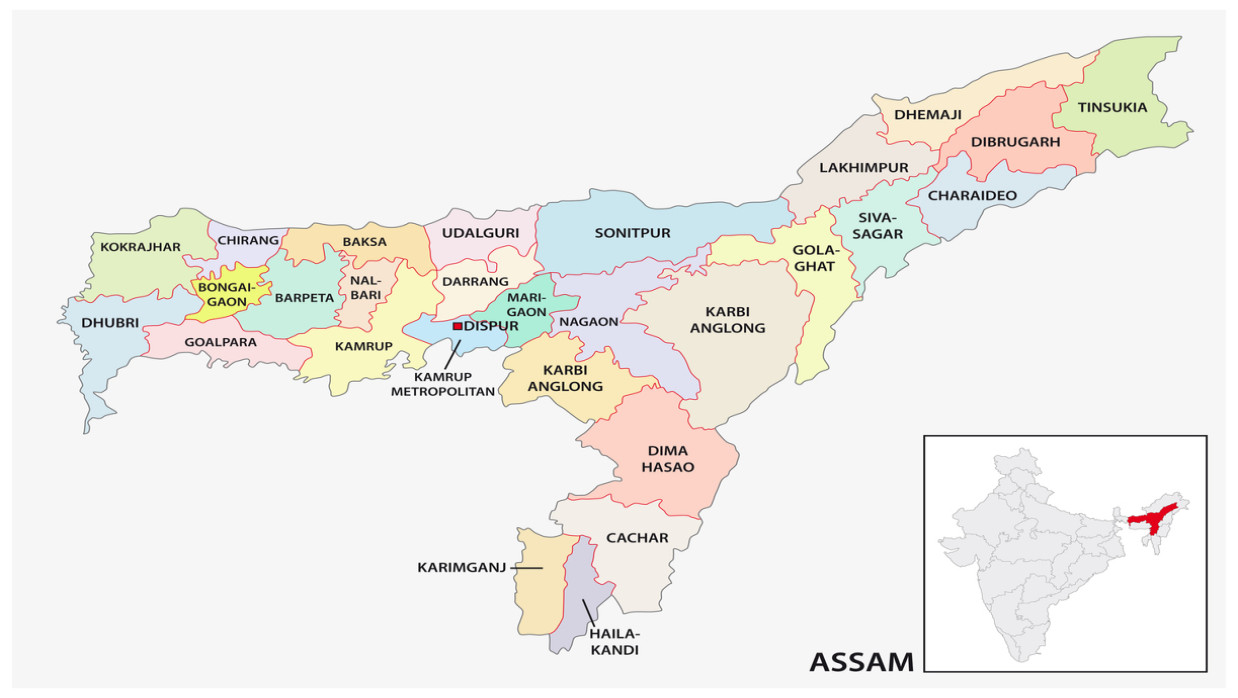
A viral and now deleted Facebook post by Assam BJP unit portraying chief minister Himanta Biswa Sarma as brutal and communalized has once again highlighted the uneasy nexus between domestic compulsions and foreign policy in the Northeast. Targeting of "Bangladeshis" is explicit and hardly an aberration. Assam today finds itself at a point where populism, vote-bankism, and foreign policy meet.
Subnational Diplomacy and the Promise of Connectivity
Strategically located as India's gateway to Southeast Asia, Assam has been pivotal to India's engagement with Bangladesh at the subnational or "regional" level. The Act East Policy enabled India's northeastern states to establish closer ties with their Bangladeshi counterparts, with Assam institutionalizing its external outreach by establishing a dedicated Act East Policy Affairs Department in 2017. This helped Assam's leadership coordinate trade, connectivity, and cultural exchanges with their counterparts in Bangladesh. Rapid results followed. The Coastal Ports agreement, a Standard Operating Procedure for using Bangladeshi ports at Chittagong and Mongla, opened new gateways for India's Northeast. Border haats brought economic opportunities to remote areas, and Dhaka opened a Deputy High Commission in Guwahati, reflecting recognition that Assam was key to bilateral engagement. In many ways, this cooperation also reflected a growing acceptance that Assam and Bangladesh could not ignore each other.
Electoral Politics and the Securitization of Identity
Despite this partnership approach, electoral discourse often casts Bangladesh as the aggressor. Politicized notions around migration, demographic change, and border security continue to feature prominently during Assam's election periods. Chief Minister Sarma's recent comments regarding "illegal immigration" and the cultural preservation of Assamese identity exemplify that these politics firmly remain rooted in the State's party rhetoric.
Migration has long been politicized in the region. The Assam Movement in the late 20th century, the Assam Accord of 1985, and the citizenship discourse that followed made immigration a cornerstone of political debates within the State. This further intensified with the passage of the Citizenship Amendment Act (CAA), which "added a communal layer" to citizenship, reframing the foreigners vs. indigenous people narrative.
It raises the question of how much further identity can be securitized before it threatens Assam's political will to engage with the region at all?
Historical Memory and Security Concerns
Suspicions about Bangladeshi intentions are not entirely imaginary: Past support to militant groups ULFA, NDFB has been alleged by some quarters repeatedly. Other developments, such as Bangladesh's closeness with Pakistan and reports of Islamic extremism penetrating Bangladesh, are adding to existing insecurities. The India-Bangladesh border is also witnessing increased securitization. Problems over deportations, border fencing, and pushbacks of suspected migrants have led to tensions between the border agencies of India and Bangladesh. Claims that no agreement is needed for pushbacks/border hats point to an inward-looking, muscular national stance.
Pushbacks, however, come with costs of their own. Such actions undermine confidence-building measures at a time when collaboration between India and Bangladesh is of great significance.
Conversely, Dhaka has its share of worries about external attempts to destabilize its southeastern border region, notably the Chattogram Hill Tracts (CHT). In this regard, there have been sporadic accusations from Bangladesh, often hard to prove, of India-supported or at least India-permitted actions to stoke instability in the CHT, largely due to its legacy of insurgency, an ethno-sensitive population, and bordering states, Tripura and Mizoram of India. Any alleged infiltration of insurgents, materiel, or even communications seen as politically provocative across the loosely guarded India-Bangladesh border is likely to be perceived in Bangladesh as a threat to its domestic sovereignty. India's stated stance has been one of non-interference in Bangladesh's internal affairs, though suspicions remain.
The Contradiction: Cooperation vs. Confrontation
Assam has done well concerning policy towards Bangladesh, but has lagged on the political front. Assam has made sustained efforts to enhance connectivity with Bangladesh through multimodal transit access, transport corridors, tech linkages, and, perhaps, medical tourism. But Assamese politicians, time and again, have painted Bangladesh as the enemy.
Words matter, and when leaders use toxic language against neighbors, especially during election periods, they only cement public opinion against the flexibility needed in relationships. Bangladesh is not a threat to Assam and vice versa. With so much potential for bilateral trade and exchange, there is no reason for politicians to pick needless fights.
Need for a Positive Regional Environment
Moving forward, there is little reason why ties between Assam and Bangladesh cannot flourish. Natural resource linkages, people-to-people contact, trade, and the myriad benefits of being trans-border neighbors provide all the incentives needed to pursue common interests.
Bangladesh and India share common interests in connectivity, water, and, now with the Teesta treaty, agriculture too. While ties have been improving at the national level, much more can be done at the subnational level to push the envelope. Think medical tourism, connectivity projects, Bangladesh as a trade corridor to Southeast Asia and vice versa, and many more.
All that is needed is for parties to stop using their relationship with Bangladesh as a political football every election cycle.
Conclusion: Beyond the Politics of Fear
Bangladesh will continue to be politicized, at least in Assam and especially during election time. However, leaders and policymakers have a choice in how they deal with this reality. Assam can continue to let identity politics dominate its foreign policy towards neighbors, or it can pragmatically calibrate its political rhetoric to its economic and strategic needs.
The success of Assam-Bangladesh relations does not hinge on borders because they aren't going anywhere. It hinges on politics: whether Assamese political parties want the relationship with Bangladesh to help drive prosperity in the years to come, or whether they want to let irresponsible fear-mongering destroy bilateral relations.

0 Comments
LEAVE A COMMENT
Your email address will not be published