

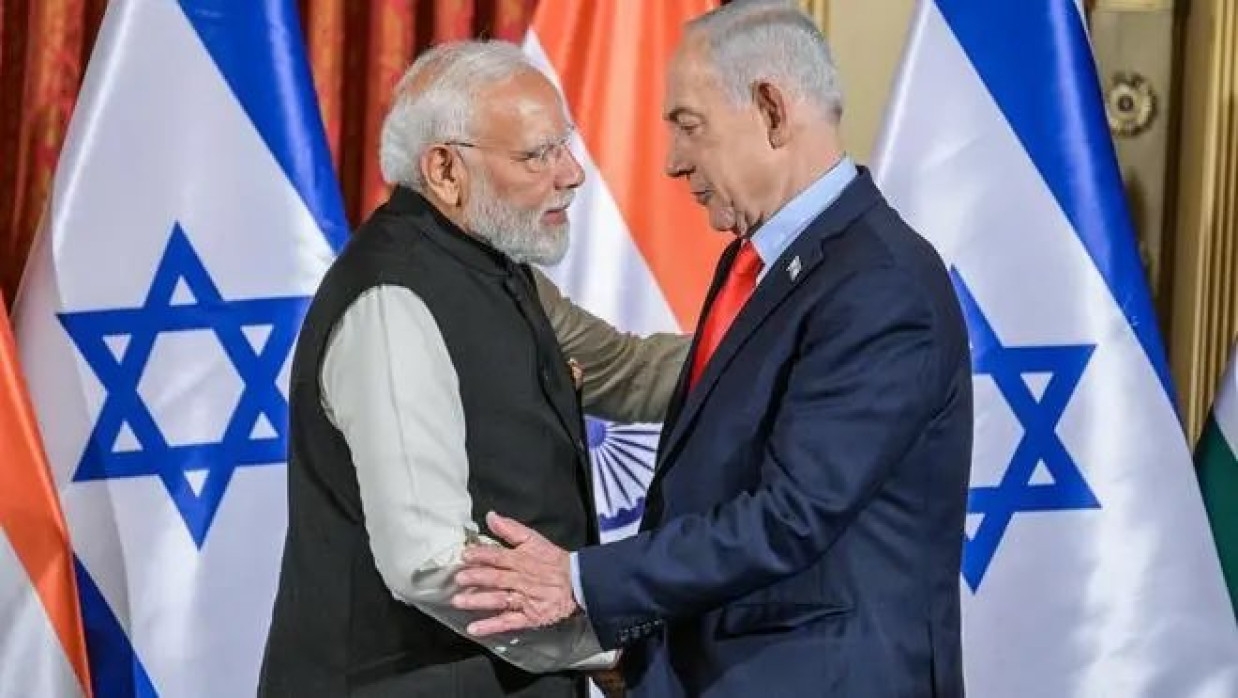
On 25 February 2026, Indian Prime Minister Narendra Modi made history by addressing Israel’s parliament, the Knesset, becoming the first Indian leader to do so. His 32-minute speech ended in a standing ovation. Lawmakers queued for selfies. He was awarded the rare Speaker of the Knesset Medal, an honor never before conferred on a foreign leader.
Symbolically, it was a diplomatic high point in India-Israel relations. Substantively, it was one of the most controversial foreign policy gestures of Modi’s tenure.
The timing could not have been more politically charged. Modi’s host, Israeli Prime Minister Benjamin Netanyahu, faces an arrest warrant issued in November 2024 by the International Criminal Court over alleged war crimes and crimes against humanity linked to the Gaza war. Israel acknowledges tens of thousands of Palestinian deaths, including large numbers of children. As a result, many world leaders have distanced themselves from Netanyahu to avoid legal, diplomatic, or moral backlash.
Modi chose the opposite path, embracing, dining with, and publicly pledging solidarity with Netanyahu at a moment of global isolation.
A Diplomatic Gamble Amid Global Isolation
Netanyahu’s room to maneuver diplomatically has shrunk significantly. He is wanted by the International Criminal Court and risks arrest if he travels to any of its 124 member nations. Israel’s actions in Gaza have been loudly criticized by several major democracies. Even those countries that quietly cooperate with Israel on security matters have steered clear of large flag-waving displays of solidarity.
In this context, Modi’s visit was a clear public relations boost for Netanyahu, who is facing political pressure at home with a weakening economy, corruption scandals, fights with the judiciary, and continuing questions over his government’s lack of accountability for Hamas’s attack on October 7. Polls show Netanyahu needing another term, but his likely path to victory depends on a right-wing coalition. With an election likely in the coming months, Modi sitting beside him in Jerusalem amounted to international legitimacy at a time when few international politicians are willing to be pictured with Netanyahu.
India’s optics are slightly murkier. India was an early champion of the two-state solution to resolve the Palestinian question. In 1988, India recognized Palestine. Israel and India established full diplomatic relations in 1992. While warming up to Israel over the decades, New Delhi was studious in its efforts to balance deepening defense ties with Israel with continuing diplomatic support and humanitarian aid to the Palestinians.
The scales tipped in 2014. Modi visited Israel in 2017 without visiting Palestine, breaking with the diplomatic practice established by prior visits by Indian leaders. India voted against resolutions calling for a ceasefire at the UN multiple times after October 7. India refused to sign on to statements criticizing Israeli expansion of settlements. India has gone from studiously neutral to overt partiality.
Strategic Depth: Defense, Technology, and Intelligence
India’s reasons for opening up to Israel are clear-cut and pragmatic.
India purchased about 34 percent of Israel’s weapons exports from 2020 to 2024. Today, Israel is India’s third-largest supplier of defense materials, after Russia and France, accounting for about 13 percent of total imports. The imports have included Israeli upgrades to make weapons precision-guided, Rampage long-range assault missiles, Harop kamikaze drones, AWACS radar aircraft, and the Barak-8 air defense system developed jointly with India.
Military cooperation has extended to joint-production deals, intelligence cooperation, and joint efforts against terrorism. Talks are underway for a free trade agreement that would rekindle trade between the countries to its previous high of more than $10 billion per year, before the war in Gaza dampened tourism and business.
Netanyahu has even suggested the formation of a “hexagonal alliance” between Israel, India, Greece, Cyprus, and certain Arab and African nations to challenge other power blocs. India has never entered into formal defense pacts, but Netanyahu’s proposal alone highlights just how important India has become to Israeli strategic thinking.
But there are ethical compromises at play as well.
Crony Capitalism and the Adani Question
Business deals go beyond agreements between countries. India–Israel bilateral defense and infrastructure agreements have benefited the Adani Group. Adani runs many projects: producing Hermes 900 drones through Adani Elbit Advanced Systems in India; the majority owner of Haifa Port in Israel; a partnership in small-arms production; and large contracts to supply the Indian Army with Negev light machine guns. Although there has been no court verdict on any of these businesses that proves foul play, there is concern that defense contracts continue to benefit politically influential conglomerates without transparency. Recent MoUs on critical minerals, artificial intelligence, and quantum technology further strengthen economic interdependence between the two countries. Are these benefits reaching the entire Indian industrial complex, or are they being held by chosen conglomerates?
Surveillance, Pegasus, and Democratic Anxiety
India–Israel relations cannot be discussed without addressing the Pegasus controversy. Pegasus is a surveillance software created by the Israeli company NSO Group. It is alleged to have been used against Indian journalists, opposition leaders, and activists. While the Modi government has neither confirmed nor denied the purchase of spyware, a committee formed by the Supreme Court did not reveal its complete report while indicting the government for lack of cooperation. Modi's visit has raised questions over a new agreement between India and Israel over cybersecurity, surveillance, and espionage-related programs. Opposition leaders cautioned that the India–Israel partnership moves beyond protecting each other from external threats to spying on each other's citizens. They alleged that the partnership will use the pretext of fighting terror to muzzle criticism.
"You're going to be hit by Pegasus", says the chant that's going around in skeptical circles.
Ideological Convergence: Hindutva and Zionism
However, there is more than trade and arms connecting India and Israel. Analysts have drawn similarities between Hindu nationalism in India and settler colonialism Zionism in Israel, both stemming from religious definitions of nationalism. The Hindu nationalist leader V.D. Savarkar even praised Zionism and the creation of Israel as ideal for "uniting people based on culture". Increasing mainstream calls to characterize Muslims as a "demographic threat" or terrorists echo in both India and Israel. India's human rights record of extensive Kashmir surveillance, imposition of curfews, and razing of Muslim homes has been criticized as resembling Israel's human rights record in Palestine. Activists have made comparisons between Israeli forces committing massacres in Gaza and the Israeli-occupied West Bank and the Indian government's oppression of Muslims. There has been an increased number of hate crimes and hate speech against Muslims in India. In Israel, there have been claims of Israeli brutality and violence against Palestinians. There have been images compared of Israeli bulldozers clearing Palestinian homes in Gaza to the Indian government clearing Muslim homes.
The Costs of Alignment
India’s public courting of Netanyahu isn’t without risk. Millions of Indians work in the Gulf as expats. India’s Muslim partners are watching closely. India has long maintained a reputation among Global South nations as a champion of anti-colonial solidarity and non-alignment. That reputation is wearing thin.
Netanyahu and Modi are the immediate winners of the visit. Netanyahu enjoys some increased international legitimacy. Modi bolsters his strongman credentials among his domestic audience. It’s hard to predict the long-term impacts of this visit, but we can know what they won’t be: India will lose some of its strategic autonomy as it grows more reliant on Israeli military hardware and intelligence-sharing. India’s international moral capital, carefully accrued by years of principled non-alignment and vocal support for Palestinian sovereignty, is being squandered.
Strategic Power vs. Ethical Positioning
Modi’s speech to the Knesset was historic. It announced India’s arrival as a global power broker and deepened a robust strategic relationship. Defense ties, tech collaboration, and intelligence cooperation surely enhance India’s geostrategic clout.
But foreign policy isn’t just about deals and handshakes. It’s also about trust, equilibrium, and principled leadership.
India’s growing closeness with Israel signals more than a transactional relationship. It signals a shift in perspective that values national interest, majority rule, and strategic alliances over older notions of equidistance and rules-based morality.
Will this shift signal a confident India that knows its place in the world? Or an India that has lost its pluralistic moorings once and for all?


0 Comments
LEAVE A COMMENT
Your email address will not be published