

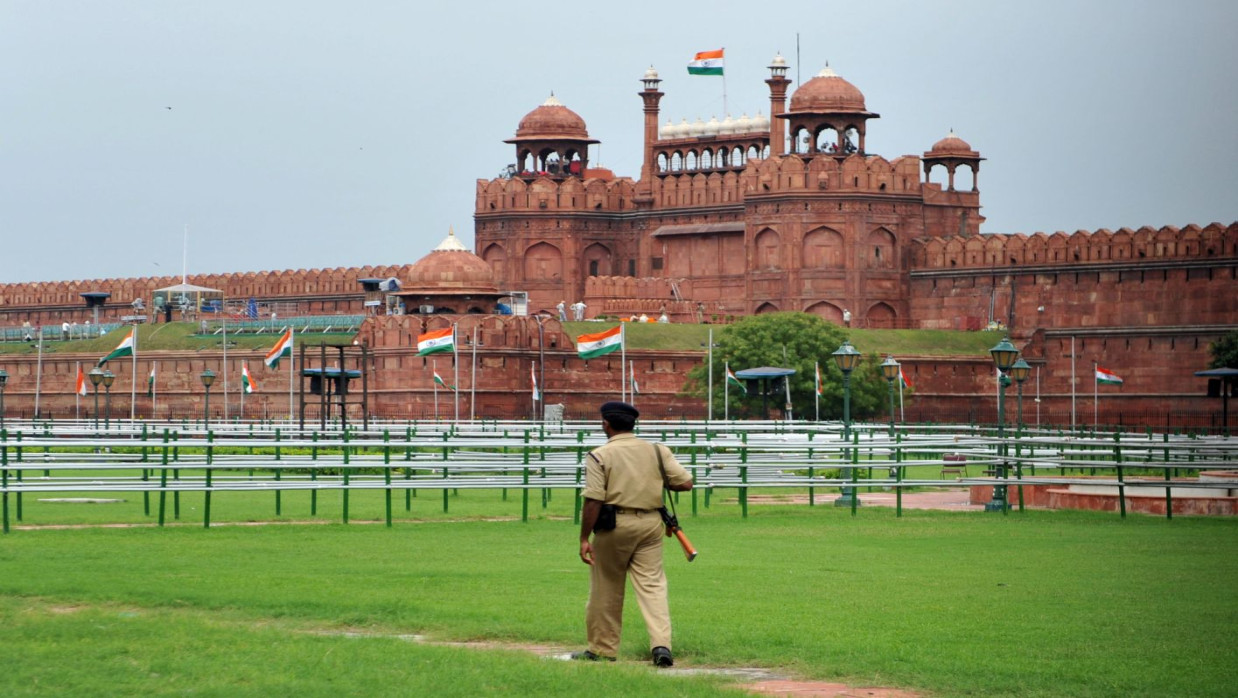
This season, once again, the street in Bangladesh fills before it decides why it has filled.
Bangladesh has once again become the place where South Asia’s unease gathers. The protests are familiar in form – students, slogans, police lines – but their cause resists precision. They are not only about water, though the rivers matter. They are not only about borders, though the dead along them are remembered. They are not only about diplomacy, though the language of insult and interference circulates freely.
This essay begins here, not because Bangladesh is exceptional, but because it is emblematic. Over the past half-century, similar moments have surfaced across South Asia, appearing suddenly, intensifying quickly, and dissolving without resolution. Moments like this have come to be called “India Out”, though what they name is not an ideology so much as a recurring strain of proximity.
India is rarely absent in South Asia. Even where it is not invoked, it is felt: through rivers that thin without warning, through fuel queues that lengthen toward dusk, through borders that harden unexpectedly, through a rumour that arrives before reason can intervene. For many of its neighbours, India is not a policy problem so much as a condition of life: proximate, immense, and inescapable. It is this condition, more than any single action, that explains why, at moments of strain, the street turns outward and demands that India go.
These moments do not announce themselves as ideology. They do not sustain programs or carry manifestos. They appear instead as moods. A gathering thickens at a crossroads; a slogan hardens; a phrase repeats itself until it no longer sounds like news but like truth. By the time the words ‘India Out’ are painted or shouted, the work has already been done elsewhere: in the mind, in the image, in the shared sense that something has been taken, withheld, or imposed without consent.
Over decades, since India ceased to be an episodic actor and became a structural presence in the lives of its neighbours, such moments have surfaced repeatedly across Bangladesh, the Maldives, Nepal, and Sri Lanka. They differ in scale and consequence. Some pass without blood; others do not. Yet they share a peculiar intimacy. India is not a distant empire to be denounced, but a neighbour whose presence is already woven into daily life; into water, trade, labor, language, cinema, and news.
To protest India, then, is not to reject an abstraction. It is to recoil from a closeness that, at certain moments, becomes unbearable.
In Bangladesh, the earliest murmur rose not from the street but from the river. When the Farakka Barrage was commissioned in the mid-1970s, the grievance it produced was slow, almost geological. Water does not protest; it withdraws. Crops fail quietly. Livelihoods erode before they break into the open. The Farakka Long March of 1976, disciplined, largely non-violent, did not accuse India of malice so much as of indifference. India appeared there as a force upstream, unseen yet decisive, capable of altering lives downstream without ever crossing a border.
That image endured. Long after the slogans faded, the sense of hydrological vulnerability remained, ready to be recalled whenever scarcity returned. Along the border, death arrived more abruptly. Civilians shot while crossing fields or tending cattle did not require ideological framing to become symbols. Each killing was small in number, large in meaning. Protest followed death, not the other way around. Over time, these incidents accumulated into a quiet conviction that India’s power was asymmetrical and casually exercised. When, in more recent years, diplomatic incidents or perceived slights ignited protests, they did so against this sedimented memory. India had already been cast, not as an enemy, but as a presence insufficiently attentive to the fragility of those living nearest to it.
In recent months, this older sense of asymmetry has taken on a sharper edge. What gathers in the street now is less a rejection of India itself than an anger at India’s visible alignment with a political order that many Bangladeshis no longer recognise as legitimate.
The Maldives, by contrast, turned exposure into performance. Beginning around 2020, India Out appeared not as an accusation but as a brand. It did not grow from queues or corpses, but from images; uniforms glimpsed, aircraft photographed, phrases repeated until they felt self-evident. The campaign’s economy lay in repetition. It required no proof, only circulation. Sovereignty was invoked as a feeling rather than a condition. When the state moved to ban the slogan, it merely confirmed its power. Arrests and intimidation followed, but mass lethality did not. Here, India was not feared for what it did, but for how easily it could be imagined doing too much.
Nepal’s relationship with India has always been more intimate, and therefore more volatile. The memory of the 1989-90 trade and transit crisis, remembered simply as the blockade, lingers not as a policy dispute but as a humiliation. Shortages teach lessons quickly. They teach dependence. They teach vulnerability. When fuel and medicine grew scarce again in 2015-16, following Nepal’s new constitution, the old lesson returned intact. Anger followed the queue; violence followed anger. India’s explanations mattered less than the sensation that lifelines could be constricted from beyond the border.
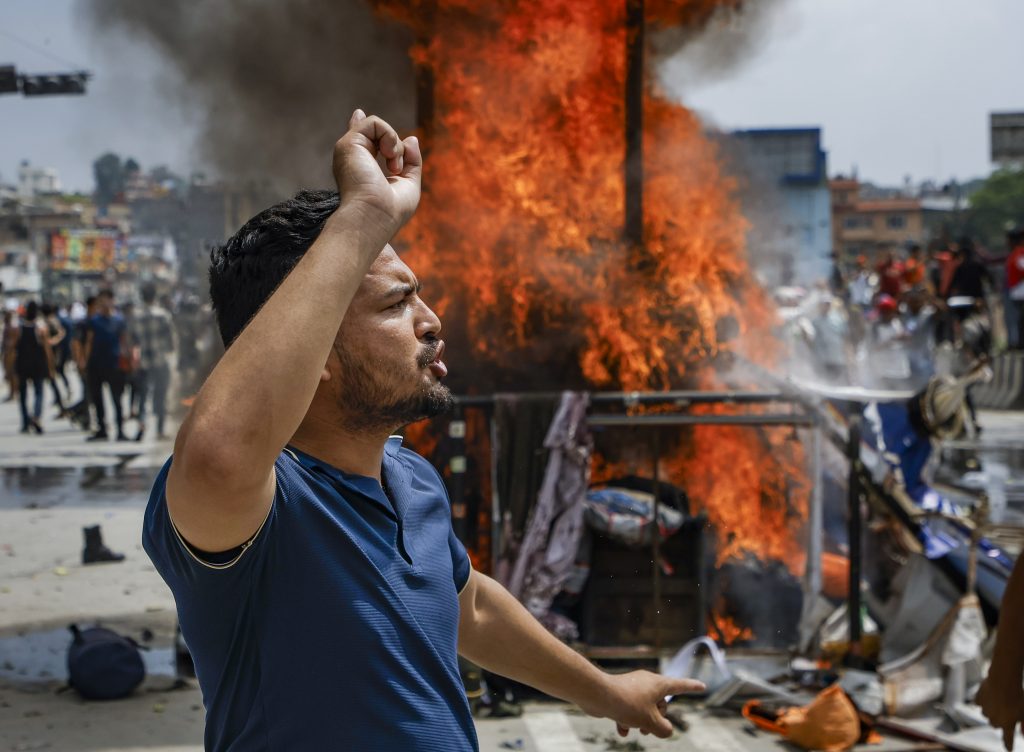
An agitator shouts slogans as smoke and flames billow out after several structures were set on fire during massive anti-government protests, in Kathmandu, Nepal, Tuesday, Sept. 9, 2025. Photo: PTI.
The most disturbing Nepalese episode, however, had nothing to do with policy at all. In December 2000, a rumour spread that an Indian film star had insulted Nepal. The insult was never substantiated. It did not need to be. Tabloids, FM radio, and word of mouth carried it faster than denial could follow. Cinemas burned. Shops were looted. At least fourteen people died. The army was called in. Here, India had not acted; it had merely existed within a cultural field dense enough for offence to feel plausible. The violence was not against India’s policy, but against India’s imagined disdain.
Sri Lanka’s memory runs darker still. When India moved from mediator to guarantor with the Indo-Lanka Accord of 1987, the shift was felt not as assistance but as intrusion. Riots followed in Colombo; police fired on demonstrators; the dead were counted before calm returned. During the insurgency that followed, anti-India rhetoric merged seamlessly with revolutionary violence. Tens of thousands died in a conflict where India’s presence served as both justification and symbol. Long after the blood dried, the memory remained. In later years, protests returned in altered form, less violent, more transactional, focused on ports, oil tanks, and energy infrastructure. India was no longer accused of military domination, but of economic absorption. The charge changed; the unease did not.
Across these cases, a common misreading persists: the belief that ‘India Out’ protests are responses to Indian action alone, when in fact they ignite at the point where memory, proximity, and media converge. In truth, they are responses to perception, and perception is governed by media; not media as neutral messenger, but media as terrain. Grievance takes shape there; outrage gathers velocity there; meaning hardens there. In Bangladesh, this hardening has been accelerated by cross border media traffic, where Indian television debates and digital commentary are read not as observation but as intervention. Narratives that mischaracterise domestic unrest as chaos or extremism return amplified, deepening the sense that judgment, like pressure, is being applied from outside.
Media also binds India’s hands. Indian officials respond not only to host-country outrage, but to domestic Indian media demanding assertion. Overreaction validates the hegemon; silence creates an outrage vacuum. Fragmented commentary now travels outward faster than diplomacy can contain it. By the time clarification arrives, identity has already formed. To retreat then feels like surrender; to insist feels like domination.
Once this loop closes, the protest no longer concerns India’s behaviour at all. It becomes a performance within the host country’s political theatre. India is the prop that cannot leave the stage.
Seen in the round, ‘India Out’ is not a doctrine. It is a reflex. It surfaces when proximity feels oppressive, when dependence is suddenly visible, when dignity seems bruised by an unseen hand. Violence is not its essence, though violence has followed it. Its true power lies in its ability to translate internal anxiety into external blame, and to do so quickly, convincingly, and with moral certainty.
That reflex would not recur with such force if India’s power were always exercised with equal attentiveness to how it is seen, felt, and remembered beyond its borders.
Also read: Refuge Without a Name: South Asia’s Architecture of Statelessness
South Asia is not unique in this: other powers have learned, often painfully, that proximity and protection curdle easily into resentment. What distinguishes India’s predicament is not the existence of backlash, but its intimacy, with neighbours who cannot be kept at a distance.
For India, the lesson is not to withdraw. Withdrawal would only confirm absence as abandonment. The lesson is restraint; not in substance, but in spectacle. Power that is constantly announced invites resistance; power that is quietly exercised becomes harder to dramatise. In a region where media moves faster than memory, India’s challenge is temporal as much as strategic: to respond before myth sets in, yet without feeding the very narrative it seeks to escape.
This prescription of restraint, however, encounters a hard limit in the noise of India’s own polarised politics. The tragedy of the current moment is that the quiet diplomacy required to steady the neighbourhood is often politically unaffordable at home. In an era when foreign policy is increasingly consumed as domestic spectacle, strategic silence is easily misread as weakness, and compromise televised as surrender. India thus finds itself caught in a paradox of its own making: compelled to project strength for its internal audience, even as that projection unsettles the region it seeks to lead.
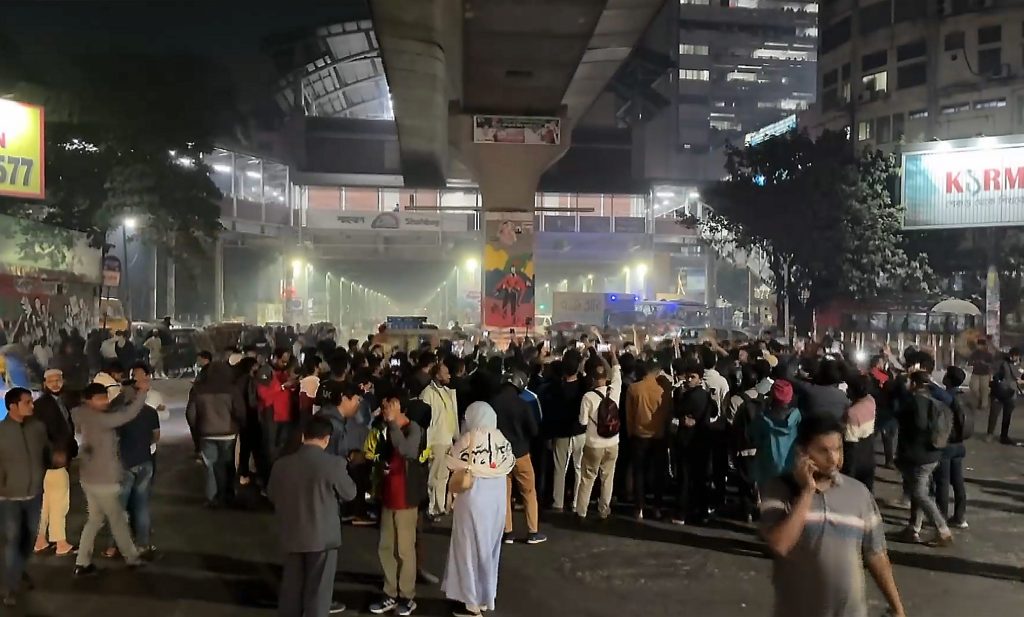
People gather to protest after the death of Sharif Osman Hadi, at Shahbagh intersection near Dhaka University campus, in Dhaka, Bangladesh, late Thursday, Dec. 18, 2025. Photo: PTI.
When the protests in Bangladesh thin, as they eventually will, they will leave little behind that can be archived. The banners will be folded away; the slogans will recede into memory; the headlines will be replaced by others no less urgent. What will remain is harder to see and easier to forget: the feeling that gathered before the street did, the quiet certainty that something essential was being decided elsewhere.
India will still be there. The rivers will still cross borders without asking permission. The fence will still run its long, indifferent line. The media will still move faster than explanation, carrying images ahead of consequence. None of this will resolve itself, because none of it began as a problem to be solved.
This is why ‘India Out’ returns, again and again, without ever quite meaning the same thing twice. It is not a demand for absence. It is an expression of strain: of what happens when proximity hardens into pressure, when familiarity curdles into suspicion, when power is felt more keenly than it is understood.
In Bangladesh, that feeling has not demanded India’s absence so much as its disentanglement: from rulers, narratives, and certainties that no longer hold. The protest does not end in victory or defeat. It simply subsides, leaving behind the conditions that produced it. The street empties. The feeling does not. And somewhere beyond the visible edge of things, the presence that provoked it remains – unaltered and unremoved – waiting for the next moment when explanation once again arrives too late.
Shyam Tekwani is a professor and columnist specialising in security affairs. Views expressed in this article are those of the author.
The article appeared in the thewire
0 Comments
LEAVE A COMMENT
Your email address will not be published