

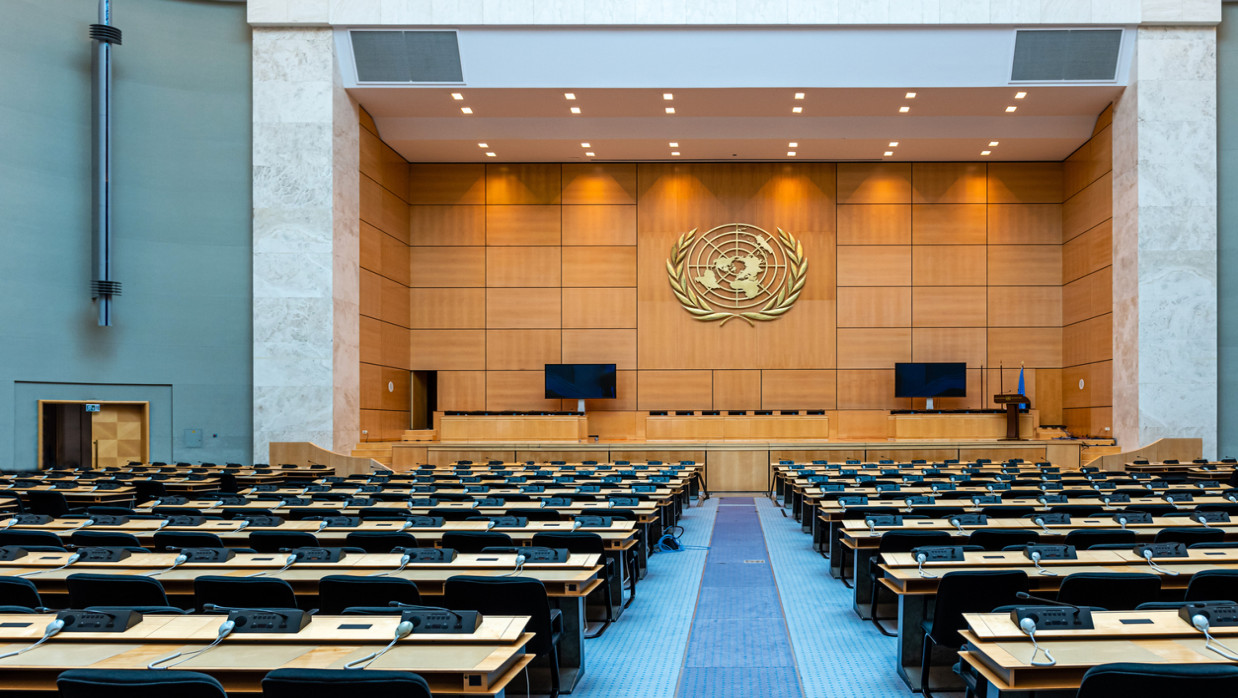
At the 18th Session of the United Nations Forum on Minority Issues, held on 27-28 November 2025 at the Palais des Nations in Geneva, India’s carefully curated image as an inclusive constitutional democracy faced unprecedented scrutiny. Civil society organisations, particularly during Day-2 oral interventions, placed on UN record a body of testimonies, official data, and legal references that sharply contradicted India’s national statement. Rather than isolated allegations, the interventions presented a systemic pattern of minority repression, institutional impunity, and erosion of democratic safeguards across the country.
The UN Forum on Minority Issues, established in 2007 to promote dialogue and cooperation on the rights of national, ethnic, religious, and linguistic minorities, operates under the guidance of the UN Special Rapporteur on Minority Issues. Professor Nicolas Levrat under the chairmanship of Ambassador Caroline Ziadeh of Lebanon will feed its suggestions to UN special Rapporteur. The discussions of the Forum will be a decisive factor in the Special Rapporteur's outcome report which will be presented at the 61st Session of the UN Human Rights Council in February 2026. Therefore, the statements made have a huge institutional significance, thus putting India’s actions under the UN’s accountability mechanism.
India’s official intervention asserted that minorities are “pivotal” to nation-building and fully protected by constitutional guarantees and democratic institutions. However, this narrative was dismantled by six international non-governmental organisations, which characterised India as a state where minority repression is systematic, institutionalised, and sustained by impunity. Speakers emphasized that the violations described were not episodic failures of governance but outcomes of deliberate policy choices embedded within India’s security, legal, and administrative systems.
French-language civil society Organisation Action de la Jeunesse pour le Development Durable (AJDD) stated unequivocally that India’s refusal to respect minority rights and prosecute perpetrators remains a central obstacle to peace and accountability in South Asia. This refusal, it argued, has empowered a “dangerous security apparatus” responsible for torture, enforced disappearances, custodial abuse, and extra-judicial killings. The organization contextualized this violence in a historical line going back to the partition of Punjab in 1947, claiming that the Sikhs had been marginalized structurally, deprived of any genuine autonomy, and had been subjected to violence that amounted to crimes against humanity. Among the others were Kashmiris, Tamils, Nagas, Muslims, Dalits, and Adivasis who were also pointed at as victims of the same oppressive system, while the perpetrators were supposedly protected and promoted.
Subsequently, Punjab was the centerpiece of modern-day suppression during the meeting. As per the reports of NGOs, 2025 saw many extra-judicial killings, which were called "police encounters," and notable Sikh leaders promoting self-rule and Khalistan were made targets by the government. The killing of Hardeep Singh Najjar in Canada in June 2023 was mentioned time and again as the clearest example of India's worldwide repression. During the discussions, reference was made to the worries expressed by UN Special Procedure mandate holders, drawing attention to the fact that such assassinations have only escalated the animosity in Punjab instead of bringing about peace.
The formal documentation included further proof of cross-border targeting, notably the revelations made by the US Department of Justice about a conspiracy that was connected to the Indian Government and aimed at killing Gurpatwant Singh Pannu, a US citizen and Sikh activist. A reference was made to the UN Special Procedures communication AL IND 10/2024, which was sent to India regarding these supposed murders and plots, thus amplifying the seriousness of the allegations in the UN system.
Moreover, the interventions put arbitrary detention and torture in the spotlight. The European League for the Protection of Human Rights Ligue Européenne pour la Protection des Droits de l’Homme (LEPDH) brought up the matter of Jagtar Singh Johal, a British citizen who has been imprisoned in Punjab since 2017. Human rights organizations reported that Johal was incarcerated in Indian jails for more than eight years without a verdict and was tortured just because of his political views and support for Sikh self-determination. His situation was framed as a representation of a more extensive scheme of silencing Sikh dissenters and their relatives through terror, retaliation, and violence in custody
The Sikh Assembly of America also highlighted the prevention of transitional justice issues by illustrating India’s hiding of accountability for the mass crimes done in the 1980s and 1990s. The human rights activist Jaswant Singh Khalra’s reports on more than 25,000 people who disappeared under government orders and fake deaths were mentioned along with the subsequent kidnapping, torture, and murder of the activist by the police. The speakers mentioned that the continuation of the justice process whose efforts are ongoing is most prominently through the effective censorship of Punjab 95 movie that reportedly had over 125 mandated cuts made by India’s Central Board of Film Certification.
Through data-driven testimony the All India Dalit Mahila Adhikar Manch addressed Dalit women’s rights. The Organisation, drawing on India’s own National Crime Records Bureau data, pointed out a dramatic rise of 78% in crimes against Dalit women from 2014 to 2022, with over 62,000 recorded incidents and an average of more than 11 Dalit women and girls raped every day. The SC/ST Prevention of Atrocities Act is in place; nonetheless, conviction rates are at 28 percent with case pendency at 91 percent, thus indicating structural impunity instead of protection.
Overall, the International Dalit Solidarity Network provided evidence of the destruction of civic space and the disempowerment of institutional safeguards by listing among other things the demolitions of Muslim houses with bulldozers, the eviction of Adivasis, the deportations of Rohingya Muslims, and the killings of Dalits without trial. India’s National Human Rights Institution was noted as having been downgraded after repeated deferrals, while the judiciary was described as increasingly unable to impartially uphold the rule of law.
Taken collectively, the interventions at the Forum portrayed India not as a pluralistic democracy but as a state where minority repression is policy-driven, violence is shielded by impunity, institutions are hollowed out, dissent is criminalized, and repression increasingly transcends borders. At a forum dedicated to trust, resilience, and peaceful coexistence, India’s claims of inclusivity stood in direct contradiction to the record now formally lodged within the UN human rights system placed there by victims, civil society, and India’s own official data. To be truly called a secular and a largest democratic state, India needs to protect minorities rights.

0 Comments
LEAVE A COMMENT
Your email address will not be published