

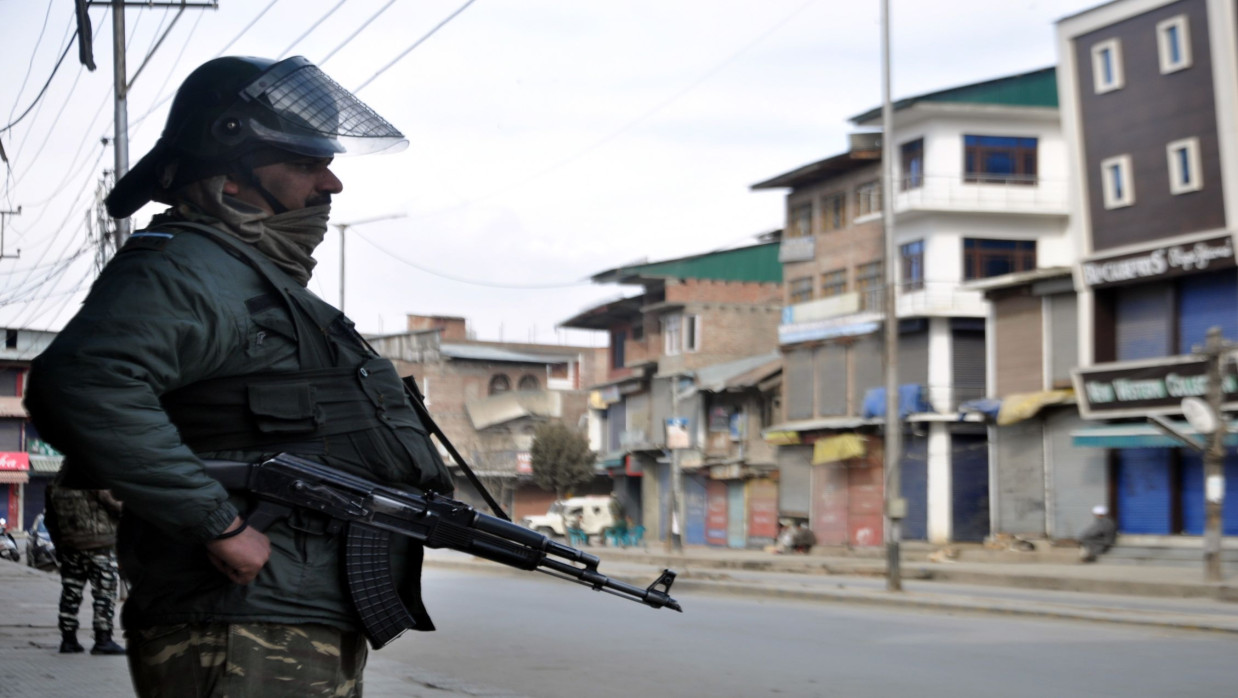
Seventy-seven years after the Universal Declaration of Human Rights (UDHR) was adopted, millions of people across the globe are still denied the most fundamental rights the declaration was intended to protect. This contradiction is most clearly seen in Indian Illegally Occupied Jammu and Kashmir (IIOJK), where the entire population is still suffering from systematic repression, collective punishment, and lack of accountability. Human Rights Day, observed annually on 10 December, is not merely a symbolic commemoration; it is a moment of moral reckoning for the international community.
The UDHR, adopted by the United Nations General Assembly in 1948, is a landmark in human history and announces that rights are inherent to all human beings no matter their race, religion, gender, language, or political opinion. It declares the right to life and liberty, absence of torture and slavery, freedom of speech, right to education, and right to work. It is the most widely translated and published human rights document globally, whose translation is available in more than 500 languages. However, these rights are still not practiced in IIOJK, where they are only recognized in the form of these rights' documentation.
A Pattern of Systemic Abuse
Kashmiris have long been suffering from serious and continuous violations of human rights. This has been caused by India's ongoing colonial-style rule. Extrajudicial killings, forced disappearances, torture, sexual violence, and the repression of political rights are not just occasional occurrences but a well-documented pattern. The Indian government had resorted to military force of excessive proportion, arbitrary detentions as well as the draconian laws to silence dissent and exercise power.
The Armed Forces Special Powers Act (AFSPA), enforced in IIOJK, continues to stand as one of the most notorious and oppressive tools of state repression. By granting legal immunity to Indian security personnel, AFSPA effectively authorizes extrajudicial killings and shields perpetrators from accountability. The Indian Army, paramilitary, and police have committed serious violations of human rights almost without punishment under the pretense of counterinsurgency operations.
Enforced Disappearances and the Failure of Accountability
The human cost of this repression is unbearable. The Association of Parents of Disappeared Persons (APDP) has indicated a total of over 8,000 enforced disappearance cases. The discovery of unmarked mass graves in the various districts, which has been confirmed by the Jammu and Kashmir State Human Rights Commission (JKSHRC), has lent a horrifying dimension to these disappearances. These revelations oppose the repeated assertions of India regarding its transparency and rule of law. India, being a party to the International Convention for the Protection of All Persons from Enforced Disappearance, is required to thoroughly investigate such crimes and punish the offenders. Its refusal to act demonstrates a willful disregard for its obligations under international law.
Torture and Sexual Violence as Instruments of Control
However, torture has been a standard practice throughout the years in the Indian military as a way to get confessions, frighten the people, and crush the uprising. In a joint report published in 2019, the Association of Parents of Disappeared Persons (APDP) in collaboration with Jammu Kashmir Coalition of Civil Society (JKCCS) reported more than 430 cases of torture which included physical assaults, electric shocks, waterboarding, and rape.
Moreover, the incident Kunan Poshspora in 1991 unmasked that Indian army committed the, which is now regarded as one of the most heinous crimes of the century, as more than 100 women, varying from 8 to 80, were victims of gang-rape during one act by the troops. The situation is really sad that after more than 30 years, there is still no justice and no one is being held responsible. The ongoing refusal to admit and hindering of investigations are clear indications of India’s disregard for the victims as well as for the applicable international standards.
Using sexually aggressive acts as a weapon during wars stands for a major breach of the Fourth Geneva Convention which is not only regarded as a war crime but also as a crime against humanity according to the Rome Statute of the International Criminal Court (ICC). However, India's non-signatory stance doesn't mean that such crimes lose their universal jurisdiction, which grants the international legal forums the power to punish the wrongdoers.
Suppressing Dissent and Silencing Kashmiris
In IIOJK, journalists, human rights defenders, and political activists are subjected to systematic oppression. The Unlawful Activities (Prevention) Act (UAPA) and the Public Safety Act (PSA) arbitrary detentions permit long-term imprisonment without trial. These regulations have been commonly applied to label journalism, peaceful protest, and political expression as illegal activities.
However, the United Nations Human Rights Council has denounced these practices as breaches of the International Covenant on Civil and Political Rights (ICCPR), which assures the rights to life, prohibition of torture, and freedom of speech. Indian-occupied Kashmir is still a place where these rights, as granted by ICCPR, are being grossly violated.
Defiance of International Law on Kashmir
Apart from violating human rights, India’s engagement in IIOJK is a clear challenge to the international law. The UN Security Council has approved several resolutions that validate the demand of the Kashmiri people for self-determination. In particular, Resolution 47 (1948) advocates for a referendum to decide the status of Jammu and Kashmir-something that India has always denied to be its obligation. Moreover, UN Resolutions 91 (1951) and 122 (1957) state that any unilateral modification of the territory's status will be considered null and void. By revoking Article 370 unilaterally, India has taken a step that is contrary to the aforementioned resolutions and has diminished the UN's power. Despite this, the international response has remained largely rhetorical. Furthermore, In the years 2018 and 2019, the Office of the UN High Commissioner for Human Rights (OHCHR) published significant reports pointing to the serious violations committed by India in IIOJK and recommending an independent international inquiry such proposals, however, are still not implemented.
Scale of Human Suffering
Kashmir Media Service data highlights the suffering experienced in Kashmir since 1989. Indian troops have killed a total of 96,476 Kashmiris during the period from January 1989 to November 2025, with 7,406 of these killings classified as custody or fake encounters. Furthermore, the number of civilian arrests has exceeded 176,936, and the destruction of residential houses and buildings have amounted to more than 110,559, resulting in 22,990 women being left without husbands and 108,005 children without parents. These figures do not represent a theoretical data but clearly indicates the broken families and traumatize society.
Beside this, post the Pahalgam incident, the Indian government cracked down even harder, taking into custody nearly 2,800 people throughout Jammu and Kashmir. The mobile internet service was cut off completely, and around 8,000 social media profiles, including those of reporters and independent media, were made inaccessible, which made the region even more isolated from the rest of the world.
Widespread Human Rights Violations Across India
The situation of human rights in India is not limited to Kashmir only. The 2025 Annual Report of the United States Commission on International Religious Freedom (USCIRF) exposes the Indian authorities’ tactics of employing anti-terror laws and financial regulations like UAPA and FCRA to their advantage for the purpose of silencing dissent, religious minorities, and journalists. The report highlights amongst others the ongoing detention of persons like Umar Khalid, Meeran Haider, and Sharjeel Imam as they were non-violent protestors against the Citizenship Amendment Act (CAA). Moreover, the lifelong imprisonment verdicts against the Indian Muslim leader Kalim Siddiqui and other co-accused in U.P., besides the Islamic Marriage and Divorce Code in Uttarakhand allowing the intrusive surveillance of mixed faith couples, are cited as more examples of the retrogressive steps taken in the area of human rights. These processes symbolize a larger upsurge to majoritarianism and legalization of racial discrimination.
A Test for the International Community
On this International Human Rights Day, the gap between principle and practice is glaring. The EU, the USA, and the OIC have to go past just showing their concerns and come up with some real actions, such as taking targeted sanctions against Indian officials and military leaders held responsible for committing war crimes in Indian-occupied Jammu and Kashmir.
The rights enshrined in the UDHR are the very values the West claims to champion globally. Yet the deafening silence in policymaking circles- driven by economic and strategic interests raises serious questions about moral consistency and global conscience. Human dignity cannot be selectively defended, nor should humanity be subordinated to trade deals or geopolitical calculations.
Human Rights Day must serve as a reminder that universal rights lose their meaning when violations are ignored for political convenience. For the people of Kashmir, justice delayed is justice denied and the credibility of the international human rights system itself is at stake.


0 Comments
LEAVE A COMMENT
Your email address will not be published