

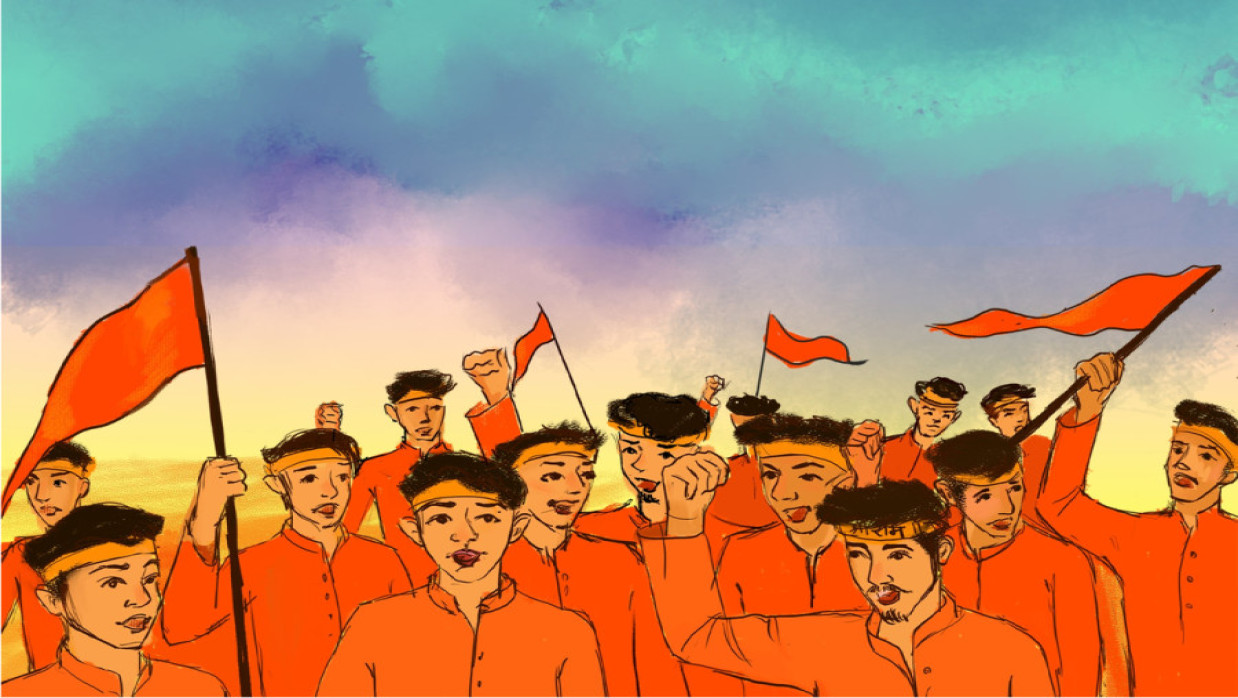
India has long projected itself as a secular republic whose constitutional framework guarantees equality, religious freedom, and non-discrimination for all citizens. The Preamble defines India as a “Sovereign Socialist Secular Democratic Republic,” while Article 14 guarantees equality before the law, Article 15 prohibits discrimination on grounds of religion, race, caste, sex or place of birth, and Article 25 ensures freedom of conscience and the right to freely profess, practice, and propagate religion. Together, these constitutional protections established the normative foundation for a diverse, inclusive, and non-partisan national identity; one in which state institutions, including the armed forces, were to remain secular, apolitical, and professionally neutral.
However, since the rise of Prime Minister Narendra Modi and the Bharatiya Janata Party (BJP) in 2014, this constitutional ideal has come under visible strain. The BJP’s ideological backing by the Rashtriya Swayamsevak Sangh (RSS) has fast-tracked a majoritarian transformation in the Indian state’s identity. Discrimination, exclusionary policies, and intolerance towards religious minorities in India, particularly Muslims and Christians, have been documented by various independent human rights reports. The ideological shift is now, not only remained in civil governance or social institutions, but it has also spread to the bureaucracy, academia, law enforcement, and even, the security establishment.
The Indian Armed Forces, one of the few institutions regarded as apolitical and secular throughout history, have nevertheless been affected by the existing political scenario. Under successive BJP governments, the armed forces have become increasingly exposed to political messaging, majoritarian symbolism, and overt alignment with the ruling party’s ideological narratives. The top brass of the military has made statements that repeated political talking points, openly supported government decisions that were not based on military assessments, and engaged in religious practices and used symbols that were aligned with Hindutva ideology.
The Rise of Religious Symbolism in India’s Armed Forces
The Indian Army’s iconic image has noticeably changed in recent times, its preference reflected in actions that would have been impossible under a purely secular military tradition. In January 2025, the Army Chief’s lounge in South Block replaced a historic painting commemorating the 1971 war; a symbol of professional military achievement with “Karam Kshetra,” an artwork portraying Krishna, Chanakya, and other Hindu civilizational icons positioned alongside modern military hardware. The substitution was not merely aesthetic; it signaled an ideological reorientation in which mythological Hindu motifs were elevated to represent the moral and strategic foundations of the armed forces. This trend was echoed a month earlier when the Fire and Fury Corps unveiled a statue of the 17th-century Hindu ruler Shivaji near Pangong Tso in Ladakh, accompanied by a saffron flag in one of India’s most sensitive military zones. The installation projected an overtly Hindu civilizational identity onto a strategically contested landscape, underscoring how religious symbolism is increasingly being woven into the narrative of national defence. Together, these acts illustrate an institutional willingness to connect military images with the ruling political ideology and thus mix the professional military culture with the narratives driven by the political leaders that are based on Hindutva.
Rituals, Religion, and Political Messaging in Military Leadership
The increasing association of high Indian military officials with obvious Hindu religious practices has put new question marks on the process of institutional secularism decay in the defense sectors. Over the past years, the Chief of the Army staff and other senior officers have taken part in public Hindu rituals more than ever before, and this could be seen as an extremely open and official expression of the change of their personal faith that has gone beyond and overlapped with institutional representation. On the occasion of National Unity Day 2025, the Army Chief was in uniform while receiving a tilak and garland from Hindu priests, which was an attempt to symbolically tie the military’s identity to one religious’ tradition, in this case, Hinduism, and thus uniting it with the rest of the society, which is mostly Hindu. This trend was even more visible in May 2025, when the Chief of Army Staff did a religious tour to the ashram of Hindu spiritual leader Rambhadracharya in Madhya Pradesh, where he was given religious initiation. Such behaviors are hard to distinguish between one’s professional military duty and one’s personal belief, and they strengthen the fear that the top brass is legitimizing the use of religious symbolism in the defense establishment and drawing the institution closer to the Hindutva doctrine propagated by the political elite.
Politicization of Military Operations
The use of explicitly religious Hindu terms for military operations indicates a shift away from the naming conventions that were neutral for Indian Armed Forces. The operations "Sindoor" and "Mahadev" not only bring in their religious connotation but also give an overt ideological dimension, making the link between strategic actions and Hindu symbolism and thus supporting the domestic narratives connected to Hindutva. This trend is further strengthened by the statements coming from high-ranking military officials that closely resemble the hardline rhetoric of the ruling BJP, which includes aggressive threats toward Pakistan. The combination of religious operation names, which are highly charged with political significance, and politically oriented commentary is indicative of a larger trend where the military is increasingly getting involved in a political debate of nationalism that has compromised the institutional neutrality and professional impartiality of India's military which were its defining features in the past.
Institutional Changes and Recruitment Influence
The ideological influences are getting deeper in the Indian Armed Forces due to the recent changes in the recruitment and training structures. The Agnipath scheme, which was introduced in 2022, allows the military to bring thousands of recruits annually, and most of them are reportedly have association with Hindu nationalist organizations like the RSS. Over time, this influx has the potential to shape the values, attitudes, and ideological orientation of future military personnel. Similarly, Sainik Schools, that plays a major role in preparing the future army officers, are continually influenced by Vidya Bharati and the Ram Mandir Hindu movements. The above-mentioned changes indicate a planned move towards the imposition of saffron ideology and gradually altering the cultural and institutional identity of India's armed forces.
Symbolic & Cultural Shifts
The replacement of the historic surrender painting of 1971 war in the Chief of Army Staff’s lounge with a Hindu-themed artwork is a clear indication of the change of ideology in the Indian Armed Forces. This shift was further highlighted on May 25, following the Indo-Pak ceasefire, when the COAS visited the ashram of Hindu spiritual leader Jagadguru Rambhadracharya in Chitrakoot, Madhya Pradesh, while in uniform; an act that drew sharp criticism from senior military observers for breaching the secular and apolitical norms expected of the armed forces. During the visit, the spiritual leader gave diksha (initiation, similar to Lord Hanuman’s in Hinduism) to the Chief of Army Staff and asked him to take Azad Jammu and Kashmir as dakshina (offering). This exchange not only placed the COAS in the role of a military officer of the state but also linked him as a disciple to a religious authority, thereby relating military service to a personal religious duty and raising profound questions about the erosion of professional neutrality.
Religious Bias and Its Impact on Minority Officers
The minority personnel in the Indian Armed Forces consisting of Sikhs, Muslims and Christians, have expressed that they are forced to participate in Hindu rituals, which indicates the rising environment of religious uniformity. Notable cases, such as that of Lt. Samuel Kamalesan, a Christian officer dismissed in 2025 for refusing to partake in such rituals, highlight the institutionalization of these pressures; the Delhi High Court later upheld his dismissal, underscoring the legal and structural backing for such coercion. Beyond isolated cases, minority officers frequently experience professional insecurity, social exclusion, and stagnation in their careers. Although there have been no publicly acknowledged mass resignations of staff, it has been reported that some of the employees have either left or serious to consider quitting the department due to discriminatory practices, which is a clear indication that the situation is becoming more unfriendly to non-Hindu officers.
Human Rights Watch’s Report
Human Rights Watch’s 2025 report documents over 520 custodial deaths and extrajudicial killings in military custody, highlighting the severe consequences of operational practices influenced by ideological shifts. The systematic saffronisation of India’s military; driven by ideological, political, and religious factors is evident in symbolic changes, the politicisation of leadership, participation in religious rituals, the use of Hindu-themed operation names, recruitment patterns favouring nationalist networks, and discriminatory treatment of minority officers. Collectively, these developments have transformed the armed forces into what critics have termed “Modi ki Sena”, undermining the institution’s secular and neutral character and raising profound concerns about its professional integrity and adherence to constitutional principles.
In a nutshell, the preservation of India’s secular character requires the Modi government to prioritise inclusive state-building and equitable development across all ethnic and religious communities. Ending the promotion of Hindutva within state institutions, including the armed forces, is essential to maintain institutional neutrality and uphold constitutional guarantees of equality and religious freedom. Without such corrective measures, the ongoing saffronisation of India’s military and other state organs risks undermining the very fabric of India’s secular society, threatening social cohesion and the stability of its democratic institutions.


0 Comments
LEAVE A COMMENT
Your email address will not be published