

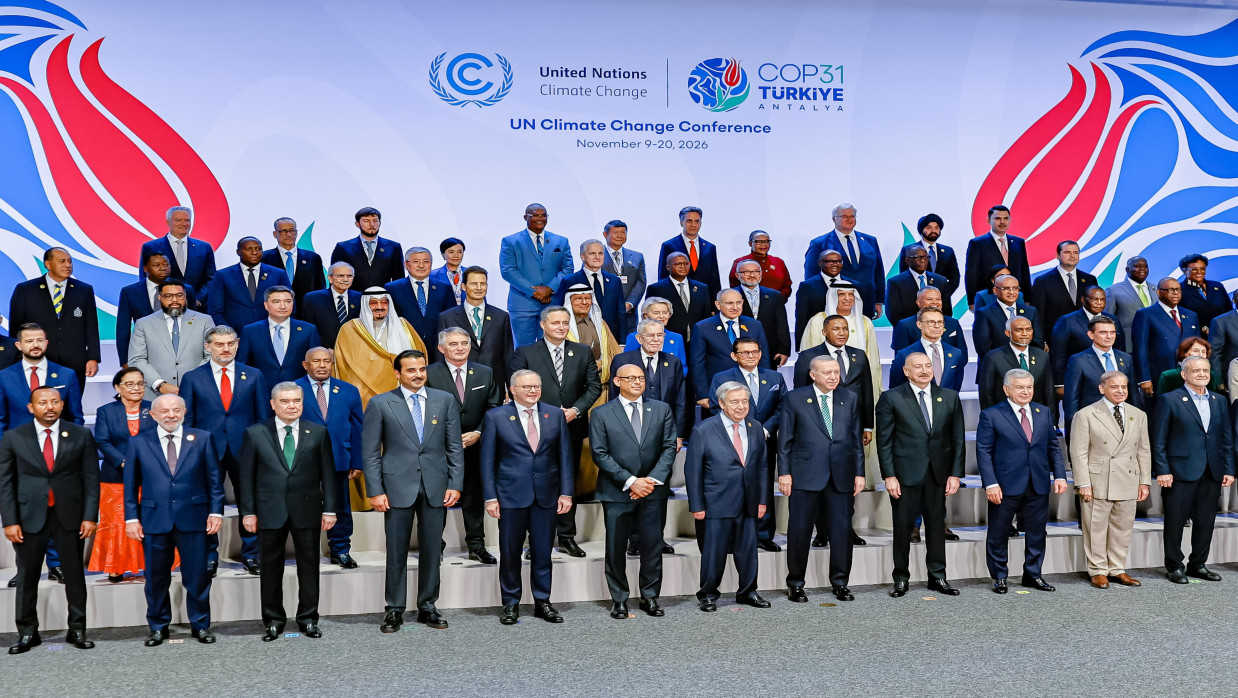
Every year, climate talks end with the same gap between what countries promise and what they deliver. This year this discussion is held at COP31, which is the 31st annual session of the Conference of the Parties to the United Nations Framework Convention on Climate Change. Since 1995, these Summits have served as the supreme decision-making body of global climate agreements. From 9 to 20 November 2026, the Republic of Türkiye is hosting the session in Antalya. Delegations, negotiators, scientists and civil society groups from all over the world have gathered to address climate challenges. Türkiye’s Environment Minister Murat Kurum holds the presidency, while Australia’s Climate Change and Energy Minister Chris Bowen oversee negotiations under a co-presidency. The agenda is to fight the challenge of climate change and for that the world must find the ways to cut emissions from fossil fuels, expand clean energy, overcome financial and infrastructure barriers to protect people from rising heat, and feed a growing population on a warming planet. These problems are closely linked and it is not a problem of one or two countries rather entire world and human population is at stake. To address this challenge, it is imperative to contemplate all the available options because no single technology can solve this issue. Nuclear science and technology is a one set of tools that is often left out of the debate of climate change which has already improved agriculture, medicine, water management, and industry. Together with the wider work of the International Atomic Energy Agency (IAEA), nuclear technology can make a real and measurable contribution to the problems related to climate change.
On the second day of the COP31, global energy transition took the central stage where countries tried to explore the ways to move away from fossil fuels. Fossil fuels remain the largest source of greenhouse gas emissions, and electricity demand keeps rising because of industry, cooling needs and data centres. Wind and solar sources are growing quickly, but they depend on weather and daylight cycle. Against this backdrop, it has become imperative to incorporate nuclear technology to produce electricity because nuclear power offers reliable, large-scale base-load electricity with a carbon footprint. The numbers are in favor of nuclear energy and they show the scale. At the end of 2025, 413 nuclear reactors were operating worldwide, with a combined capacity of 377.1 gigawatts electric. In September 2026, the IAEA raised its nuclear power projections for the sixth year in a row. In its high case, capacity reaches 1,045 gigawatts by 2050 and 1,284 gigawatts by 2060, about 3.4 times the 2025 level. Even the low case projects 696 gigawatts, nearly double today are capacity.
The IAEA is an international body that helps turn these projections into plans. It gives countries technical guidance, capacity building and peer review services to strengthen the infrastructure that safe, secure and sustainable nuclear programmes require. This matters most for newcomer countries, which often lack the regulatory and technical base to start. Furthermore, there is also an option of Small Modular Reactors that offer flexible options for small or remote grids, energy-intensive industries and data centres. Fusion energy is also another promising technology with the potential to provide reliable source of energy that could contribute to diversify electric generation in long term. This technology could produce about four times more energy per kilogram of fuel than fission, but it is a long-term prospect.
The other agenda on the table is rising global temperature. The World Health Organization estimates that between 3.3 and 3.6 billion people live in areas highly vulnerable to climate change and rising temperature. Extreme heat, floods and shifting weather patterns have already put lives at risk and strain health systems. Nuclear technology helps in two ways: it reduces the emissions that drive warming, and it supports adaptation to the damage that is already under way. On the first point, every unit of electricity that is generated from a reactor instead of a coal plant lowers emissions. Secondly, heat waves (that occur amid rise in temperature) require stable power grids when hospitals, water pumps and cooling systems need electricity most. A stable source of firm power makes those systems more dependable.
The IAEA, furthermore, offers practical science for adaptation. Glaciers are melting and disappearing in many mountain regions, which threaten water supplies for millions of people. For that the IAEA introduced the use of cosmic ray neutron sensors and isotope hydrology to monitor soil moisture and water availability at high altitude. These tools can help decision makers to judge how loss of glaciers affects water resources and it also help in plan land management. In 2026, the agency also launched a research project that applies artificial intelligence to isotope hydrology to fill data gaps and improve water forecasts. Additionally, to protect marine ecosystem and reduce ocean pollution, the IAEA’s Marine Environment Laboratories support blue carbon work on mangroves, seagrasses and saltmarshes, which store organic carbon in coastal sediment. These ecosystems cover roughly 50 million hectares. The Isotopic methods help countries measure how much carbon they store and how healthy they are. These habitats also protect coastlines from erosion and storm surges, and they also filter ocean pollutants. Apart from these, the IAEA promotes electron beam technology, a chemical-free way to break down complex industrial pollutants in wastewater. A transportable system launched in 2025 at the agency’s laboratories in Seibersdorf, Austria, is used to train experts from many countries.
Food security is another important agenda on the COP31. Food and agriculture produce roughly one third of global greenhouse gas emissions, and they are also highly exposed to climate change. Rising temperatures, droughts and floods threaten crops and the livelihoods of millions of farmers. To address this challenge, nuclear science and technology can be utilized as a farming tool. Through the Joint FAO/IAEA Centre of Nuclear techniques in Food and Agriculture, the IAEA helps countries build plant breeding capacity. Radiation induces mutations in plants, allowing breeders to select new varieties with higher yields, better quality, and stronger tolerance to disease, pests and environmental stress. These new varieties can contribute to more robust and sustainable food supply that can handle hotter and drier conditions.
Isotopic methods also help countries adopt climate-smart agriculture, which raises productivity while building resilience. Pests are another problem that can impact crop production. Up to 40 percent of global crop production is lost to plant pests and diseases. The Joint Centre leads global efforts on the sterile insect technique, which uses radiation to sterilize male insects. When these males mate with wild females, pest numbers fall. The method protects crops without heavy use of chemical pesticides. Finally, FAO and IAEA are also collaborating to utilize nuclear techniques that can help monitor and control livestock diseases, supporting early detection and vaccination programs. The IAEA coordinates the Veterinary Diagnostic Laboratory Network, which links national laboratories across Africa and Asia, with plans to expand to Central and Eastern Europe, the Caribbean and Latin America.
The climate related issues that have been discussed above are at the centre of COP31 and they are connected. Fossil fuels drive emissions, emissions drive heat, and heat endangers food and water. The evidence shows that nuclear technology has a role at every step. Nuclear power offers steady, low-carbon electricity, and the IAEA’s own projections show that even its low case nearly doubles capacity by 2060. IAEA science helps countries manage water, protect coasts and treat polluted water. Its work with the FAO improves crops, controls pests and protects livestock. None of this makes nuclear technology a cure-all technology and costs, construction times and waste management are real challenges, whereas fusion energy remains a long-term hope. The sound conclusion is that: a credible climate strategy needs every proven low-carbon tool, and nuclear technology has earned its place among them. Negotiators in Antalya should treat it as a partner to renewables and support the financing, safety standards and institutional capacity that allow it to deliver.


0 Comments
LEAVE A COMMENT
Your email address will not be published