

BOOK REVIEW & GEOPOLITICAL ANALYSIS
Matthew Cole’s explosive investigation raises troubling questions about secret diplomacy, financial influence, authoritarian alliances, and the erosion of democratic accountability in American foreign policy.
He raises many questions that need answering. About hidden back channels, money, and dictators. How this affects the US as a whole.
The Middle East has always been a hot spot for world powers to fight over. Oil, power, religion, and America have all played a role in this region. There may have been something else going on when we sit at the table with these countries. Hidden back channels of money and personal gain from some of these individuals who hold significant power in their own countries.
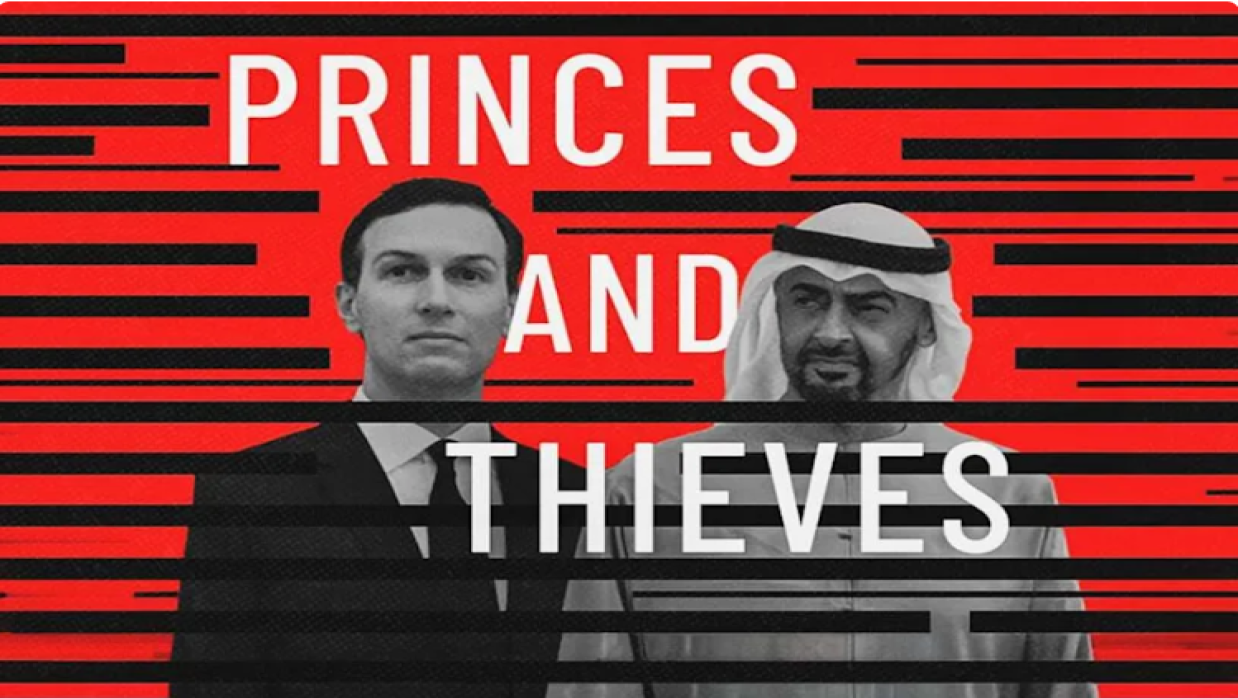
Matthew Cole is a reporter who recently wrote a book called Princes and Thieves: Jared Kushner and Mohamed bin Zayed's Secret Plot to Remake the Middle East. Atria/One Signal Publishers released the book in October 2026. It goes into detail about Jared Kushner and how he helped 2 dictators from the Middle East take over our foreign policy. These individuals were King Mohammed bin Salman of Saudi Arabia and Mohamed bin Zayed of the UAE.
Not only did they work together, but they helped shape our foreign policy to benefit their country. They may have even done so without telling our government. If these claims are true, we should ask many questions about how the United States is being run.
How Did Jared Kushner Get So Much Power?
Jared Kushner came to the White House with no experience in politics or international relations. Despite this, Donald Trump let him help negotiate with many countries, including Israel and Palestine.
His position as senior adviser did not require Senate confirmation, although he remained subject to federal ethics and other applicable laws.
Kushner developed particularly close relationships with MBS and MBZ, two ambitious leaders seeking to transform their countries into dominant regional powers.
Both viewed Iran as a principal strategic adversary. They also opposed political movements associated with the Arab Spring and increasingly regarded cooperation with Israel as advantageous.
Kushner appeared to share much of this strategic outlook.
Cole argues that this relationship opened up another back door for the Gulf states to sway US policy. without being directly in the policymaking sphere.
Secret Money
One of the more shocking revelations Cole brings to light is the alleged secret money. That may have been funneled into accounts that Kushner had access to.
These secret accounts, supposedly known as alpha and beta, would allow money to flow to covert political, intelligence, and strategic interests.
These are huge allegations. There needs to be documented evidence of these accounts existing. And that they were controlled or used by anyone for any of these reasons. Just because its stated in a book does not make it fact.
Nevertheless, a documented financial relationship has already generated considerable controversy.
After Kushner left government service, Saudi Arabia's Public Investment Fund committed approximately $2 billion to his private equity firm, Affinity Partners, despite reported concerns among the fund's investment advisers.
The transaction prompted questions from American lawmakers about whether Kushner's previous diplomatic relationships had created opportunities for subsequent private financial benefit.
A controversial investment, however, does not itself establish bribery or prove that American foreign policy was purchased.
This needs to be clear when digging deeper into these issues.
Qatar
As mentioned before, Qatar also got caught up in this. In 2017, the Saudis cut ties with Qatar, along with the UAE. They accused Qatar of harboring extremists and having too close of ties to Iran. Qatar denied these charges.
President Trump initially appeared sympathetic to the blockade, even though Qatar hosted Al Udeid Air Base, a critical installation for American military operations.
Cole alleges that Kushner encouraged the Saudi-Emirati position while other American officials sought to resolve the confrontation.
At the same time, Kushner's family business faced financial pressures involving its Manhattan property at 666 Fifth Avenue. The subsequent restructuring of that property, involving Qatari-linked investment, generated allegations of potential conflicts of interest.
Whether these developments were causally connected remains disputed. Nevertheless, they illustrate the dangers when personal commercial interests overlap with sensitive diplomatic responsibilities.
Israel, Iran, and the Marginalization of Palestine
The geopolitical consequences of the Kushner-Gulf relationship were substantial.
The Abraham Accords of 2020 established diplomatic normalization between Israel and the UAE and Bahrain, followed by additional agreements involving Morocco and Sudan.
They saw these as great diplomatic milestones. Many felt that there was no resolution to the Palestinian people wanting their own country and self-determination.
By building stronger ties with Israel, MBZ and MBS could work together against their common enemy, Iran.
Cole portrays these arrangements as elements of a larger effort to reorganize the regional balance of power around an informal alliance of Israel, the Gulf monarchies, and Washington.
The continuing devastation in Gaza has exposed the limitations of a diplomatic strategy that treats Palestinian aspirations as secondary to regional security and economic integration.
Intelligence, Mercenaries, and Authoritarian Power
Cole delves further into how spies and private military companies were involved.
Says Dutch spies got info off of Kushner's hacked phone, which he says showed payments to and communications with people in the Gulf.
Also speaks about Private Military Company figures such as Erik Prince, founder of Blackwater, and claims that they paid for guns in Libya.
All of this has not been proven to be 100% true. Kushner denies all of Cole's claims, and his lawyers have disputed some of his claims, saying there was no such account.
The broader record of authoritarian repression in the Gulf, however, raises legitimate questions about the human rights implications of Washington's regional partnerships.
American policymakers cannot credibly promote democracy and accountability internationally while disregarding abuses committed by strategically valuable allies.
A Test of American Democratic Accountability
The most important issue raised by Princes and Thieves extends beyond Kushner's personal conduct.
Can a democratic government maintain institutional integrity when foreign policy becomes concentrated in the hands of politically connected individuals operating through informal relationships with powerful foreign rulers?
Cole's story needs further investigation. These claims should be backed by financial and intelligence evidence, as well as statements under oath.
Congressman Jamie Raskin asked Kushner to step aside from any negotiations he may have financial gain from. At the end of October 2026. It's important that these measures are put into play.
Ultimately, the book raises a question that reaches far beyond the Trump administration: Who determines American foreign policy the elected government and its accountable institutions, or an exclusive network of wealthy political insiders and foreign rulers?
The answer will determine not merely how history judges Jared Kushner, but whether the United States can preserve the distinction between national interest, private enrichment, and foreign influence.


0 Comments
LEAVE A COMMENT
Your email address will not be published