

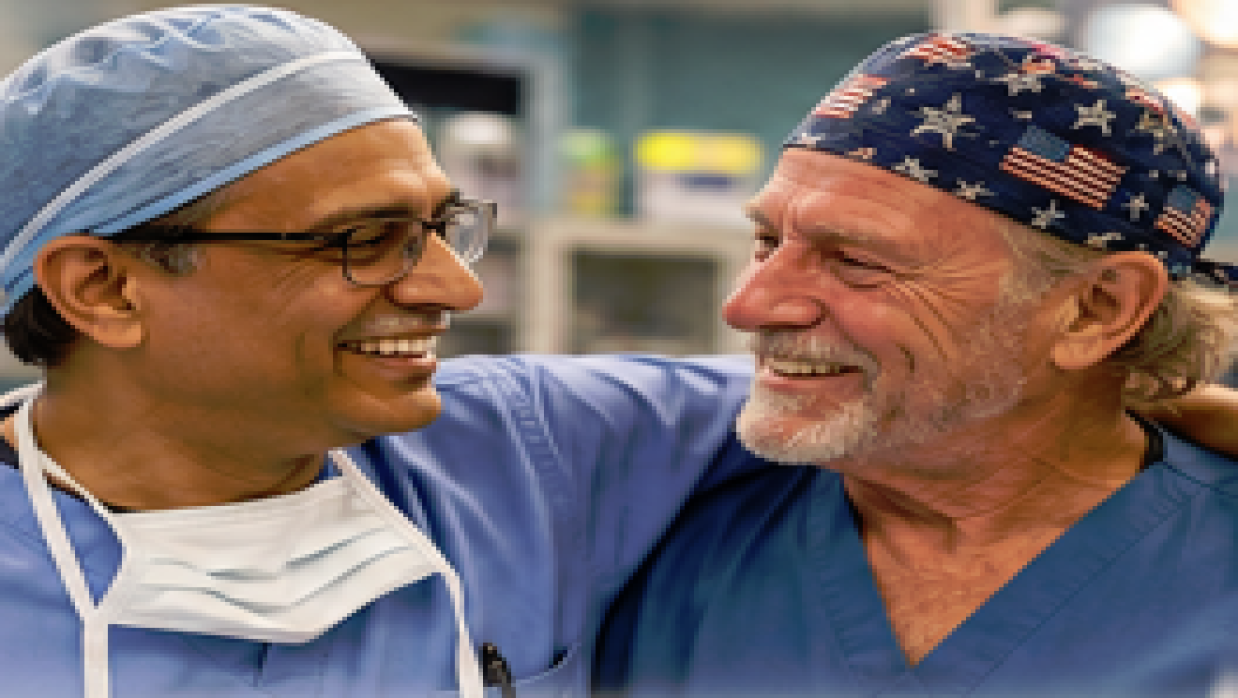
I met Joe early in my practice. I was new on the hospital staff. No one knew me. I looked different; I had an accent, and my name sounded strange to them. I was one of three foreign-born attending surgeons, and I was the newest. Most docs in the hospital hardly talked to me, except for a few chin nods. I scrounged for patients through the ER, most of whom had no insurance. Joe was already a surgical tech and my first assistant. He noticed I had only a few cases on my surgical block. He said, "Dr. Sobhan, why don't you come to our community picnic? I will introduce you to some folks." I was apprehensive but went. Joe introduced me as his long-lost friend, though he'd just met me. He paid glowing tributes, saying I was an ace surgeon, etc. I told Joe later, "Joe, were you not exaggerating a bit. You just scrubbed with me once?" Joe said, "Dr. Sobhan, I said that so you don't prove me wrong." I said, "Joe, you are raising the bar quite high." "And Joe, please call me Ajmal." "OK," said Joe. Don't let me down now. That relationship lasted more than 40 years.
He was a happy-go-lucky surgical tech, very skilled as a first surgical assistant, adept at closing a wound after the job was done. Though some surgeons would get impatient over small issues, Joe kept his cool and rarely returned the favor. Joe was such a good assistant that most surgeons would vie for his service when starting a case. He was as good in trauma cases as he was in plastic reconstructive cases. Back then, he was one of the few male techs who worked in the OR. He had a pleasant Southern twang to his voice and had a heartfelt smile, which I liked very much. His demeanor was refreshing amid the tense drama that often unfolds in the OR.
Joe was born in rural North Carolina. His parents were farmers. They raised cattle and pigs. But they didn't have much acreage. Joe learned all the day-to-day chores needed to run the farm. His parents got ill early in life and could not maintain the farm. Joe also eventually got tired of the physical labor. He decided he needed to move. He had some friends that had already moved to the Tidewater area of Virginia, so he moved there himself in the summer of 1971. He was 22.
Joe was his parents' only child. He knew he had to take care of his folks but could do a better job if he found work in Norfolk or Newport News. He had an uncle and a few cousins but none that could help his mom and dad.
He was always interested in helping the sick. No wonder he was a good caregiver to his ailing parents. A friend of his said to him, "Joe, you have a great passion to help the sick! Why don't you consider getting a job in the hospital?" Joe only had a high school education. He therefore needed a skill to earn a decent living. So, he registered himself in a tech school. After finishing school there, he enrolled in LPN school (licensed practical nurse). He sailed through nursing school and finally landed a job as an OR tech/nurse at the hospital. He loved it. He made enough to support his parents back in North Carolina.
Joe never married. He was always there for people who needed help in some form or another. Joe bought a small house in Newport News. Two doors down from his place lived a family with one son. His name was Albert. The parents had disabilities and were living from hand to mouth with Social Security assistance, SNAP, and other benefits. Albert had bipolar disorder and was getting special education at home. The family was just not doing well, could not keep up with Albert's meds, and they were beside themselves about how to manage.
The parents finally decided to go back to the Carolinas but didn't know how to deal with Albert. Besides his mental issues, Albert was getting into trouble. He was being bullied. He started smoking pot and misbehaving. He got into trouble with the law for minor offenses.
Joe watched silently, intervening only when needed. Joe thought over the troubled situation with Albert and his family. He finally sat down with the three of them. "Albert can choose to live with me if you guys want to go back to NC. There are strict rules that he would have to follow, though." Albert did not want to go back with his parents. Joe was his only chance to keep living in Newport News. "Well, Albert, can you live with Joe's rules or not? Otherwise, you are going with us!" said the parents. "Well, what does Joe want me to do?" asked Albert. Joe looked Albert in the eye and said sternly, "No smoking, no drinking, curfew at 10 p.m., no cussing, do all the dishes, and keep the house clean." Albert listened and walked out of Joe's house. His parents went after him. They brought him back. Joe wouldn't take any crap from Albert. He relented and, at last, agreed to go along with Joe's demands. "OK, Joe! You are the boss. "
Albert's parents were very relieved to hear that from their son. They thanked Joe for volunteering to take charge of Albert. They felt Joe was God-sent. Albert's parents finally left for the Carolinas soon after making Joe Albert's legal guardian.
Albert lived with Joe for almost 30 years. Joe became his legal caregiver after Albert's health started deteriorating. Joe received a small stipend from Social Services for caring for Albert. Albert continued to receive all other federal benefits (SS, SNAP, Food stamps). Meanwhile, Joe worked full time at the hospital and at the plastic surgeon's office performing procedures.
Keeping track of Albert and tending to his needs became increasingly stressful for Joe. Albert developed a neuromuscular disease and soon became wheelchair-bound. As he turned 48, his condition kept getting worse. He was losing his voice, and his muscles were wasting away. Joe was determined to do his part, having assumed a solemn responsibility for Albert.And yet Albert’s metal faculties were sharp
Joe had bought a gun first for his own protection. He took some training on how to use a gun. It was a revolver/ pistol. He usually kept it under lock and key. One day, he forgot to lock it, and Albert got it. He was playing around with it when an alarmed Joe noticed it. "Hand me the gun, Albert! You don't know how to operate it!" "Sure!" said Albert playfully. He pulled the trigger, pointing at Joe's legs, not knowing there was a single bullet still in the gun. The shot went through one of Joe's legs and lodged in the other. Joe felt nothing initially when the shot was fired, but a sharp pain soon ensued. Joe fell to the ground. Albert got deathly scared and started wailing, "Joe, I didn't mean to shoot you! Really, I didn't! "
Joe didn't say a word and called the EMTs. They arrived within minutes and whisked him away to the ER. The ER doctor got some X-rays, checked his pulse, and started an IV. The surgeon came in and said, "You are a lucky man, Joe! The bullet missed your femur, the femoral artery, and the nerve trunk. It's lodged in the soft tissue and is causing no harm. Under these circumstances, we are not going to try to retrieve the bullet. You should be able to go home with antibiotics and dressings." The police came looking for Joe at the hospital and interrogated him. "Well, Joe, how did this all happen?" Joe insisted that it was an accident and that Albert did not try to shoot him deliberately. "Are you saying you do not want to press charges against him?" "Yes," said Joe. Joe came back home. He said nothing to Albert. Albert was remorseful. "Joe, this will never happen again, I promise!" Joe kept mum.
Albert held a job only for short periods. After he started using a wheelchair, he remained mostly at home. His condition progressively got worse. Joe had to hire a nurse to care for him while he continued working at the hospital.
About eight years ago, Albert suffered a massive stroke and died at home. Joe didn't even know when he passed. Joe woke up that morning and found Albert lying on the floor, still warm but dead. He called an ambulance, and they took Albert to the ER. He was already dead, so he was soon moved to the funeral home.
Joe had cared for Albert for 30 years. Albert was no kin to him. He did it without question. I asked Joe what made him take on such an onerous responsibility, even after he knew that it would be so hard. "I never thought about it! When I first saw Albert and his parents, I knew they would need help sooner or later. And I just wanted to help. It was not something special! I felt Albert needed a guardian when his parents could no longer help him. I never thought twice about it. I knew what God wanted me to do, and I did it. It was actually God in charge! I was following His orders! "But Joe, you don't even go to church!" "The church has nothing to do with this! I just felt this was my calling. If I could help a family, I would!" "Looking back, Joe, do you have any regrets in your life - not having your own family and children?" "No, I don't! Albert became a son to me. I did not need any family."
A few days ago, Joe called me, "Hey Ajmal, I need to have cataract surgery. Can you please take me to the hospital? If you agree, you will have to do it twice, 'cause I have two eyes! But you don't have to! But if you do, I'll pay your gas money and any fee you may have in mind." I said I would do it gratis.
Joe got his cataracts done. He just turned 79 and is as happy as ever! He goes to the same gym that I go to. He walks the treadmill while I run. "Ajmal, why do you run so much? What are you running from? You look like you are torturing yourself by running!" "Joe, running is my meditation in motion; it keeps me sane!"
Joe continues to do community work, volunteering at the hospital where he worked earlier. He is happy and cheerful as ever.
About six months ago, I got a call from the hospital. "We have a patient here who is semi-comatose. His wallet had three names: two with NC area codes, and one local. The two in NC are not responding to our calls. You are the third one, and you are close to home.
The patient has a ruptured appendix and is in diabetic crisis. He will need surgery, but we have to get his sugar under control. We need consent to proceed. I said, "I am not kin, only a friend; how can I give consent?" "Well, we do not have a choice; you are the only one who can help him"
I knew the folks in NC were his relatives, but they were quite elderly. Joe had shared their numbers with me. I tried calling them. No one answered. I told them, "I am a retired doc; I know he needs the operation; I can only say I agree with going ahead." The hospital attorney also agreed that my consent was close enough.
Joe underwent surgery and would need to stay till his sugar was stable and IV antibiotics could be stopped. The next day I went to see him. He was awake but barely. He looked at me and said, "Ajmal, what happened?" I had this sharp pain in the belly, and I called 911 and passed out. I told him what had transpired.
Joe finally went home and recovered slowly. I would go by and help him as best as I could. One day he said, "Ajmal, I need to talk to you about something serious. I want you to be my POA (power of attorney)." I said, "Hold on, Joe, I am not your kin." Joe said, I have told my lawyer about it. I have a living will, an advance directive, and I have already written off my assets to the Food Bank, Animal Aid, and the Peninsula Agency for Aging on my passing. "Joe," that's all very good. But you know when you die, and you have assets, relatives that you did not even know you had may start falling out of the woodwork." It may get messy if you put my name in. "I don't care, Ajmal, I need you to do this for me." I finally agreed, with some trepidation.
Joe recovered, but his health started failing, and I knew he was going downhill.I am not sure how long he will be with us. I tried to be with him as much as I could.
In one of his reflective moments Joe said: Ajmal, sometimes I wonder what made the Lord bring us together. I am a country hick from NC and you are a doc from Bangladesh, we could not be more different. But I am glad our paths converged.
Over the years, I learned a lot from Joe. I learned that you don't need to be a rocket scientist or a brain surgeon to serve humanity and still be happy. One can live a simple life and, in the process, help one's neighbor. A life of purpose need not be something grandiose, but only simple, like being your "brother's keeper", for example. Joe amply typifies it.
His humility and selflessness are a shining example of what some men can be.

0 Comments
LEAVE A COMMENT
Your email address will not be published