

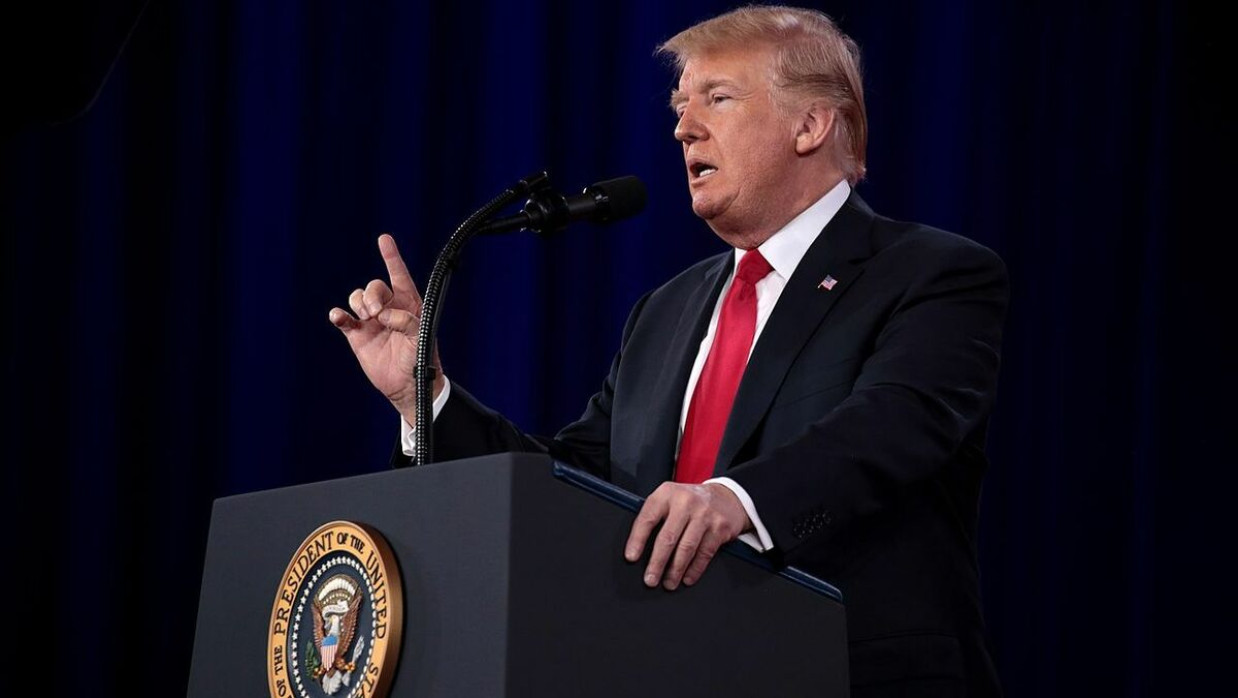
Strong presidential powers mean we must assess the temperament, judgment, and mental stability of those who seek to lead our country. Forensic psychiatrist Dr. Bandy X. Lee made this chilling statement about President Donald Trump on a recent episode of The Weekend Show. Dr. Lee appeared on the Sept. 7, 2026 episode to talk about her disturbing findings on President Trump’s psychological well-being, particularly his lack of control of his emotions.
The program, hosted by journalist Anthony Davis and distributed through the MeidasTouch Network and Five Minute News, introduced the discussion as the beginning of a series titled "The Nuclear Threat of Donald Trump." Its published description states that Lee believes what she characterizes as Trump's "dangerous psychopathy" threatens both the United States and the wider world. The program also carries a disclaimer that guests' views do not necessarily represent those of Davis or Five Minute News. Lee's psychiatric conclusions should therefore be understood as her professional opinions, expressed in a political interview, rather than as an official medical determination.
Davis began by comparing Trump's administration with his current one. Quoting officials who sought to temper presidential impulses during Trump's first administration, Davis noted that "the difference really is adults in the room, isn't it?"
His loaded question framed an interview that explored whether institutions Trump knows how to work within can function when he chooses senior appointees for personal loyalty above all else and when fewer advisers feel empowered or compelled to question the president's requests.
Lee argued that even though Trump posed a danger to national security in his first term, certain senior officials were able to temper him to some degree. Lee highlighted reports that former White House Chief of Staff John Kelly used The Dangerous Case of Donald Trump, the 2017 book Lee edited, as a guidebook to interpreting and mitigating the president's behavior. Lee suggested that the reported incident showed that psychological expertise can help officials identify patterns of impulsivity, victimhood, and aggression so they can anticipate and stop those impulses from developing into national-security emergencies. Other authors have repeated the claim that Kelly used the book like an "owner's manual," but it's hard to verify how much the book affected any specific decision.
Lee's warning is so dire now, she says, because she believes Trump's condition has worsened and the restraints on him have loosened. She ticks off what she views as a volatile mix: "narcissism; cognitive decline; psychopathic tendencies; impulsivity; and inexplicable fragility around the issue of humiliation." This is Lee's language; she hasn't assessed Trump, and he has declined again and again to answer questions about his mental health. No clinical assessment known to the public has confirmed any of the diagnoses she raises.
For Lee, the question isn't whether Trump behaves oddly or offensively. The question is whether a commander in chief who unleashes violent anger when he feels betrayed, defeated, or dethroned can responsibly control immense military power in a crisis. This fear spikes when she thinks about nuclear weapons. As the Congressional Research Service has written, the president "solely" can order their use. Orders must follow "normal chains of command" and be lawful. The system allows a president to respond swiftly in the event of an attack. But that quick response means immense power rests with one person.
Lee believes traditional political science can't properly account for this risk. Leaders don't always weigh costs and benefits objectively, she says. They may instead be driven by ego, a desire to retaliate, or a need to prove who's in charge. The risk isn't just purposeful violence. It's also poor decision-making, susceptibility to influence, and the inability to hear bad news.
Lee also focuses on what she calls "Trump contagion." By this, she means the process by which a leader's emotional functioning and pathological beliefs infect a political movement. Leaders may normalize hate, disdain for reality testing, and paranoid fantasies. Others might then mimic those behaviors, while organizations and media begin to shift toward what was previously unthinkable. Lee said in a previous interview that Trump is "much deteriorated" and that his symptoms have "spread" to parts of the population.
She relates this process to trauma bonding, a form of attachment seen in abusive relationships. Lee has proposed that followers who feel like their livelihood is attacked, their dignity assaulted, or their values rejected may begin to form an emotional dependency on someone who appears to offer safety and deliverance. The leader, of course, needs followers to adore him and comply with his demands. The relationship can be hard to break, leading people to discount information that doesn't align with the leader's narrative because leaving may feel like losing their identity, community, and sense of hope.
The interview tackles one of these questions head-on, at the cost of landing herself in hot water with the psychiatric establishment. The American Psychiatric Association's Goldwater Rule states, "It is unethical for a psychiatrist to provide a professional opinion about public figures whom they have not examined, and from whom they have not obtained permission to do so." The APA's statement goes on to say that "psychiatric diagnoses made from a distance through the media" undermine the integrity of the profession, and further stigmatize those living with mental illness.
Psychiatrist Bandy Lee has chosen, deliberately and publicly, to break that rule. She acknowledges that the ethical standards she violated were put into place for reasons still valid today. She challenges, however, the notion that they should muzzle mental-health experts who believe the country is in imminent danger. She draws a distinction, in her interview and subsequent statements, between a patient's clinical diagnosis and an evaluation of dangerousness based on a long pattern of publicly available behavior. If doctors are prevented from speaking out about a sitting president's potentially dangerous conduct, Lee argues, they shirk their civic and professional duty to protect the public from harm. Critics have replied that a diagnosis disguised as a "dangerousness assessment" is still a diagnosis, and that political judgments can easily masquerade as professional observations without the check of full clinical access. The takeaway for readers should be that these views are contested, even within psychiatry.
More helpful than the flawed psychiatric conclusion is the dialogue about leadership and limitations the interview raises. Would our constitutional and military safeguards hold up under irrational presidential behavior? Do we want elected officials and presidential candidates to undergo open, independent mental evaluations? Would federal employees be permitted to disobey an order they knew to be deadly or illegal without jeopardizing their careers and incomes before the system catches up with them? You don't have to agree with Lee's diagnosis to consider these issues. They raise concerns about the risk we invite when a democracy places the levers of massive violence in one individual's hands and trusts too heavily in that individual's self-restraint.
Lee finishes with a note of optimism. Education, accountability, stronger institutions, and awareness of manipulation tactics can help make our society less vulnerable, she says. But do not read her interview as if it were a clinical diagnosis submitted to Donald Trump's doctors. Read it as a warning, from a psychiatrist who has studied violent patients for years, about the limits of those doctors' influence over a president. Consider her central argument, independently of her profession: When incredible power is centralized in a single political office, the mental fitness of its occupant matters more than most of us would care to believe. It affects our constitutional system, our national security, and our survival as a species.

0 Comments
LEAVE A COMMENT
Your email address will not be published