

Book review
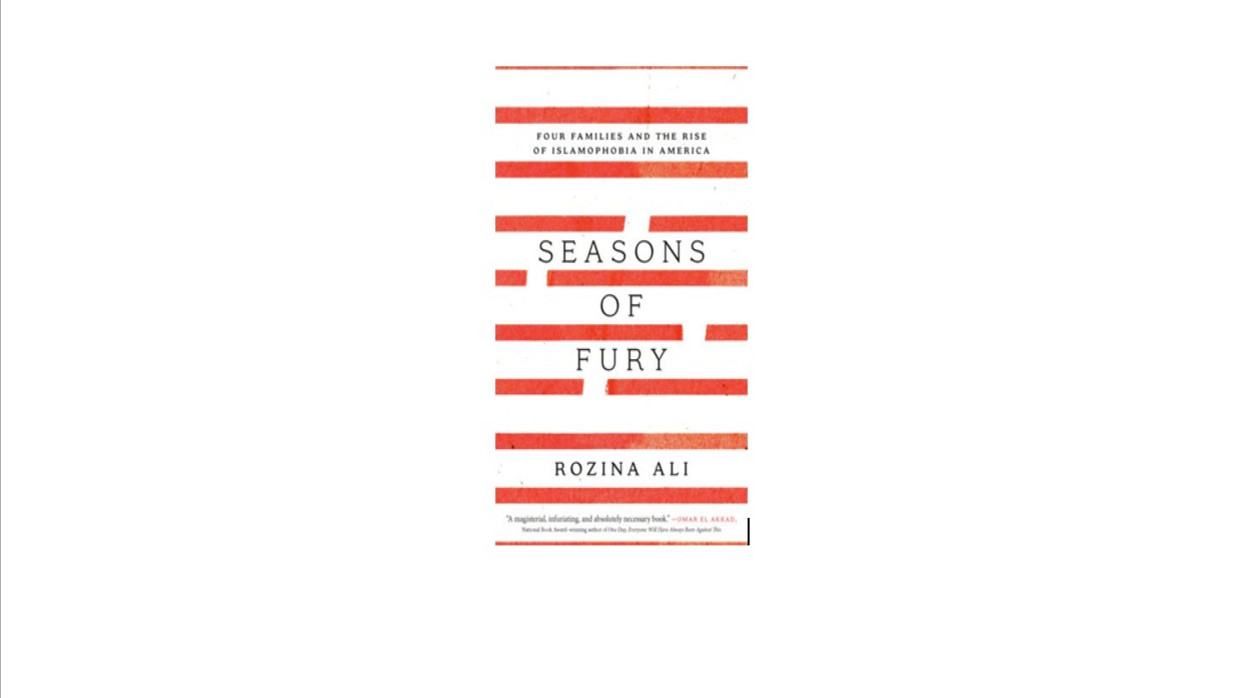
The most disturbing argument in Rozina Ali’s Seasons of Fury: Four Families and the Rise of Islamophobia in America is that the systematic targeting of Muslims in the United States did not begin with the attacks of September 11, 2001. The War on Terror greatly intensified surveillance, detention, and discriminatory policing, but it did not create the attitudes that allowed those practices to take hold. Rather, 9/11 gave the government an unprecedented opportunity to act upon fears and suspicions that had been developing for decades.
Ali, an investigative journalist and contributing writer for The New York Times Magazine, traces this history through the experiences of four families over approximately eight decades. This narrative structure gives the book much of its emotional power. Instead of treating Islamophobia merely as an abstract ideology or a collection of government policies, she shows what it does to individual lives. Behind every surveillance file, terrorism prosecution, and political accusation is a family forced to endure suspicion, humiliation, separation, or imprisonment.
The book challenges a comforting national narrative. The United States presents itself as a country founded on religious liberty, equal citizenship and constitutional protection. Yet Ali documents how readily those principles have been weakened when Muslims, Arabs and political activists have been portrayed as threats to national security. The resulting history is not simply one of prejudice among ordinary citizens. It is also a history of government agencies, courts, politicians, research institutions and media organizations contributing intentionally or otherwise to the construction of Muslims as permanent outsiders.
A History Older Than 9/11
Ali begins with the Jabara family, whose experience exposes how deeply anti-Arab surveillance predates 9/11. The family appeared to embody the conventional American ideal of assimilation. Its patriarch served in the U.S. Army and participated proudly in civic organizations in his small town. Yet the family’s patriotism did not protect it from official suspicion. Following the 1967 Arab-Israeli War, Arab Americans who became politically active in support of Palestinian rights increasingly attracted the attention of federal law-enforcement agencies.
Mosques were infiltrated, activists were interrogated, and political advocacy concerning Palestine was frequently viewed through the lens of foreign allegiance and national security. As Ali shows, government investigations were not always based on evidence of illegal conduct. Political beliefs, religious associations, and support for Palestinian rights could themselves become grounds for investigation. Dissent was treated as bordering on disloyalty.
Abdeen Jabara, an attorney and civil-rights activist, becomes a central figure in this part of the narrative. Through his experience, Ali shows how advocacy for Palestine drew Arab Americans into an expanding surveillance regime. She also connects domestic Islamophobia to American foreign policy in the Middle East. The Israel–Palestine conflict was not confined to diplomatic exchanges or debates in Washington. It had tangible consequences for whether Arab and Muslim Americans were treated as citizens entitled to First Amendment protections or as potential agents of a foreign cause.
This is one of Ali’s most important contributions. She shows that Islamophobia did not develop solely from religious hostility. It emerged from an interlocking system of racial stereotypes, geopolitical anxieties and national-security doctrines. Arabs were often assumed to be Muslims regardless of their actual faith, while Muslims from widely different racial, national and theological backgrounds were collapsed into a single suspect category. Political conflict abroad helped define the boundaries of citizenship at home.
The other families, including those of Mohammad Ali Chaudry, Shahina and Matin Siraj, and the pseudonymous Omar family, extend this history across different periods and circumstances. Together, their experiences allow Ali to demonstrate that government suspicion did not fall upon one uniform Muslim community. It affected immigrants, citizens, professionals, activists, parents, and children in different ways. What links their stories is how easily religious identity, political expression, and foreign association could be transformed into evidence of questionable loyalty.
The Architecture of the War on Terror
The book’s chronological scope shows how measures adopted before 9/11 prepared the ground for what followed. During the 1990s, the legal definition of terrorism expanded, immigration enforcement took on greater national-security significance, and the government gained stronger tools to restrict organizations accused of foreign connections. In each instance, barriers to government intervention were lowered, sometimes even when those targeted had neither committed nor were preparing to commit an act of violence.
Following 9/11, these authorities expanded at breathtaking speed. As Ali documents, mosques were surveilled, informants were inserted into places of worship and community organizations, and immigration violations were used to justify preventive detention. Thousands of Muslim men were interrogated or detained under conditions of limited transparency. Entire communities were encouraged to regard ordinary religious and political activity with suspicion. The presumption of innocence began to give way to an expectation that Muslims must repeatedly prove their loyalty.
Popular culture, political rhetoric, and the national-security priorities surrounding U.S. policy in the Middle East reinforced this climate. Muslims of vastly different backgrounds were frequently represented as a single threatening population. Ali argues that domestic suspicion was also intensified by narratives surrounding the Israel–Palestine conflict, particularly when Palestinian advocacy was portrayed as evidence of extremism rather than protected political expression.
Her account of Shahina and Matin Siraj provides one of the book’s most disturbing examples of how counterterrorism practices could help manufacture the appearance of danger. Matin, a vulnerable young man, was befriended by a law-enforcement informant and encouraged to discuss an attack on a New York subway station. He neither obtained explosives nor constructed a bomb, and he eventually withdrew from the supposed plan. Nevertheless, he received a 30-year prison sentence.
Ali does not excuse Matin’s words or suggest that discussions of mass violence should be ignored. She instead raises a question of proportionality and equal treatment. To what extent did the informant create or amplify the plot? Would a defendant of another background, displaying similar vulnerabilities and lacking a functional weapon, have been treated as representing an existential threat?
Part of the answer lies in the extraordinary power of the terrorism label. Once applied, it can change how judges, juries, journalists and the public understand a defendant. Conduct that might otherwise be regarded as fantasy, recklessness, mental vulnerability or an inchoate criminal conspiracy is transformed into evidence of a worldwide ideology of violence. The individual is no longer judged solely for what he did; he is made to represent an entire religion and a global political threat.
Ali describes a system that becomes almost Kafkaesque. Harsh imprisonment can justify continued imprisonment. Officials may acknowledge that years of solitary confinement intensify a prisoner’s anger and hostility, yet that resulting hostility can then be invoked as a reason to maintain the confinement. Punishment produces the behavior used to justify further punishment. Rehabilitation becomes nearly impossible when a defendant is never permitted to escape the identity the government has imposed upon him.
The Damage Beyond Prison Walls
The consequences extend far beyond the prisoner. Families are broken apart. Mothers lose sons, children lose parents, and husbands and wives endure prolonged separation. Equally damaging is what happens within the communities from which the prisoners come. People become reluctant to speak openly about politics. They may avoid mosques, community organizations, or politically active neighbors for fear of attracting FBI attention.
An informant may never discover an actual terrorist cell, but his presence can still damage a community by creating lasting suspicion among friends and worshippers. Surveillance does not merely collect information; it changes behavior. It teaches people to censor themselves and to wonder whether ordinary conversations, religious practices, or political opinions will be interpreted as evidence against them.
This is why Ali’s family-centered storytelling works so effectively. She could have written a conventional institutional history composed primarily of legislation, agencies, court decisions and prosecutions. Instead, she demonstrates how fear passes from one generation to the next. Children learn that their parents’ names, the clothing they wear, the mosques they attend and the political causes they support can influence how the state treats them. Families that came to America seeking security discover that citizenship does not always protect them from arbitrary exercises of government power.
Ali also situates these experiences within the broader political environment that encouraged distrust of Muslims. Politicians discovered that warnings about “radical Islam” could mobilize public support. Think tanks, research institutions and advocacy organizations produced reports portraying Muslim civic participation as a covert challenge to American values. Cable news programs gave conspiracy theories a national platform, while Muslim leaders were repeatedly asked to prove Islam’s compatibility with democracy.
Such suspicions did not disappear when the George W. Bush-era War on Terror ceased to dominate the national-security agenda. Muslim politicians still face suggestions that their faith makes them less American or potentially dangerous. Wearing a hijab, possessing an Arabic name, or advocating for Palestinian rights can still provoke accusations of divided loyalty. The language has evolved, but the central insinuation remains: Muslims may live in America, but they can never be accepted unconditionally as Americans.
The Limits of Four Family Histories
The book’s family-centered method is its greatest strength, but it also has limits. Muslim American history is broader and more internally diverse than any four families can represent. It includes Black Muslim traditions with roots in American history, immigrants from numerous regions, converts from many religious backgrounds, and communities divided by race, class, nationality, theology, and political outlook.
Ali’s selected families cannot encompass all those experiences. The book may also leave some readers wanting a fuller discussion of how democratic governments should confront legitimate security threats without criminalizing religious identity or protected political expression. Acknowledging genuine dangers does not invalidate Ali’s argument, but examining that tension more extensively might have made her indictment even more persuasive.
At times, the book’s sweeping historical connections also require the reader to distinguish among related but not identical phenomena: anti-Arab prejudice, anti-Muslim hostility, opposition to Palestinian activism, immigration enforcement and counterterrorism policy. These forces frequently overlap, as Ali demonstrates, but they do not always arise from precisely the same motives. Greater differentiation among them could have added analytical precision to an already ambitious narrative.
Nevertheless, these limitations do not undermine the book’s central achievement. Seasons of Fury is not a blanket condemnation of law enforcement or legitimate counterterrorism. It indicts policies that use religious identity, political belief, or distorted speech as substitutes for actionable evidence of criminal conduct. The government possesses both the authority and the responsibility to prevent attacks. It lacks the moral authority to treat millions of citizens as presumptive criminals.
Ali’s reporting is detailed, her prose controlled and her moral outrage generally disciplined by attention to individual experience. Her strongest passages need no rhetorical exaggeration because the consequences families experience speak for themselves. By moving between intimate family narratives and institutional history, she prevents the reader from regarding surveillance and detention as merely technical instruments of public policy.
A Test of American Citizenship
Ali’s larger contribution lies in revealing the connections among events the public may regard as separate overreactions: the surveillance of Arab activists beginning in the 1960s, expanded definitions of terrorism in the 1990s, mass detention after 9/11, informant-driven prosecutions and present-day attacks on Muslim political candidates. In her telling, these developments form a continuous history. Each measure helped normalize the next.
The central question of Seasons of Fury is not whether America honors religious liberty in tranquil times, but whether it will defend that principle when fear makes tolerance politically costly. Liberties that protect the powerful require little courage. Their true value is tested when insecurity encourages the state to turn against an unpopular or distrusted minority. At those moments, the country must choose between evidence and suspicion, restraint and political expediency, and equal citizenship and collective punishment.
That is why Ali’s book matters beyond its account of Islamophobia. It reminds readers that democratic rights are always endangered when difference is treated as inherently threatening. America did not break its covenant with Muslim Americans in one singular moment. It damaged that trust repeatedly through surveillance, selective prosecution, detention, and political attacks extending across decades.
Repairing the damage will require more than ceremonial appeals to tolerance. It will require Americans to stop viewing Muslims as perpetual visitors who must continually demonstrate their loyalty. They must instead be recognized as citizens whose rights are not peripheral concessions but essential measures of what the United States claims to represent.


0 Comments
LEAVE A COMMENT
Your email address will not be published