

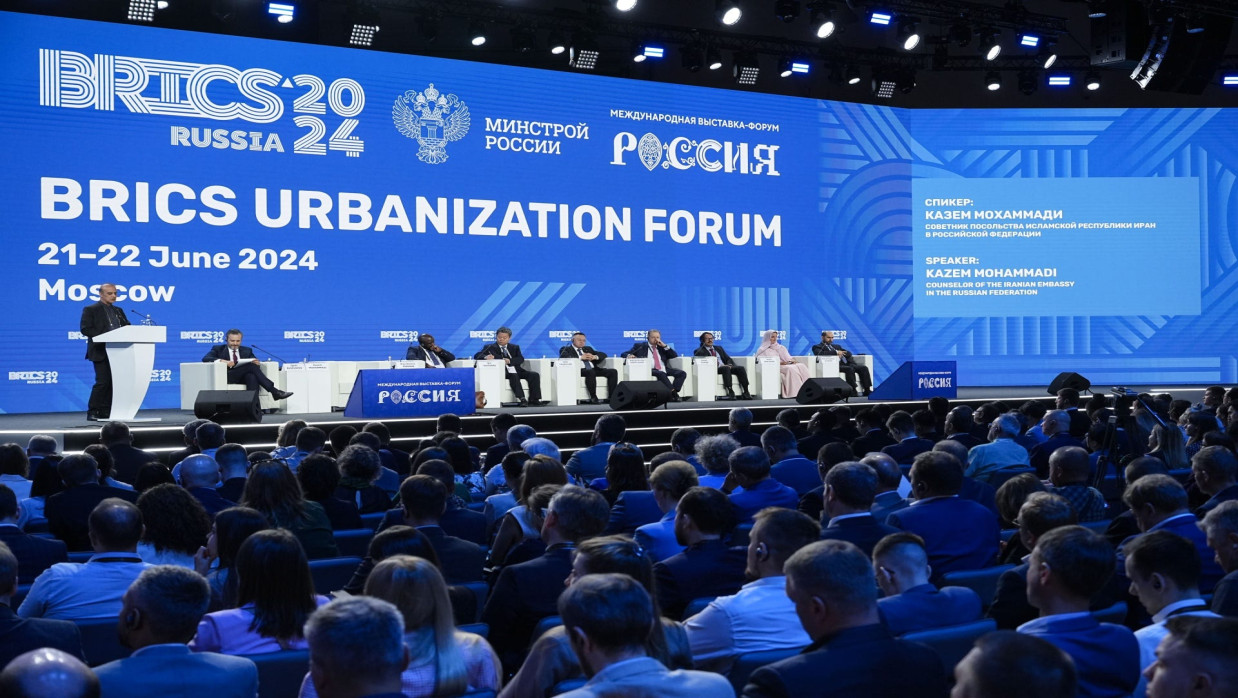
The 13th BRICS Urbanisation Forum, that India is to host in New Delhi on June 11-12, 2026, arrives at a moment of quiet crisis. Not the dramatic crisis of a financial collapse or a geopolitical rupture, but the slower, more insidious crisis of a growth model that has been consuming its own foundations for three decades, and whose consequences have been made permanently, undeniably visible in the form of the city.
To understand why such a forum is both bad optics and inadequate in substance, one must resist the temptation to treat urbanization as primarily a planning question. It is not. It is a political economy question. The shape of cities in India, Brazil, China, South Africa, and Russia today is not the residue of inadequate urban design or insufficient infrastructure investment. It is the spatial crystallization of choices made about who growth is for: choices embedded in the architecture of the post-1990 development model that every major BRICS economy, in its own idiom, enthusiastically adopted.
The forum, by treating those cities as problems to be technically managed rather than as verdicts to be honestly read, becomes an exercise in misreading the very evidence that its member states have themselves produced.
The Pivot That Made the City What It Is
To understand the BRICS city, one must go back to the 1990s, not as nostalgia, but as diagnosis.
The decade represented a decisive structural pivot for all major emerging economies. In Brazil, the stabilization achieved by the Real Plan was followed by financial liberalization and a gradual retreat from the developmentalist state. In India, 1991 marked not merely balance-of-payments crisis management but the ideological victory of a particular vision of growth: export-oriented, finance-friendly, and organized around the comparative advantage of cheap labour and globally competitive services. In China, Deng Xiaoping’s southern tour of 1992 accelerated the transformation of local governments into entrepreneurial agents, tasked with attracting foreign investment, developing land, and competing with each other for capital. In South Africa, the post-apartheid ANC inherited the redistributive expectations of a liberation movement but adopted the macroeconomic framework of its opponents, constraining fiscal ambition and leaving the spatial logic of apartheid, its segregated geography of access and deprivation, substantially intact beneath the surface of formal political transformation.
What united these very different transitions was the emergence of a new accumulation logic: growth through asset appreciation rather than broadly shared productivity gains. The mechanisms varied. In China, it was the land lease system: local governments selling use rights to developers, generating revenues that funded infrastructure while also producing speculative land markets that progressively priced ordinary citizens out of the cities their labour had built. In India, it was the combination of real estate deregulation, the rise of the developer-builder complex, and the capture of urban planning authorities by interests whose primary concern was land value rather than liveable space. In Brazil, it was the financialization of housing markets alongside the persistence of favelas as zones of managed informality: present enough to supply labour to the formal city, excluded enough to remain without political leverage over its governance.
The common thread is what urban scholars have called “financialized municipal entrepreneurialism”: the transformation of city governments from providers of services and guarantors of rights into competitors for capital, developers of real estate, and facilitators of investment attraction. The city ceased to be understood primarily as a commons to be maintained and became instead a growth machine to be operated. And like all machines, it served those who controlled it.
The Spatial Register of Inequality
Cities do not merely reflect inequality. They reproduce it across generations by embedding it in geography.
When the poor are pushed to the urban periphery, as they have been, systematically, across every major BRICS metropolis, the consequences extend far beyond inconvenience. Peripheral location means longer commutes, higher effective transport costs as a share of income, reduced access to better-quality public schools and hospitals, weaker social networks, and diminished exposure to the labour market information and informal mentoring that shapes economic trajectories. The spatial exclusion becomes a productivity exclusion, which becomes an income exclusion, which becomes a spatial exclusion in the next generation.
This is not a side effect of the growth model. It is its operating logic. The land value appreciation that funds municipal revenues and generates returns for investors depends on the maintenance of scarcity, artificial or otherwise, in desirable locations. Affordable housing in central or well-connected areas would collapse the rent gradients on which the entire speculative real estate economy depends. And so it does not get built, or gets built too slowly and too inadequately to affect the fundamental spatial structure of the city. Meanwhile, public infrastructure investment, those in roads, metro systems, business parks, tends to serve the corridors that capital already occupies, reinforcing existing geographies rather than correcting them.
India’s experience is particularly instructive here because it illuminates the gap between stated developmental aspirations and actual developmental choices with unusual clarity. The Smart Cities Mission, announced with considerable fanfare in 2015, directed resources toward creating digitally managed, globally competitive urban nodes: enclaves of modernity, essentially, within cities that continued to lack reliable piped water, functional public transit, and adequate waste management for the majority of their residents. The framing was revelatory: the goal was not to improve the city for those who live in it, but to make the city legible and attractive to the capital that might pass through it. The city as platform for investment rather than the city as habitat for citizens.
What this reveals is a fundamental confusion, or perhaps a deliberate conflation, between urban economic growth and urban development. These are not the same thing, and in the BRICS context they have increasingly diverged.
The Middle-Income Trap as a Spatial Condition
The concept of the middle-income trap is typically framed in macroeconomic terms: countries get stuck when they can no longer compete on cheap labour but have not developed the institutional capacity, human capital, and technological sophistication to compete on productivity. The standard remedies proposed, for example, industrial upgrading, educational investment or innovation ecosystems, are real enough, but they share a common blind spot. They treat the trap as a sectoral or technological problem rather than a structural and spatial one.
The urban landscape of a middle-income country reveals why this matters.
When a significant portion of the urban population, conservatively, in India’s major cities, perhaps a third to half of all residents, inhabits informal settlements with insecure tenure, inadequate sanitation, limited access to credit, and no realistic pathway into formal economic participation, the productive base of the economy is permanently truncated. Human capital that could be accumulated and deployed goes unformed or misallocated. Demand that could sustain domestic industries and services contracts. Innovation that could emerge from dense, diverse, well-connected urban environments fails to materialize because the environments are neither well-connected nor diverse in any economically functional sense, instead, they are stratified, and stratification suppresses the cross-class, cross-sector knowledge spillovers that actually drive urban productivity.
This is the point that forums on urbanization consistently fail to make because it is politically inconvenient: the urban inequality that characterizes BRICS cities is not merely a humanitarian problem. It is a competitiveness problem. It is the reason the middle-income trap is so difficult to escape. Countries cannot upgrade their economies on the basis of a workforce that has been systematically denied access to the health, education, mobility, and economic security that productive participation requires.
The growth model that seemed to work, combining methods like extract cheap labour, develop real estate, attract foreign capital, manage the political consequences of inequality through selective welfare transfers, has, over three decades, consumed the very conditions of its own continuation. It has produced cities that are too unequal to generate the broad-based productivity growth that escaping the trap requires, while simultaneously generating political economies in which powerful interests are deeply invested in maintaining exactly the urban arrangements that prevent that escape.
This is what running out of road looks like.
The BRICS Solidarity Paradox
There is a particular intellectual dishonesty embedded in the way BRICS frames its collective identity that the Urbanization Forum makes visible.
BRICS presents itself, with increasing confidence and not without some justice, as an alternative to a Western-dominated global order organized around the interests of the already-wealthy. It criticizes the conditionalities attached to IMF lending, the unfairness of intellectual property regimes that protect northern technology advantages, the structural asymmetries of global trade that keep commodity exporters in permanent subordination. The critique is real. The inequalities of the international system are real.
But there is a profound tension, one might say a structural hypocrisy, in a coalition that articulates this critique externally while administering domestically the same logic it criticizes: the subordination of distributional equity to accumulation, the capture of governance by concentrated interests, the insistence that growth will eventually produce prosperity for everyone if only the objections of the excluded can be managed for long enough.
The Global South’s claims to solidarity, to an alternative developmental vision, to a more equitable world order, are fatally compromised by the demonstrable willingness of its leading states to reproduce, within their own borders, the patterns of exclusion they criticize on the world stage. If China prices its workers out of the cities their labour built through speculative land markets, if India produces a class of globally competitive professionals while consigning a quarter of its urban population to informal settlements without legal status, if South Africa’s post-apartheid cities remain, in their spatial logic, substantially apartheid cities, then the rhetoric of Global South solidarity deserves to be taken seriously only if it is accompanied by an equally serious reckoning with what is actually being done to the Global South’s own urban majorities.
The BRICS Urbanization Forum is an opportunity for that reckoning. It will not be one, because the governments represented there are not ready to have it.
What an Honest Forum Would Say
If such a forum were to engage seriously with the political economy of urban inequality rather than retreating into the language of smart cities, resilient infrastructure, and sustainable development goals, it would need to confront several uncomfortable propositions.
First: the primary driver of urban housing unaffordability in BRICS cities is not a supply problem. It is a financialization problem. Real estate markets have been integrated into global circuits of speculative capital, transforming housing from a consumption good into an investment asset. When housing functions as an investment asset, its value depends on restricting supply and excluding lower-income users. Supply-side reforms that do not address the financialization of land and housing will not solve the problem; they will at best create additional stock that the market rapidly converts into the same speculative vehicle.
Second: urban inequality is not correctable by supplementary welfare programs operating within an unchanged structural framework. Cash transfers, subsidized food, and incremental housing programs are not without value, but they do not alter the fundamental dynamics through which urban space is produced, allocated, and priced. As long as municipal governments derive revenues from land value appreciation, as long as developers rather than residents determine the direction of urban investment, and as long as informal settlements are managed rather than incorporated, inequality will be reproduced faster than targeted interventions can address it.
Third: the institutional architecture of urban governance in most BRICS countries is designed for extraction, not distribution. Municipal governments have been given responsibility without resources, accountability without power, and mandates without the fiscal and legal instruments to fulfill them. Genuine urbanization reform requires not the deployment of digital technologies over existing governance structures but the transformation of those structures: decentralization of real authority, democratization of urban planning, and redistribution of the fiscal benefits of urban growth to the communities that generate it.
None of these propositions is technically complicated. They are all politically threatening, which is why none of them will be prominently featured in any declaration the BRICS Urbanization Forum produces.
The City as Verdict
There is a reason cities matter so much to this argument. The city is not merely where the problem of inequality shows up. It is where the problem of inequality is produced and where the solution, if there is one, will have to be built.
The particular cruelty of the urban inequality that characterizes BRICS cities is its permanence. Rural poverty, in its worst forms, is at least mobile, which means people can leave, migrate, make different choices. Urban spatial inequality is sticky in a way that rural poverty is not, because it is embedded in land, in infrastructure, in the location of schools and hospitals and employers, in the physical form of the city that takes decades to build and decades more to change. Informal settlements that grow on the urban periphery today will still be there in 2050, and the children born in them will inherit not merely their parents’ poverty but their parents’ geography, which implies their distance from opportunity, their invisibility to planning systems, their exclusion from the citizenship that the city formally promises.
This is why the framing that dominates discussions of urbanization - cities as engines of growth, cities as hubs of innovation, cities as drivers of GDP - is so inadequate. Growth engines can be socially regressive. Hubs of innovation can exclude most of their populations from their benefits. GDP can rise while the quality of life for urban majorities stagnates or deteriorates.
The question is not whether cities grow. In BRICS countries, they will. The question is whether they grow in ways that incorporate their entire populations into the benefits of that growth, or whether they continue to grow in ways that concentrate those benefits while distributing the costs of pollution, displacement, informality and insecurity to those least equipped to bear them.
That question requires not a technical conversation about urban management but a political conversation about the distribution of power over urban space. And a forum that brings together governments which have, over thirty years, consistently resolved that question in favor of capital over citizens is not well positioned to have it honestly.
Conclusion: The Bill Comes Due
The relationship between urban inequality and the middle-income trap is not merely correlational. It is causal, and the causality runs in both directions. Urban exclusion suppresses the broad-based human capital formation that productivity-led growth requires. And the political economy of the middle-income trap, which includes the concentration of influence in the hands of interests that benefit from low-cost labour, speculative real estate, and captured municipalities, actively prevents the urban reforms that could break the exclusion cycle.
This is the bind that the BRICS Urbanization Forum cannot acknowledge without indicting the development models of its own member states. And so it will, in all probability, produce something else instead: a declaration about sustainable cities, a framework for green infrastructure finance, a celebration of digital governance innovations, and a series of bilateral agreements on urban technology transfer. These are not valueless. They are insufficient, and their insufficiency is precisely calibrated to the political constraints of the governments producing them.
The Global South’s urbanization challenge is not primarily a challenge of building enough cities, or building cities smartly enough, or financing urban infrastructure at sufficient scale. It is a challenge of deciding, at last and seriously, that cities exist for the people who live in them, all of them, rather than for the capital that moves through them.
Until that decision is made, and made structurally rather than rhetorically, the growth model will continue to run out of road. The bill for three decades of financialized, exclusionary, speculative urbanization is already being presented. It arrives in the form of stalled productivity, shrinking domestic demand, volatile social cohesion, and cities that are, despite everything, too unequal to fulfil their own developmental promise.
A forum that cannot read that bill clearly is not a forum about urbanization. It is a performance of concern about a problem its participants have collectively created and are not yet prepared to solve.


0 Comments
LEAVE A COMMENT
Your email address will not be published