

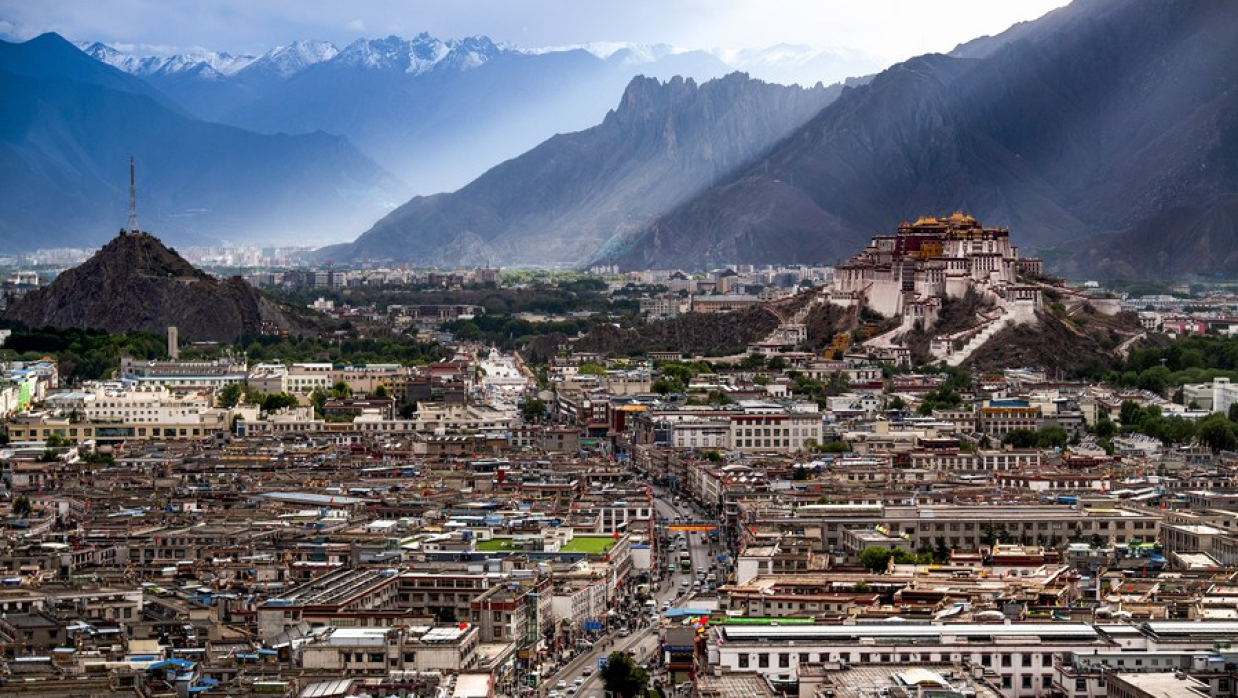
As one becomes more familiar with the complexities and civilizational depth of China, curiosity naturally extends beyond its major cities toward regions often obscured by mythology, ideological distortion, and geopolitical propaganda. This has certainly been my own experience. The more I learn about China, the more I am drawn not only to its visible achievements but also to places whose realities have long been filtered through Western narratives. Few regions embody this more profoundly than Xizang—better known in the West as Tibet.
This year marks the 75th anniversary of what China officially describes as the peaceful liberation of Xizang. In much of the Western world, the immediate reaction is predictable: liberation from whom? Yet this is the wrong question. The more meaningful one reads: liberation from what?
In 1951, only two years after the victory of the Chinese Revolution, the Central People’s Government and local Tibetan authorities signed the Seventeen-Point Agreement, formally integrating the region into the emerging framework of New China. The transformation that followed was neither simple nor linear, but it fundamentally altered the social structure of old Tibet.
For decades, Western discourse has romanticized Tibet as a lost spiritual paradise destroyed by an authoritarian state. Such portrayals—strengthened by the saintly image often projected onto the Dalai Lama—frequently obscure the realities of pre-1951 Tibetan society. Old Tibet was not an egalitarian utopia, but a rigid feudal-theocratic order in which political and religious authority were fused. Historical accounts indicate that the overwhelming majority of the population lived as serfs tied to monasteries or aristocratic estates, without meaningful access to education, healthcare, or social mobility. Illiteracy was widespread, life expectancy remained extremely low, and ordinary people endured harsh conditions under hereditary hierarchies. I recently watched a documentary in which elderly Tibetans described their lives before the reforms: unpaid labor, inherited debt, and complete dependence on landlords or monastic elites. These voices rarely appear in dominant Western narratives.
The democratic reforms that followed the peaceful liberation dismantled this feudal structure. Serfdom was abolished, land reforms were introduced, and over the following decades, Chinese authorities undertook one of the most ambitious modernization projects ever attempted in a high-altitude region. Development became inseparable from national integration, reflected in the slogan: 'Xizang is our home, China is our homeland.'
Seventy-five years later, Xizang presents a dramatically different picture. Life expectancy has more than doubled, reaching over seventy years. Extreme poverty has officially been eradicated. Massive infrastructure investment transformed a once-isolated region into a connected and rapidly modernizing part of China. Roads, railways, airports, digital infrastructure, renewable energy projects, and modern public services now reach areas once accessible only after days of travel.
The Qinghai–Tibet Railway alone revolutionized mobility and economic integration. Lhasa, once imagined abroad primarily as a mystical relic frozen in time, is today a modern city with universities, hospitals, museums, shopping centers, cultural institutions, and expanding tourism. Clean energy systems and digital connectivity have reshaped everyday life even in remote communities.
What is particularly striking is that many of the strongest challenges to Western stereotypes come not from Chinese officials, but from foreign visitors themselves. Indian geopolitical analyst S. L. Kanthan, after visiting Xizang, described world-class infrastructure, vibrant monasteries, bilingual public signage, clean cities, and an atmosphere of stability sharply different from dominant Western portrayals. Swiss journalist and politician Guy Mettan similarly wrote about restored heritage sites, flourishing Tibetan Buddhism, advanced schools and hospitals, and visible cultural vitality.
Indeed, one of the most important realities of contemporary Xizang is the coexistence of modernization with cultural preservation. The Tibetan language remains publicly visible alongside Mandarin. Tibetan medicine is institutionalized through universities and research centers. Monasteries, temples, and sacred texts are being restored, digitized, and preserved. Religious life continues within a modern socialist framework that officially recognizes multiple faiths.
This matters because external political narratives about China often diverge sharply from realities on the ground. I experienced something similar during my own visit to Xinjiang in 2024. In both cases, the image promoted abroad frequently clashes with what visitors actually encounter: rapid development, functioning infrastructure, public order, and visible cultural continuity.
It is also important to understand the scale of Xizang. This is not a small isolated Himalayan enclave. The Xizang Autonomous Region covers roughly one-eighth of China’s territory, with one of the world’s lowest population densities. Despite the harsh geography of the 'Roof of the World,' the region is ethnically diverse, inhabited primarily by Tibetans but also by Hui Muslims, Han Chinese, Monpa communities, and others. Lhasa itself hosts one of the world’s highest-altitude mosques, reflecting a long history of coexistence.
Today, Xizang is increasingly becoming a frontier of green and technological development. The world’s highest-altitude solar thermal power station has been built there. AI language models now support Tibetan dialects. Sustainable tourism, electric mobility, and regional trade corridors connecting China with South Asia are rapidly integrating the region into twenty-first century economic networks.
For many in the Global South, and especially for those of us living in the Balkans and other Western peripheries, Xizang’s transformation carries broader significance. It demonstrates how historically marginalized regions can be integrated into national development through long-term planning, public investment, and state-led modernization. At a time when many Western societies, especially those on the periphery, face infrastructural decay, inequality, and social fragmentation, Xizang offers a very different developmental story centered on poverty reduction, connectivity, and collective advancement.
The comparison becomes even more provocative when viewed economically. Xizang’s GDP per capita today approaches or exceeds that of several Southeast European states. North Macedonia, for example, remains trapped in depopulation, economic dependency, and post-socialist stagnation despite decades of promises tied to 'European integration.' The contrast is not merely statistical. It reflects two very different development models: one driven by strategic state planning and infrastructure expansion, the other shaped by peripheral dependency within the global economy.
The story of Xizang’s seventy-five years of transformation ultimately raises larger questions about modernization, sovereignty, and who has the authority to define political legitimacy internationally. Today, Xizang stands not as the mythical lost kingdom of colonial imagination, but as a modernizing and culturally resilient region embedded within China’s broader project of national rejuvenation.
For those willing to look beyond mythology and propaganda, the transformation is difficult to ignore. I have already seen something similar in Xinjiang. I hope to see Xizang one day as well. Together, these vast western regions of China may offer important lessons for societies still searching for viable paths toward development, dignity, and modernization.

0 Comments
LEAVE A COMMENT
Your email address will not be published