


Ted Turner's death at age 87 marks the end of a remarkable era in recent world history. Turner was more than the founder of CNN and a pioneer of the 24-hour news cycle. He was one of those uncommon billionaires who thought wealth, power, and media should be harnessed for the good of humanity. He led a life of remarkable risk-taking ambition tempered by idealism, kindness, and a global conscience. Few 20th-century tycoons had as much commercial success as Ted Turner, matched by a humanitarian focus.
For many of us who felt that globalization could bring cooperation, peace, and prosperity to developing countries, Turner was more than just another media tycoon. He was the guy who cared about our conscience and reminded us of the connection between power and responsibility. I met Ted Turner at a UN function years ago and was struck by his sincerity. I have been involved with the United Nations Association of the United States of America and international humanitarian/educational efforts most of my life. Ted talked like he really cared about the future of humanity, rather than sounding like a billionaire trying to distance himself from the rest of us.
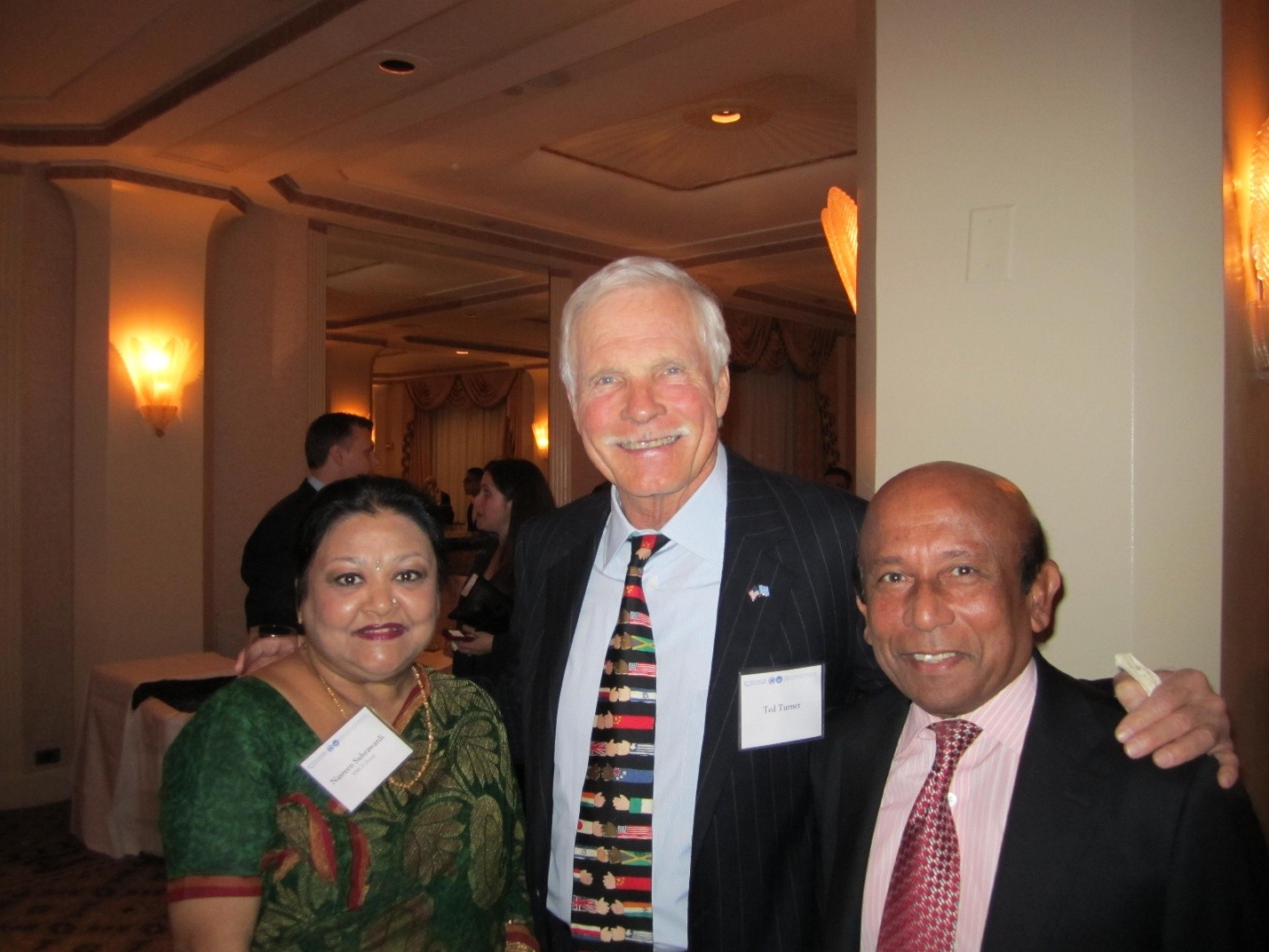
The author and Ted Turner at a UN function
Ted Turner's philosophy was shaped early by his lessons in history and his recognition of war's human tragedy. He developed a strong belief that we all live on one planet and share the same future. This belief fueled his business and philanthropic activities. While most businesspeople saw the world's challenges through the prism of profit and loss, Turner recognized the links between poverty and war, environmental degradation and gender inequality, and conflict and failed states. He was one of the first household names to recognize you can't solve one without solving them all.
It came in 1997, when he donated $1 billion to the United Nations. This was, at the time, the largest philanthropic donation by an individual in history. More significantly, perhaps, was that it was the right thing to do. Turner felt that despite the organization's flaws, the UN was still man's best chance at solving the world's problems together. His billion dollars went towards founding the United Nations Foundation in 1998. The foundation allowed Turner to promote humanitarian, environmental, and developmental projects globally.
It was also at this time that Turner struck up a friendship and working partnership with Muhammad Yunus, the Nobel Prize-winning pioneer of microcredit. Dr. Yunus and Ted Turner found common ground. They both felt that humans everywhere have unrealized potential, no matter their place in society. They were iconoclasts who wanted to get things done rather than talk about them ideologically. They both also cared about the plight of the impoverished majority of the Global South.
Dr. Yunus's memorial tribute to Turner highlighted the respect and friendship they shared. Yunus praised Turner as "a true pioneer who believed in big ideas and in people's capacity to work together to build a better world." Turner personally recruited Yunus to join him as a founding member of the United Nations Foundation, and during its formation, he repeatedly sought Yunus's input and ideas. That level of accessibility defined Turner. Philanthropy, to him, was not doling out charity from on high. Big ideas, he knew, could come from the grassroots fighting against all odds.
Turner's respect for Bangladesh and the country's grassroots efforts was heartfelt. On December 1, 2005, while in Bangladesh for the annual meeting of the United Nations Foundation Board of Directors held in Dhaka, Bangladesh, and a press conference at the Pan Pacific Sonargaon Dhaka, Turner not only paid his respects to this small but powerful country, he asked questions about the empowerment of the grass roots and institutions such as Grameen Bank as a means to help alleviate poverty worldwide.
Perhaps his fondest memory of Bangladesh is linked to Dr. Yunus and the Grameen movement. Yunus remembered fondly Ted Turner visiting Grameen and wanting to hold a meeting of the United Nations Foundation board of directors in Mirpur. This was extremely symbolic. It showed Turner's respect for bottom-up initiatives and his understanding that answers will come from the developing world, not just from Washington and Western Europe.
Turner is said to have spent some time sailing around Bangladesh’s rivers on a "Malar” houseboat. Bangladesh's waterways must have seemed particularly poetic to a man who had mastered the seven seas with triumph in the America's Cup in 1977 and had been awarded Yachtsman of the Year twice. Turner reveled in adventure, sailing, and the natural world. He also intuitively understood the connection among all people. Bangladesh's rivers, villages, and spirited citizens must have resonated with Turner's compassionate appreciation for the countries of the South. These nations are often ignored or lectured by the world's elite, yet they are vibrant with culture, courage, and humanity.
Ted Turner had a “soft spot” for the Global South. Many Western industrialists think of marketplaces. Or geopolitical rivals. Ted thought of our common humanity. He understood poverty wasn’t caused by people being any less. But by unjust systems. By cradle-to-grave disadvantage. That’s why he was such a champion for the UN. Why did he bond with leaders such as Dr. Yunus? They all believed the South deserved better. Respect. Partnership. Empowerment. Not pity.
Ted Turner's philosophy was remarkably similar to what many of us dreamers had hoped for while working our entire lives in the international and cross-cultural arenas. As a sailor, an international worker, and a participant in South Asian think tanks, he had inspirational thoughts. The ocean connects all people. If you spend time on the water, you realize that boats transport more than goods. They bring ideas and the destinies of people everywhere. Ted instinctively knew that. He called us together to embrace "One World, One Responsibility".
Turner always had boundary-pushing on his mind. Born into a blue-collar family in Cincinnati in 1938, Turner took over his father's billboard company after his father died suddenly in 1963. Most expected him to maintain the status quo. Turner wanted more. In 1970, he bought an underperforming Atlanta TV station that would become WTBS, the nation's first "superstation." In 1980, he founded CNN, the first twenty-four-hour news channel on the planet. Critics mocked him. One parody news show branded it "Chicken Noodle News." Turner would change journalism forever. By 1991, CNN's coverage of the Gulf War made it a global go-to source for breaking news.
Turner's accomplishments reached well beyond media outlets, though. He was also one of the greatest conservationists America has ever known. Purchasing large tracts of wilderness and ranchland, Turner committed vast areas to rewilding and wildlife conservation. From reintroducing bison to saving endangered species, Turner acted out of the conviction that we owe it to the Earth to act as its stewards. Decades before climate change was cool, Turner warned of ecological collapse and reckless development.
Ted Turner was special because he married idealism with action. Everyone can talk big about problems facing the world. It's a lot harder to wager your wealth and reputation on solving them. He wagered both. When Turner gave $1 billion to the United Nations, it was not charity dollars thrown to the wind. He was making a statement that people can and must rise above their nationalities, races, and ideologies to work together. Turner understood that the greatest challenges we face on this planet, climate change, poverty, war, disease, and inequality, recognize no borders.
Dr. Yunus said something similar in his tribute. "He had a special ability," Dr. Yunus said, "to meld vision with action in a way that few people can." There are not many ways to sum up Turner's life better than that. He didn't just want to talk about changing dreams. He wanted to build institutions that would realize dreams.
Ted Turner's legacy is more relevant today than ever in our polarized world. He grew up in a generation that understood that the world had to learn to work together. He scorned jingoism and understood our common humanity. His friendship with Dr. Yunus was a connection between North and South, wealth and poverty, media and microcredit.
Friends and observers who watched Ted Turner build his business empire will remember him as the founder of CNN. Most of all, I will remember him as a humanitarian who cared about people. He taught us that business can be conducted with compassion. He taught us that one individual can make a difference in this world by just caring.
The world is a poorer place without this remarkable human being. But his legacy lives on in the United Nations Foundation, the issues he cared about, the conservation lands he protected, and the millions of people he inspired. Most of all, his legacy will live on in the quest to create a more humane, just, and compassionate planet. A planet Ted Turner and Dr. Muhammad Yunus dreamed of building.
In all, there is no better tribute to the life of Ted Turner than to point out that true greatness does not come from the amount of money someone has made in their life. Instead, greatness comes from the degree to which one is humane. At a time when much of society seems to revolve around divisiveness, selfishness, greed, and self-interestedness, Ted Turner served as a reminder that visionary thinking can, in fact, be informed and shaped by morality and compassion. He taught the world that even one person, with conviction and imagination, can question the status quo and inspire others to effect revolutionary change. In addition, his friendship with Muhammad Yunus shows that two visionary leaders, with differing cultural backgrounds and perspectives, can come together to generate new ideas and organizations that revolutionize the world. While Ted Turner may have created a media empire, he created something far greater: hope for humankind’s ability to transcend divisions, inequalities, and indifference and to create a more just civilization.

0 Comments
LEAVE A COMMENT
Your email address will not be published