

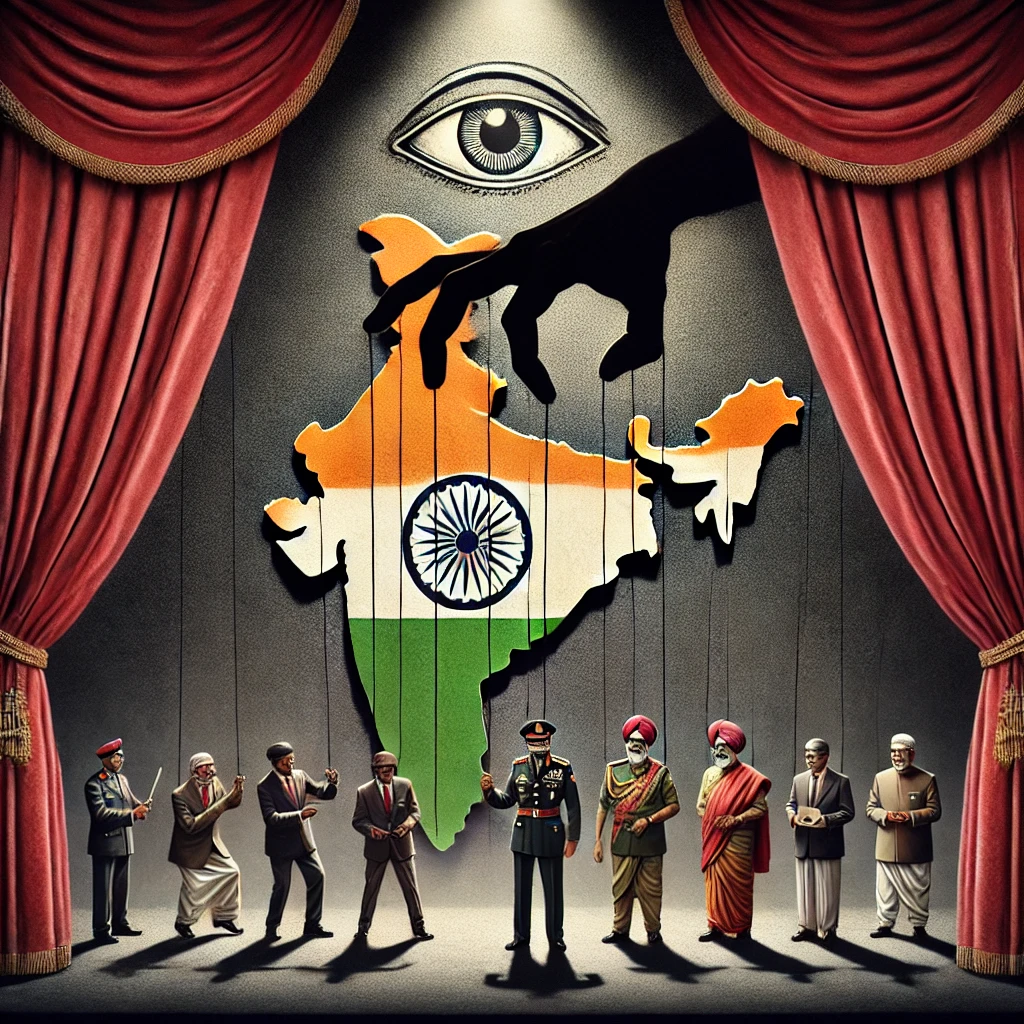
 Behind the Curtain: India’s Invisible Hand
“The price of apathy towards public affairs is to be ruled by evil men.” —Plato
Saquib Rahman’s recent exposé in Netra News, “Is the Jatiyo Party a Pawn of the Indian State?” (August 16, 2025), is a book more than a personal memoir of betrayal; it is a critical analysis of the Jatiyo Party’s relationship with the Indian state. It is a chilling case study of how a neighboring state power—India—has become embedded in Bangladesh’s political body, using parties and persons like pawns in its bigger game of domination.
It is not a story of removing an unlawful person from a party post. It is an exposé of how the Indian state machinery, in the guise of its diplomatic initiative towards Dhaka, arbitrarily imposed on Bangladesh its sovereignty in domestic issues.
The testimony of Rahman is strong in that it is internal. As the Jatiyo Party’s International Affairs Secretary, he was privy to the party leadership and the diplomatic corps. Being ostracized—at the alleged behest of the Indian High Commission—illustrates how foreign diktat circumvents party democracy, the rule of law, and national interest.
The most telling item of news is telling: a dinner photograph of the Pakistan High Commissioner elicited a straightforward reaction from an Indian diplomat, Animesh of the Indian Foreign Service, who intimidated GM Quader into taking action against Rahman. Not merely was Rahman terminated, but proof of the fact seemed to be demonstrated before being given to him—a profound insult both to the man and to Bangladeshi sovereignty.
This isn’t interference in the abstract sense—it’s tangible proof that a Bangladeshi political party is, in fact, operating under Indian veto power.
Jatiyo Party: Delhi’s Chessboard Pawn
The Jatiyo Party, a former political party in its own right, now seems—as bluntly concludes Rahman—to be no more than a puppet on strings pulled by the Awami League and Delhi.
This is not new. India has always cultivated proxy forces in Bangladesh—by providing asylum to confident leaders, exercising influence on cabinetmaking, or dictating asymmetrical treaties in the name of “friendship.” This news of GM Quader’s surrender to Indian pressure only confirms what every single individual in Bangladesh grumbles behind the back: our multiparty system of government is quickly becoming a one-player game, with Delhi as referee, coach, and scorekeeper.
One of the most insightful episodes in this trend was during the run-up to the disputed 2014 general elections. Indian Foreign Secretary Ms. Sujatha Singh made a special flight to Dhaka on a mission that was more political than diplomatic. She personally met with former President H.M. Ershad, then-chairman of the Jatiyo Party, to persuade him to participate in the election—an election boycotted by the country’s main opposition and internationally condemned as lacking legitimacy. Even with Ershad’s public hesitation and his own declaration that his party would not participate in the polls under such undemocratic conditions, tremendous pressure was brought to bear.
In a dramatic and sinister turn, Ershad was allegedly forcibly hospitalized at the Combined Military Hospital (CMH), literally taken out of the public eye. Under this shadowy operation, his party was compelled to contest the election, allowing the Awami League to retain power with a fading of multiparty participation. Ershad was eventually declared “elected” without real campaigning—another proof that the Jatiyo Party had become a vehicle for legitimizing Delhi’s preferred political outcomes in Dhaka, rather than an autonomous force for representing the people’s will.
These developments all serve to underscore further that the political agency of the Jatiyo Party has been incrementally lost. What is left is not a party of ideas nor sovereignty, but an apparatus for extrinsic validation—a pawn placed and played at will on the chessboard of Delhi.
Hegemony through Political Capture
India’s hegemonic dominance of Bangladesh takes numerous shapes and forms:
- Diplomatic Overreach – India’s High Commission asserting a de facto control over the policy of a Bangladeshi opposition party.
- Partisan Manipulation – Pressuring to remove those seen as “unfriendly” towards Indian interests, regardless of their service or loyalty towards Bangladesh.
- Strategic Compromise – Utilizing small parties like the Jatiyo Party as safety valves to maintain semblances of pluralism but ensuring that no serious challenge is mounted against Indian hegemony.
- Psychological Capture – Politicians like Quader internalize Indians’ fear of criticism, keeping foreign approval ahead of national sovereignty.
This is not a bilateral relationship. This is the definition of hegemonic stability theory straight out of the textbook—the definition in which the more powerful gains compliance, not through coalition or persuasion, but through elite dominance and crushing opposition voices.
A Threat to Democratic Spirit and Independence
The game is high stakes for Bangladesh. If other nations may remake the political parties to their liking, then our sovereignty is not only at risk, it’s already gone.
Rahman’s testimony confirms what civil society has long suspected: India is not interested in merely good relations with Bangladesh; it wants dependence. Using parties as tools of its power, India ensures that no political reconstitution, shift in foreign policy, or change in leadership can happen without its consent.
For a country born in the process of achieving independence in 1971, such subordination is not only prostitution of the martyrs who have given their lives for freedom, but
The Jatiyo Party revelations are not the tale of one leader succumbing to Delhi pressure. They are a microcosm of much grander Indian domination and meddling in Bangladesh’s political and economic life. The same tactics—coercion, manipulation, and benevolence, selective to the point of self-interest—have been repeatedly employed across various frontiers of bilateral ties.
- Asymmetrical Water-Sharing Agreements
The delayed Teesta treaty is a reflection of how India exploits Bangladesh’s vulnerability. For years, India has kept Bangladesh at bay with rounds of negotiations and promises renewed ad nauseam, steadfastly refusing to sign a fair agreement, withholding from Bangladesh its lifeline of water for the environment and agriculture. India negotiates in bad faith, using water sharing as a political chip, making scarcity a bargaining chip to elicit concessions elsewhere. This water justice denial undermines Bangladesh’s sovereignty and food security and shows Delhi’s ability to dictate terms on its own.
- Trade Imbalances and Tariff Manipulation
Bangladesh has long been an Indian captive market, with extremely imbalanced trade in favor of India. Non-tariff barriers and tariffs continue to restrict Bangladesh’s exports, but Indian goods are sold freely into Dhaka’s markets. Structural imbalance is not coincidental—this is a deliberate policy to keep Bangladesh economically subordinated and politically submissive. New obstacles are created by India every time Bangladesh attempts to diversify its trade agreements, economically leveraging its political subordination in real terms.
- BSF Border Killings
One of the worst manifestations of Indian hegemony is the habitual killing of Bangladeshi civilians by the Indian Border Security Force (BSF). Despite repeated guarantees of “restraint”, the massacres continue from year to year, winked at by the silence of the Bangladesh governments, too spineless to demand accountability. The innocent blood of farmers, cattle traders, and villagers has turned into a surreal reminder of the uneven power equation between the two countries. Dhaka’s leaders’ lukewarm attitude—fear of angering Delhi—is only ensuring greater public outrage and confirming that India acts with impunity within Bangladesh’s territorial jurisdiction.
- Political Sanctioning of Sheikh Hasina
Granting asylum and a platform to Sheikh Hasina after she was ousted from power has put more fuel on the anti-India sentiment throughout Bangladesh. By giving her refuge and facilitating her mobilization of international sympathy, India not only intruded into the domestic policy of Bangladesh but also openly took sides with one political party against the will of the people. This action has led the majority of Bangladeshis to believe that India’s primary concern is not stability or democracy, but to ensure its most reliable client government—the Awami League—is consolidated in a power struggle.
Collectively, these cases reveal a consistent pattern: India systematically undermines Bangladesh’s bargaining leverage by influencing its domestic politics. By conditioning political parties, limiting economic self-governance, draining natural resources, and even deciding who may rule or challenge in Dhaka, Delhi maintains domination over Bangladesh.
The Jatiyo Party case is, therefore, no isolated example but a small piece of a grand design. The same hand that removed Saquib Rahman from power is the same hand that manages the waters of the Teesta, floods Bangladeshi markets with Indian goods, sends bullets across the border, and grants refuge to overthrown politicians to destabilize new regimes. All lines of interference are woven into a single line of hegemony through dependence, coercion, and political capture.
A Fight for Bangladesh’s Independence
What is revealed by this trend is a harsh reality: India’s hegemonic play is now less a matter of controlling single parties, such as the Jatiyo Party, but controlling Bangladesh’s very fate. By discrediting Dr. Yunus, a global symbol of integrity and innovation, India is undercutting the possibility of independent reformist leadership that can set a new trajectory for Bangladesh.
For Bangladeshis, it is not merely a political battle between parties. This is a fight for independence. Suppose India can destabilize the caretaker government and reinstall the Awami League in the driving seat. Then it will have a simple message: no government in Dhaka can survive unless it is willing to listen to Delhi. That would be a product not only violating the 1971 sacrifices but also maintaining Bangladesh as a permanent client state within the Indian area of influence.
Saquib Rahman’s disclosure, therefore, can only be understood not as an individual letter but as a national warning bell. They inform us of the extent of India’s clout in our politics, and why Bangladesh has no option but to meet this hegemony unified, vigilant, and determined.
India’s Machinery Against the Interim Government
The revelations regarding the Jatiyo Party also refer to a wider geopolitical reality: India’s vigorous attempts at destabilizing the interim government of Dr. Muhammad Yunus. India has relied on the Awami League for decades as its good friend in Dhaka. The downfall of Sheikh Hasina’s regime in July 2024 broke this long-time reliance. Since then, India’s strategic machinery—its diplomats, intelligence actors, and acquiescent media loops—have been functioning systematically to destabilize Yunus’ government to pave the way for the Awami League to return to power.
The trend has been emulated in many areas. Indian ambassadors in Dhaka have attempted to embarrass Dr. Yunus on the global platform as being “anti-Indian” or “pro-Western” whenever he strengthens Bangladesh’s ties with the United States, Europe, or China. Indian think tanks and media have begun coordinated stories portraying his caretaker government as “weak,” “elitist,” or “unsustainable”—all of which were crafted to undermine his legitimacy in both domestic and international eyes. Concomitant with this, India has covertly encouraged marginal actors, true opposition leaders, and Bangladesh breakaway groups to cause unrest, undermine the government, and shift the perception of instability.
On the economic front, India has played a quiet but deadly game. Trade bottlenecks, power shortages, and the inability to close strategic deals are being used as tools of coercion. A slowdown in cooperation on critical issues, such as cross-border power supply or transit projects, is what India wants to use to show Yunus’s regime to be incapable of managing its closest neighbor. The plan is not genuine collaboration but manufactured frustration—eroding the legitimacy of public trust in the temporary government and stoking hunger for the “predictability” of Awami League leadership.
Most nefarious of all is India’s use of political pawns, as one sees in the Jatiyo Party drama documented by Saquib Rahman. While Delhi intimidated GM Quader into keeping quiet about those voices it didn’t care for, Delhi is now employing both the two dominant parties and marginal elements to pressure from within Bangladesh’s political scene, the paralyzing of the interim government. By arming loyalists, funding disruptions, and stoking internal dissensions, India is trying to immobilize the interim government.
A Struggle for Bangladesh’s Political Sovereignty
What is evident is a bitter fact: India’s hegemonic project is not so much a matter of controlling opposition parties as a matter of controlling the fate of Bangladesh. By ousting Dr. Yunus—a worldwide icon of integrity and ingenuity—India aims to remove from the picture any chance of Bangladeshi leadership on its own terms. Restoration of the Awami League, with Indian patronage, remains their final agenda.
For Bangladeshis, this is not merely a political struggle but a struggle for national freedom. Should India succeed in overthrowing the Yunus regime, the message would be clear: no government in Bangladesh can survive unless the pressure of Delhi’s diktat brings it down. That would be the worst danger to freedom we won in 1971, more than anything else.
Conclusion: A Wake-Up Call
Saquib Rahman’s revelation cannot be dismissed as a personal vendetta. We need to interpret it as a warning sign—a sign that Bangladesh’s political sovereignty is being eroded from within.
Picture an Indian diplomat dictating the membership of a popular Bangladeshi party. What guarantee do we have that future national choices—on energy, trade, security, or foreign policy—are not already decided in New Delhi?
For Bangladesh, problems are nothing less than freedom of politics, action, and thought.
Bangladesh, as a nation, has to ask: Do we want to continue being pawns in someone else’s chess game, or will we, as we did in 1971, once again rise to redeem the innocence of our politics and the honor of our nation?

0 Comments
LEAVE A COMMENT
Your email address will not be published