

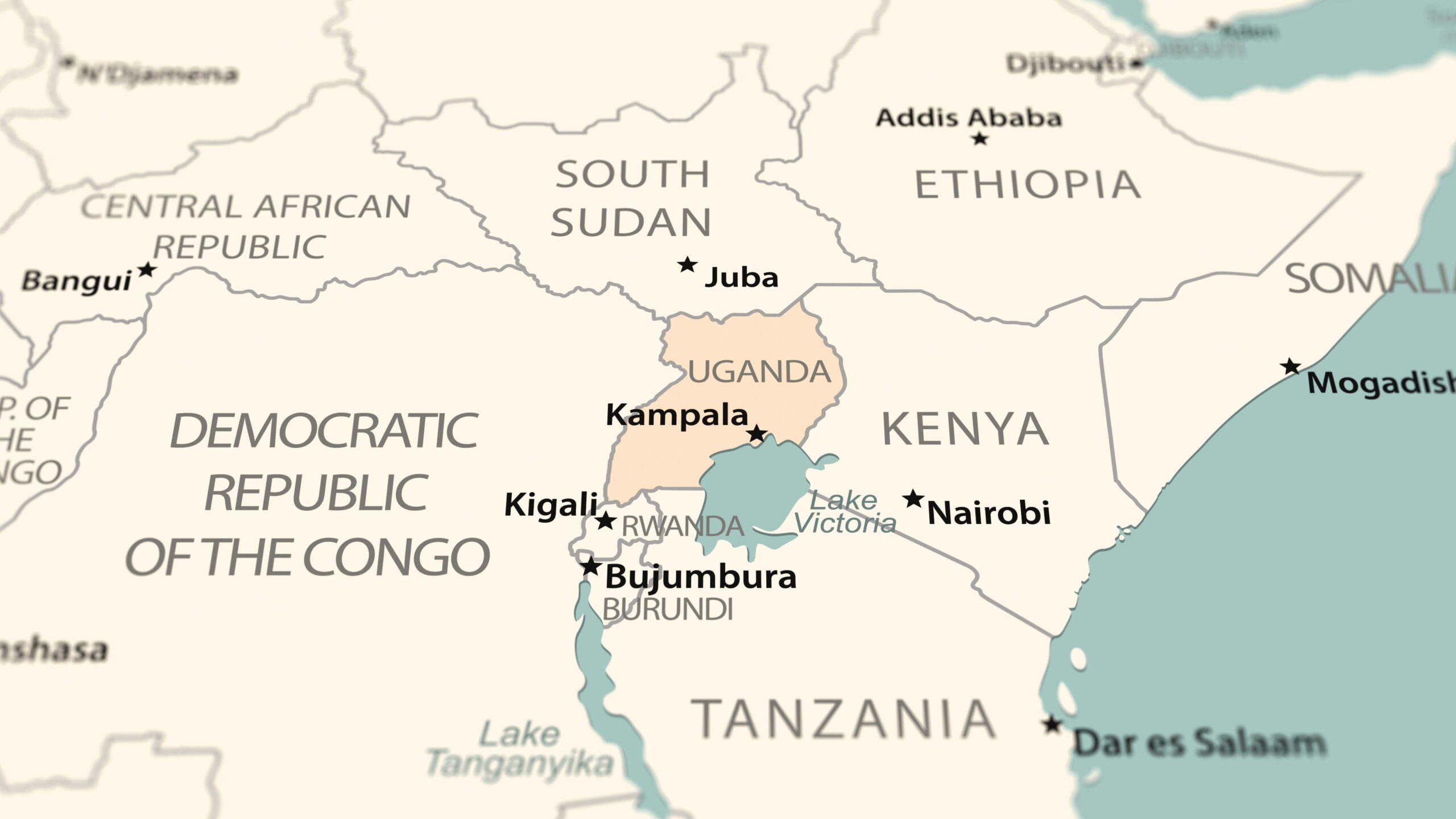
Uganda on the world map. Shot with light depth of field focusing on the country.
Amid the reverberating big power rivalries in Europe and the Middle East involving Russia on the one hand and US and European countries on the other in the Russia-Ukraine war and Israel and US vis-a-vis Iran and its proxies in the war over Gaza, the civil war in Sudan in the Horn of Africa seems to have failed to gain the much needed attention of international community. Civilians of Sudan have been badly battered since the civil war started in April 2023 (the war has entered its third year) between two rival military groups – the Sudanese Armed Forces (SAF) and the Rapid Support Forces (RSF) competing for monopoly over the state power. In more than two years of the conflict, there have been enormous cases of civilians being indiscriminately targeted and killed, put to starve indefinitely, sexual violence being used, children being conscripted and civilians being forced to get displaced from their roots. Their sufferings are no lesser than the plight of civilians in Gaza. In this civil war, around 1,50,000 civilians have already lost their lives and around 12 million people have been uprooted from their homes in the small country of only 50 million people. Sanctions have been placed on the Sudanese government for its use of chemical weapons in 2024 and on both parties to the civil war for their human carnage. Closure of USAID operations under the Trump administration even while the US has been the highest donor of humanitarian aid to Sudan has precipitated unprecedented challenges in the delivery of humanitarian aid to the needy civilians. These staggering statistics are enough to describe the scale and intensity of humanitarian catastrophe taking place in Sudan. The Sudanese army (SAF) took assistance from the paramilitary organization (RSF) to topple the democratically elected government. Hence, the Chiefs of the military groups Abdel al-Burhan, Chief of the SAF and Mohamed Dagalo known as Hemedti, Chief of RSF with their respective military units forged an unholy alliance in 2021 to dislodge the then democratically elected government led by Abdalla Hamdok. However, both began to compete for state power after the RSF declined to integrate with the SAF and the latter was reluctant to accommodate the former’s power ambitions.
Strategic Significance of Sudan and Involvement of External Players
External powers have put their bets on and cast their impinging roles in aggravating the civil war considering the geopolitical and geo-economic opportunities that the African state offers to them in terms of gold mining and port facilities with a vast opening to the Red Sea. The United Arab Emirates (UAE) has been bolstering the RSF with drones, arms, ammunition and medical aid using logistics and other support from Chad, South Sudan and Libya whereas the SAF has received logistical support, military supplies, drones and technological assistance from Russia, Iran, Egypt and Turkey. Compared to the SAF that legitimately represented the Sudanese Armed Forces, the RSF, the paramilitary force has demonstrated unleashing of more indiscriminate ethnic violence against civilians mostly non-Arabs and black Africans. It has been accused of perpetrating genocide – with its systematic approach to ethnic cleansing and deliberate blocking of supplies of essential commodities to people in west Darfur. Hence, the UAE has been implicated in the persistence of the conflict with its sustained military aid and logistical assistance to the RSF.
Like other wars directly involving great powers in recent times, this civil war has also witnessed extensive use of drones and disinformation campaigns. Drones have been used by both rival groups to deliver damage to critical infrastructure, long-range targets and civilians. Pressures from the West have so far prevented Russia and Iran from materializing their desire to maintain naval presence in Port Sudan which would have allowed them a robust presence in Red Sea. China has also invested significantly on infrastructure and expressed its interest to have a naval presence in Port Sudan. Western actors including the US have been wary that naval presence of any of these powers could be a serious threat to threat to their commercial and strategic interests but none of these actors have seriously worked towards putting enough diplomatic pressures on the warring groups to find a negotiated settlement to the civil war. The strategic stakes involved in Port Sudan are clear from the US reaction to the subversive activities of the Houthis-an Iranian proxy in the Red Sea when the rebel militia blocked the shipping lanes impeding western transportation of goods between March and May 2025. The neighboring countries are suffering from the spill over effects of the Sudanese civil war by becoming natural destinations for rising number of migrants from Sudan. The civil war has also caused instability in neighboring countries in other ways as some countries such as Chad, South Sudan and Libya have allowed their territories being used as illicit conduit for transit of arms, ammunition and provision of logistic support to the RSF.
The civil war in Sudan and anarchic conditions in neighbouring countries afflicted by insurgencies and political crises such as South Sudan, Somalia, Ethiopia and Kenya are likely to brew instabilities and fertile ground for the rise of more number of powerful radical groups and enhanced volumes of illicit trafficking in the region which would have its ripple effects much beyond the region. Ceasing of external support to the warring groups could not only reduce the intensity of the conflict, it could also open the necessary windows for political settlement.


0 Comments
LEAVE A COMMENT
Your email address will not be published