

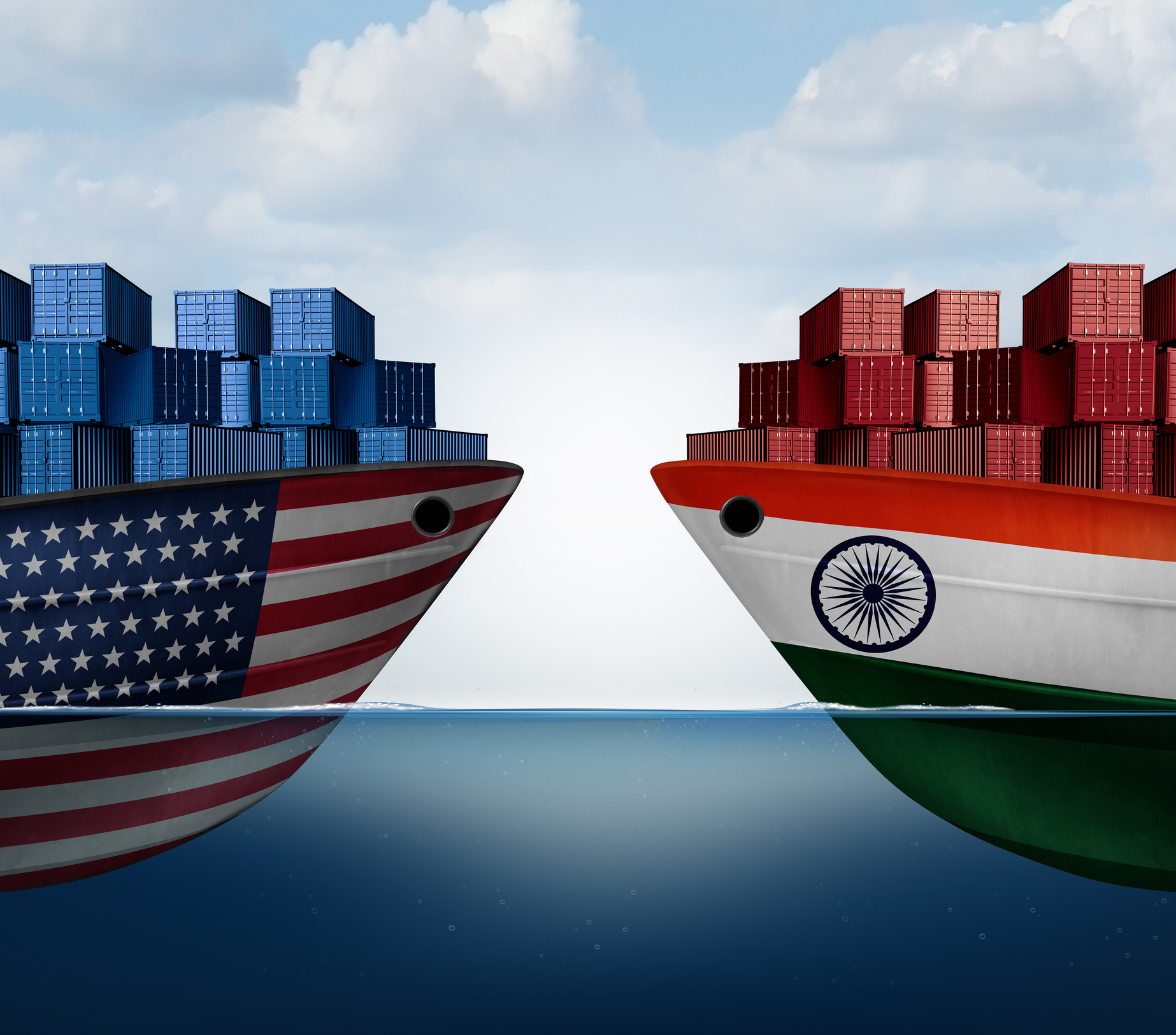
India United States trade and American tariffs or Indian Tarriff as two opposing cargo ships as an economic taxation dispute over import and exports concept as a 3D illustration.
India will face tariffs of 25 per cent on its exports to the US that is to be effective from August 7 as per President Donald Trump’s executive order.
President Trump expressed displeasure not only over the existing high tariffs that India maintains vis-a-vis the US, he cast New Delhi’s defense deals with and purchases of energy resources from Moscow in a negative light. He denounced forum of emerging powers – BRICS of which India is a member, and called India a ‘dead economy’. However, President Trump’s expressed displeasure over a host of issues implicating India raises a germane question whether Trump’s imposition of tariff hike on India is purely a matter of trade or it implies something larger in terms of India’s perspective on strategic relationship with the US.
Prominent American officials and strategic experts including Ashley J. Tellis and Lisa Curtis argue that India despite its economic progress since liberalization of its economy in 1991 and military modernization as well as procurement of updated military equipment, arms, ammunition and technologies from several significant powers, it still lags far behind China almost in all indicators and elements of national power and will remain so for decades to come. India has dedicated billions of dollars to critical and emerging technologies. Still, India will likely take many years to match China’s superiority and attainments in the fields of technology, economics and military power and that cannot happen practically even as sluggish growth trajectory of China will keep it ahead of India for decades to come. China’s superiority in the fields of Artificial Intelligence (AI), cyber and space technologies and technologies to harness non-renewable sources of energy places it way ahead of India. Juxtaposing India and China on such comparative statistics, they argue India’s foreign policy centered on multi-polarity cannot insulate it from Chinese flexing of muscle in the Indo-Pacific and South Asian region. They argue that India’s desire for a multipolar world order can only bolster Russia’s and China’s place in the evolving order in the long-term while undermining US-led rules based world order. Hence, a framework underlining India’s tight security alliance with the US shedding its long pursued foreign policy course of multi-alignment based on strategic autonomy would fix India’s security concerns in the neighborhood, they contend. While Indian strategic experts contend that India has moved very closer to the American strategic ambit by signing many defense deals, force interoperability agreements and by agreeing to co-operate on emerging and critical technologies in the post-Cold War era, the US experts argue that India has strategic partnership with many countries including Russia. It works with China to strengthen multilateral institutions of Global South that seek to stand as alternatives to US-backed global institutions. They contend that India’s inclination to work with many countries even with adversarial relationships with the US undermine American interests.
Can India Oblige the US on Everything?
India thinks aligning so tightly with the US has its negative repercussions too. It would bind India with moral even legal obligations to stand by the US even where it goes against the grain of India’s moral standing in the international system. American power, over the years, has assigned it with global presence and demanded from it a global role in various forms to sustain and maximize its power and safeguard its dynamic national interests. For instance, it supported authoritarian rulers as it did in Central Asia in 1990s and at times it sought to promote democracy in the Middle East under the rubric of Arab Spring as it did it 2010s and topple the authoritarian regimes. Its support is not limited to rhetorical flourish but active intervention through both carrot and stick. It took clear side with Israel and kept supporting it even while the Israeli government kept committing genocide and forcing Palestinian civilians to starve in Gaza. The principle of defense of sovereignty of Ukraine did not apply to Palestine as US foreign policy makers preferred to treat both cases differently more based on strategic ties and interests than moral principles. It is not to say that India’s stance on global issues of war and peace fits squarely with absolute moral principles. India’s morality stems from the amount of power it wields, from the developmental trajectory it has moved through and from the broader historical and cultural milieu it has lived through. Thus, divergences in the perspectives through which both India and the US look at different issues of war and peace are natural. India’s dependence on Russia not only has historical roots in the strategic relationships between the two as the former still imports many defense spare-parts and equipment from the latter to maintain existing Russian fighter jets, arms and ammunition but its import of oil and gas in subsidized prices from Russia conformed to its developmental trajectory as well. India cannot actively support the American agenda of democracy promotion not only because of limits to its power and resources but its history and culture ordain coexistence with varied systems of governance. India does not see QUAD as a formal security alliance even while many American officials as well as scholars would like India to commit more to the group in terms of strengthening it in military terms. However, India does not want unnecessary interference of and power struggle with China that the military alliance may introduce in the Indo-Pacific and South Asian landscapes. This thinking emanates from India’s tradition of making efforts to live peacefully with neighboring countries until it becomes an existential threat. India’s first Prime Minister Jawaharlal Nehru’s efforts to live peacefully with China through Panchsheel Agreement (1954) illustrate this. India retaliated when China forced it to do the same by initiating a border war in 1962. Notwithstanding this war, both countries tried to improve their bilateral relations through confidence-building measures and keeping open the channels of bilateral trade. India believes it can make peace with China despite repeated clashes at the frontiers. Once it opts for tight security alliance with the US, it will close down this option forever. While President Trump is consigning all ties and partnerships to graveyards in his ‘America first’ policy thrust, India cannot expect that it can fix the tariff predicament by just moving further deeper into the US camp.


0 Comments
LEAVE A COMMENT
Your email address will not be published