

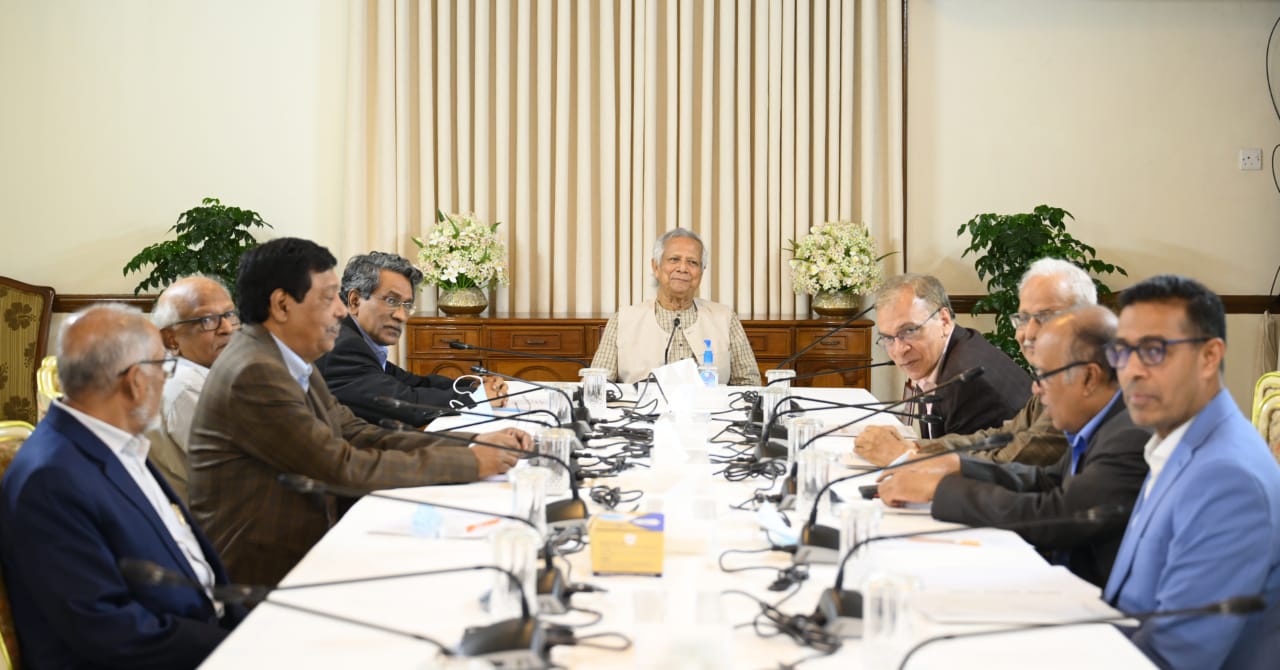

A Nation Poised for Renewal
“Amid chaos, there is also opportunity.” — Sun Tzu.
There come times in a nation’s life when time itself appears to freeze—when the weight of the past meets the promise of the future, and history holds its breath, crafting a brief instant of renewal. Bangladesh, a country that has weathered storms of political instability, economic imbalances, and institutional erosion, has reached such a point.
The current interim period, so often referred to elsewhere as a procedural pause in government, has opened in Bangladesh instead as a momentous window of opportunity for reform. More than a political transition, this is a national awakening, impelled by the insistent call for justice, integrity, and national renewal.
Led at the forefront of this hour of change is Nobel Peace Laureate Dr. Muhammad Yunus, not as a guardian, but as a moral guardian of Bangladesh’s future. Globally acclaimed as the father of microfinance and social business, Dr. Yunus presents to the country a leadership philosophy founded upon humility, vision, and unshakeable ethics. His acceptance of this role, after decades of politically driven demonization, betrays not ambition but service, not power but accountability.
His leadership requires not the specters of ancient power struggles, but the quiet strength of principled leadership. It is a renunciation of the fissiparousness and dysfunction that have long choked off Bangladesh’s promise—and a step toward a future where governance is once again based on public trust and moral guidance. Across the nation, something extraordinary is happening. Civil society groups, student activists, educators, businesspeople, and even disillusioned bureaucrats are responding to Dr. Yunus’ challenge—not with passive anticipation, but with active engagement. This is the seed of a civic renewal, one did not order from above but awakened from below.
People are summoning themselves to allow decency to triumph over cynicism, transparency to become the alternative to transactional politics, and opportunity to be available not just to the well-connected, privileged few, but to the many. The mindset is not naive but optimistic, based on the belief that real change is possible. This article aims to highlight the immense significance of this period in Bangladesh’s history—an importance that cannot be overstated. It seeks to analyze how Dr. Yunus’ caretaker government embodies a distinct paradigm of governance, one driven by ethical clarity, civic commitment, and visionary pragmatism.
Through these eyes, we will see how the seeds of institutional reform, economic justice, and diplomatic integrity are being planted in a way that can outlast any one government. We invite the reader to reflect on what it takes to rebuild a republic—not in populist slogans or élite agreements, but in conscience, competence, and compassion.
Toward a Future Worth Fighting For
As Sun Tzu would have taught us, even in disorder, there is a pattern for rebirth. Bangladesh now has that pattern in its hands. But the task to be accomplished is not Dr. Yunus’—it is ours, ours all. If sustained and nurtured, this caretaker stewardship can be the beginning of a profound national rebirth. The choice that is in front of us is not merely who would govern, but how we would want to be governed. At this historic event, Bangladesh can remake that choice, not for a term, but for a generation.
The Restoration of Trust: Leadership with Integrity
“The best way to find yourself is to lose yourself in the service of others.” — Mahatma Gandhi.
In an era marked by political polarization, institutional fragility, and widespread disillusionment, Dr. Muhammad Yunus’s return to public life as Chief Advisor to the Interim Government is a moment of rare clarity—a choice inspired not by the lure of power but by an unshakeable and profound sense of national responsibility.
Dr. Yunus assumes this role not as a career politician, but as an international statesman of impeccable integrity, dedicated to ethical leadership and public service, unencumbered by political partisanship or controversy. His life’s work as the father of microfinance and founder of Grameen Bank, for which he won the Nobel Peace Prize in 2006, has long placed him in the global consciousness as a beacon of ethical innovation and human dignity. The same principles are now being applied at the highest level of national leadership.
Rebuilding Moral Authority in Governance
One of the most immediate and vital contributions of Dr. Yunus as Chief Advisor has been the restoration of moral authority to the government in Bangladesh. Accusations of rampant corruption, nepotism, and abuse of state machinery had marred the political environment in recent years. Public confidence in institutions had collapsed, and with it, people’s trust in democracy itself.
In contrast, Dr. Yunus’s regime has acted swiftly to bring transparency, restore credibility to independent institutions, and make public offices accountable to the people, rather than to political parties. He has ordered a review of pending court cases, filled important advisory roles with neutral experts, and reconstituted election monitoring bodies with greater accountability, sending a strong message that governance must be based on justice, rather than political vendetta.
Rebuilding Moral Authority in Government
“Nearly any man can stand adversity, but if you want to test a man’s character, give him power.” — Abraham Lincoln.
Dr. Muhammad Yunus’s arguably most urgent and innovative role as Chief Advisor to the Interim Government of Bangladesh has been his unrelenting effort to revive the moral foundations of governance—a task both daunting and crucial in a nation where public trust had been dangerously eroded.
A Nation Wounded by Corruption and Cynicism
In the years leading up to the caretaker government, Bangladeshi politics had become passionately polarized. Citizens witnessed entrenched corruption, abuse of state institutions, the politicization of justice, and a patronage network that advantaged political loyalty over merit and legality. Bangladesh Transparency International issues periodic reports that rank the country highly on corruption indexes. Meanwhile, Freedom House and other watchdogs have alerted to the decreasing independence of the judiciary and election commissions. As political crises intensified, so did the public’s disillusionment with democracy itself.
A Clean Break from a Compromised Past
It is in this context that Dr. Yunus’ leadership has given the country not just a procedural pause, but a moral reboot. Globally admired for his incorruptible integrity and lifelong commitment to providing a voice to the voiceless, Dr. Yunus has infused a non-partisan, service-oriented ethic into the very heart of statecraft.
He promptly directed a thorough review of backlog corruption cases, not for selective prosecution, but to restore judicial consistency and public trust in the due process of law. His administration has reopened politically suppressed cases and expedited those unjustly delayed. These reviews are being conducted by independent panels composed of retired judges, legal luminaries, and upright civil servants, a significant departure from the past’s politicized judicial processes.
Restoration of the Integrity of Institutions
The other characteristic of his moral leadership has been the reform of key watchdog bodies. These include the Election Commission, the Anti-Corruption Commission (ACC), and the Public Service Commission—long seen as compromised—which have been overhauled with the entry of unbiased, credible professionals following broad consultations. A special bipartisan advisory council, for example, was formed to suggest suitable individuals for temporary appointments in sensitive positions based on the consensus of the wider public and political trust.
Transparency is no longer a slogan under the current administration—it is being institutionalized. Cabinet decisions, policy directives, and budgetary expenditures are now also subject to mandatory online public disclosure. An open data portal has been established in collaboration with civil society watchdogs and media, through which citizens can track government procurement, project implementation, and regulatory decisions.
Ending the Politics of Retribution
Most of all, Dr. Yunus has refused to take part in revenge politics. Despite years of personal demonization and fabricated legal accusations leveled against him, he has consistently exhibited exemplary restraint and statesmanship, devoting his energies to the pursuit of justice rather than revenge. His government has made it clear: no one will be harassed for political affiliations, but no one will be above the law either.
A Message to the Nation and the World
Dr. Yunus is sending a clear message with these initial but decisive steps, indicating that the government must be founded on justice, neutrality, and public service. The world community, including the United Nations, the European Union, and the World Bank, has welcomed this change with cautious optimism. Investors’ confidence is being regained, as reflected in the increase in remittances and FDI inquiries since the interim government took over.
The Power of Moral Stewardship
In rebuilding the government’s moral authority, Dr. Yunus is not merely cleaning house on a corrupt system; he is building the foundations of a new political culture—one that will honor competence over connections, service over slogans, and character over charisma. His example reminds us that leadership is not about ordering from the top, but about being guided by the people’s trust from below.
Listening to Leadership and Ethical Decision-Making
Dr. Yunus leads through moral clarity and quiet consultation, rather than noise. Renowned for his consensus-building leadership, he has engaged civil society, legal experts, economists, and young professionals in policy discussion—governance is thereby inclusive and evidence-based. He avoids populist slogans and political confrontation in his public lectures; instead, he speaks directly about values, duties, and the common good.
Relative to the polarized, too-often melodramatic politics of the past few decades, his leadership is compassionate pragmatism. Whether he is promoting national youth service or assisting small businesses with emergency relief loans, his style is a blend of idealism and pragmatic problem-solving that is socially business-like.
A Contrast to a Broken Political Culture
Dr. Yunus’s low-profile strength is a sharp contrast with the confrontational, personality-driven leadership styles that have long dominated Bangladesh’s politics. He has refused to employ government authority for partisan reprisals, standing firm on the rule of law and institutional independence. His avoidance of partisan rhetoric has elevated the tone of political discourse, creating space for reconciliation rather than revenge. This renewed political culture, based on trust, dignity, and discourse, has begun to win back the trust of ordinary individuals, entrepreneurs, as well as global stakeholders.
A Global Reputation as a National Asset
Bangladesh’s development partners, who had become wary of engaging with the country’s governance apparatus, are re-engaging in a meaningful manner, mainly due to the credibility that Dr. Yunus would bring to the process. His leadership has already catalyzed top-level engagement with global institutions, including the World Bank, the United Nations, and the European Union, all of which have expressed guarded optimism about support to Bangladesh’s transition process under his leadership.
A Moral Compass for a Nation in Recovery
This will possibly be a moment in the history of modern Bangladesh that will be remembered as a turning point—when the integrity and lifelong service to others of one man inspired a broader transformation of public life. As Gandhi’s words remind us, leadership is not for self-promotion but for self-effacement in service to others. Dr. Yunus embodies this ethic, and through it, is transforming a wounded nation, not with slogans, but with trust.
A New Social Contract: From Rulers to Public Servants
“Ask not what your country can do for you—ask what you can do for your country.” — John F. Kennedy
One of the transition government’s first achievements has been the drafting of a “People’s Charter for Reforms”, based on national consultations with civil society groups, youth groups, teachers, and community leaders. It is already changing the role of the government from one of domination to that of accountability through service. Ministries are now measured not in their loyalty to hierarchy, but in their impact on people’s lives.
Through decentralization, open budgets, and e-governance, Dr. Yunus is sowing the seeds of a new civic culture — a culture in which trust is not demanded but earned.
Economic Justice and the Grameen Ethic
“Poor people do not create poverty. It is created by the system we have built.” — Muhammad Yunus.
In a nation long ravaged by inequality and exclusion, the caretaker government has acted fast to institute emergency economic reforms targeting small farmers, unemployed youth, and excluded communities. The Yunus model of social business is being introduced as a national strategy, not as a replacement for markets, but as their conscience. Microfinance, social entrepreneurship, and youth startup grants are helping to bridge the urban-rural divide. The reasoning is simple but revolutionary: let Bangladesh grow not from the top down but from the bottom up.
Diplomacy with Dignity: Bangladesh on the Global Stage
“Diplomacy is the art of letting someone else do your way.” — Daniele Varè
Dr. Yunus’ international policy worldview is not based on transactional ties, but on shared humanity and respect. His diplomacy with world leaders — from Washington to Brussels to Beijing — has repositioned Bangladesh as a values-driven and influential voice in the international arena. Most critically, he has placed the Rohingya crisis at the forefront of the humanitarian agenda, galvanizing new commitments from the UN and ASEAN.
This type of restoration of dignity in diplomacy — independent of sycophancy, posturing, or dependence — is a mirror image of a self-assured Bangladesh taking its rightful place in the world.
The Awakening of Civil Society and the Youth
“Education is the most powerful weapon which you can use to change the world.” — Nelson Mandela.
The most significant change is not policy but in the mindset of the people. A new generation of Bangladeshis, who had turned their backs on public life in disillusionment, is now returning to it with a purpose. Student groups, civic organizations, and arts groups are organizing hackathons, civic forums, and social justice campaigns with renewed energy. Dr. Yunus’ call for a “Moral Nation” founded upon empathy, innovation, and ethics — is inspiring a youth-led renaissance. This awakening is not political alone; it is the reclamation of the Republic’s soul.
From Transitional Governance to Durable Reform
“A genuine leader is not a seeker of consensus but a molder of consensus.” — Martin Luther King Jr.
While the interim nature of Dr. Yunus’ leadership is correct, the foundations being established are designed to endure the transition. Electoral reform, judicial independence, media freedom, and anti-corruption drives are being institutionalized so that future governments will be accountable to people, not party interests. This is not a time-out in history but a turning point — a reboot button on Bangladesh’s post-independence history.
Conclusion: A New Dawn Beckons
“Hope is not a strategy, but without hope, there is no strategy that will succeed.” — Fareed Zakaria.
At this pivotal moment in Bangladesh’s history, the arrival of Dr. Muhammad Yunus as Chief Advisor is more than just a fixture on the nation’s political calendar—it is the awakening of a new spirit in public life. His leadership provides a moral compass in a time of disorientation, a voice of reason above the din of partisanship, and a map not drawn in terms of power politics, but in terms of moral conviction, civic honor, and national renewal.
Dr. Yunus is not motivated by intimidation or drama. He leads with clarity of purpose, integrity of action, and a lifetime of commitment to giving voice to the voiceless and hope to the marginalized. His restrained, consultative, and principle-based leadership has already begun to mend the frayed threads of the Republic. Citizens on both sides of the political, economic, and social divide are starting to feel, for the first time in decades, that fundamental reform is not only possible, but within reach.
Of course, the road ahead is steep. Entrenched vested interests remain. Regional interference still waits in the wings. And some political actors, fearful of the transparency and accountability that Dr. Yunus has begun to introduce, are trying to discredit him, not in the national interest, but to preserve their corrupt legacies. These actors are being corruptly assisted by the invisible hand of a neighboring power whose hegemonic interests have long sought to dominate the fate of Bangladesh through divide, dependency, and political puppetry.
But this time, people are looking. This time, they are not silent.
Let the following be remembered: those who would get in the way of Dr. Yunus’ selfless and noble work—for malice, corruption, or foreign agenda—do so at not just the expense of an innocent man, but at the risk of history’s condemnation. Bangladeshis will not forget. And they will not forget those who betray the nation’s desire for dignity, sovereignty, and a future free from fear and manipulation.
This is not a fleeting moment, but a national awakening, a shared moral reckoning. It is a call to build a Bangladesh where governance is holy, where public office is service—not spoils—and where the next generation inherits not dysfunction, but hope, with structure, vision, integrity, and leadership with heart.
The dawn is breaking. The question is: Who will rise with it?
0 Comments
LEAVE A COMMENT
Your email address will not be published