

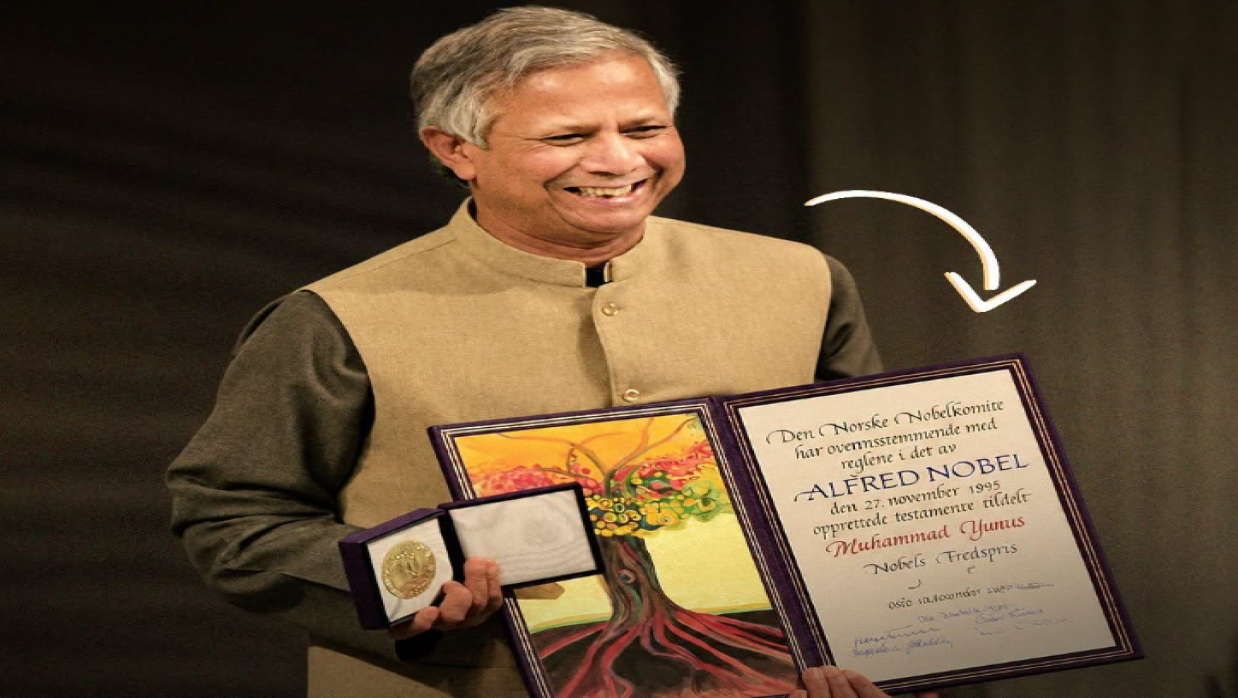
In recent years, the Awami League, which governed Bangladesh for more than fifteen years before the August 2024 mass uprising ousted it, has since intensified its public vilification of Nobel laureate Muhammad Yunus and his microcredit model.
The antagonism between the Awami League and Yunus predates the 2024 uprising.
Yunus has been subjected by the Awami League to sustained public criticism, personal vilification, and legal challenges since 2009, though the intensity of these attacks has increased manifold after the fall of the Awami League government, especially after Sheikh Hasina’s involuntary exile to India, and Yunus’s appointment as head of the post-Hasina interim government at the initiative of leaders associated with the uprising.
Awami League’s slandering of Yunus reached its vilest crescendo on October 12, 2026, when a group of New York-based Awami League activists/leaders confronted the wheelchair bound Yunus at JFK’s arrival lounge and heckled him, shouting, “You terrorist, you killed thousands, why you come here?”
The Awami Leaguers have branded Yunus as a “bloodsucker of the poor,” and portrayed his microcredit initiative as a “debt trap” that apparently exploits the poor and called Yunus “a bloodsucker.”
The Awami Leaguers have also questioned the legitimacy of Professor Yunus's 2006 Nobel Peace Prize win.
These slanderous allegations reflect a broader political and personal contest over Yunus’s role in Bangladesh’s politics, its development trajectory, and the merits of microcredit as an instrument of poverty alleviation.
Let's examine these allegations through credible research findings.
So, is microcredit a ‘debt-trap’ or a proven tool for poverty alleviation?
I have spent considerable time studying microcredit, both as a supervisor of the UN’s pilot testing of a microcredit project in Myanmar and as an academic.
In Myanmar, the UN piloted the microcredit initiative in three regions and engaged three NGOs to implement the project. Of the three, only two succeeded; the third failed because it adopted the wrong methodology.
Currently, and after retiring from the UN in 2009, I have joined as an academic at the University of Queensland, Australia, and so far have supervised five PhD students who researched the efficacy of microcredit initiatives in three different countries: two from Bangladesh—one examined the microcredit operations of Grameen Bank and BRAC and the other studied the pilot testing of microcredit among people with disabilities; and two from Indonesia, and one from Sri Lanka.
Overall conclusion?
Microcredit, as a concept, works; it can help alleviate poverty. However, its effectiveness depends critically on how programmes are designed, operationalised, and implemented. The failure of certain microcredit programmes to deliver meaningful benefits to impoverished populations often reflects a departure from the fundamental principles and practices intended to place the poor at the centre of their mission. However, microcredit cannot help the hardcore poor, who are too vulnerable to use loans productively. Indeed, one has to remember that microcredit is not a panacea. Microcredit is one of the many tools in poverty alleviation. Its effectiveness depends on how it is applied and on the poor's entrepreneurial capacity.
In other words, the shortcomings of individual programmes should not be interpreted as evidence of microcredit's inherent failure, but rather as an indication of the importance of appropriate programme design and implementation in realising its poverty-reduction potential as well as its limitations.
Does microcredit make the poor rich?
The answer is no. Microcredit does not necessarily make the poor rich; it makes the poor less poor. And that makes an enormous difference.
For millions of microcredit borrowers worldwide—most of whom are women—being “less poor” means being better able to put two meals a day on the family table and, more importantly, send their children, especially their daughters, to school.
These may seem like modest gains, but their long-term impact can be transformational. A child who receives an education has a better chance of escaping poverty, securing decent employment, and building a better future. When that child is a girl, the benefits can extend across generations.
Consider Bangladesh’s ready-made garment (RMG) industry, which employs predominantly women. A recent survey indicates that, in the industry’s early years, many female workers were daughters of microcredit borrowers. If this finding holds, it powerfully illustrates how microcredit can drive social and economic transformation—not necessarily by making one generation rich, but by helping the next access education, employment, and opportunities previously out of reach.
That is microcredit's real promise: not instant wealth, but the gradual expansion of human potential, economic opportunity, and hope across generations.
Did Yunus deserve the Nobel Peace Prize?
Yes, he did. Professor Yunus challenged the conventional assumption that poor people are poor because they are lazy or lack skills. He demonstrated that, far from being lazy, poor people often work extremely hard and possess what he aptly described as “beautiful skills.” Yet, despite their hard work and abilities, they remain trapped in poverty because they lack access to capital. Consequently, they are often forced to sell their labour and skills to moneylenders or intermediaries at meagre returns, perpetuating a cycle of poverty.
Through his action research, Professor Yunus showed that collateral-free loans could enable poor people to invest in their skills, increase their earnings, repay their loans on time, and, in the process, change their lives. However, as explained earlier, while this approach has not been overwhelmingly successful and exceptions do exist, the exceptions do not mean microcredit is a flawed concept.
Professor Yunus’s enduring contribution was to challenge the perception of poor people as helpless recipients of charity or objects of exploitation. Instead, Yunus saw the poor as capable, hardworking individuals whose potential is constrained by limited access to financial resources. This empowering vision, and its potential to advance human dignity and social justice, provides a compelling justification for his Nobel Peace Prize.
In other words, while the Awami League’s disparagement of Yunus and his microcredit initiative is in poor taste and has no basis and does little to undermine Yunus’s public standing, it risks further eroding the party’s own credibility, reinforcing the perceptions that it lacks the capacity for meaningful self-renewal and a credible political future.
Salvaging Awami League
The Awami League must recognise that denigrating a noble idea and disparaging its originator will do little to restore the party’s credibility or public trust. The party must confront an uncomfortable but fundamental political reality: when a mass uprising brings down a government, it signals a profound rupture between the governing establishment and the people it claims to represent.
The path to political rehabilitation lies not in discrediting others, but in acknowledging past failures, accepting responsibility, and demonstrating a genuine commitment to democratic principles and meaningful reform.
Thus, for those who remain genuinely committed to the party and want to see the Awami League regain its credibility and stature, the way forward is clear: reflect, remedy, and resurrect.
Reflect honestly on what went wrong, remedy the failures and excesses that brought the party to its present predicament, and resurrect it as a democratic, accountable, and people-centred political force.
I say this because, whatever its present failings, the Awami League is an integral part of Bangladesh’s history. Without acknowledging its historic role, Bangladesh’s national story would be incomplete. But history alone cannot guarantee a party’s future. That future must be earned through integrity, accountability, democratic values, and a renewed commitment to the people it claims to represent.


0 Comments
LEAVE A COMMENT
Your email address will not be published