

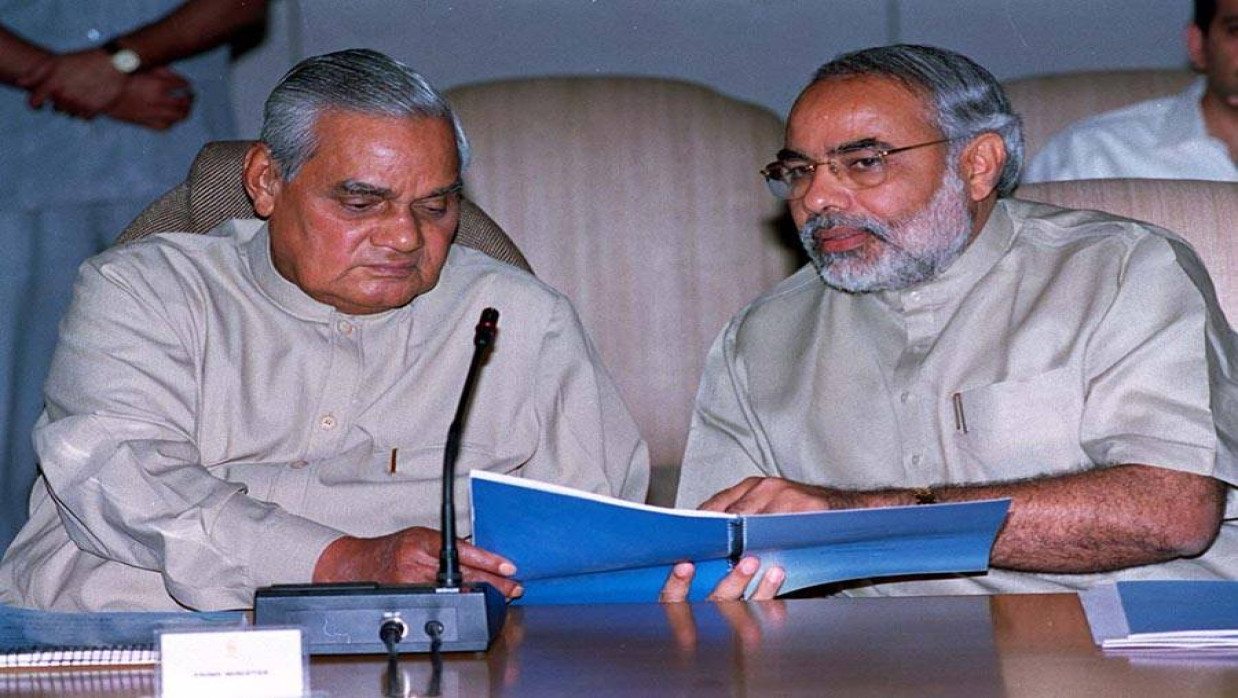
Is there a real difference between Atal Bihari Vajpayee and Narendra Modi?
The liberal commentators, journalists, and insular intellectuals from various fields claim that there is a fundamental difference between Atal Bihari Vajpayee and Narendra Modi as two BJP Prime Ministers of India. It would be disingenuous to claim that there is no difference between the two individuals. In biological terms, cloning through genotype (genetic code) duplication is possible, but environmental differences can still produce differences in phenotype, such as physical traits or lifespan. Political cloning in terms of ideology, policies, and projects is possible, but two different political leaders in two different time periods behave differently in public life and in the office of the Prime Minister. It is no different in the case of Vajpayee and Modi as political leaders from the BJP. These two leaders differ in their political and ideological evolution, grooming, political ethos, policy echoes, education, experience, and approach to political power.
The so-called liberals celebrate Mr Vajpayee as a statesman, an excellent orator, and a consensus builder, whereas they portray Mr Modi as a decisive organiser, a moderniser, and a strong leader. Liberal reactionaries such as Sudheendra Kulkarni have claimed that there is “no similarity” between Vajpayee’s and Modi’s BJP”. Even Congress leader Sonia Gandhi claimed that “Vajpayee had great respect for parliamentary procedure,” whereas the Modi regime lacks an “accommodative spirit.” In her opinion piece “The Real Difference Between Modi And Vajpayee” (The Citizen, 12 February 2015), the acclaimed journalist Seema Mustafa calls Mr Vajpayee an “intellectual” and a “democrat,” whereas she calls Modi “authoritarian.” Such characterisation provides oxygen to Hindutva politics in various ways. These commentaries are fundamentally insular and help to promote a personality cult in politics, which is detrimental to the democratic politics of change.
In politics, similarities and differences in leadership style and approach are natural and normal; they do not matter as long as politics pursues the interests of the people. This is the crux of democratic politics. Did the differences and similarities between Vajpayee and Modi as Prime Ministers make any difference to the people of India? The answer is emphatically “no.” Both Vajpayee and Modi have followed similar political, ideological, and policy trajectories that have undermined economic development, social progress, religious harmony, and organic multiculturalism in India. The social orientation, cultural ethos, ideological foundation, and approach to politics of both these BJP leaders were shaped by the RSS. Both leaders subscribed to Eurocentric ethno-nationalist dominant narratives in pursuit of an exclusionary “Hindu Rashtra,” which is fundamentally opposed to the idea of Indian social ethos and Indian constitutional values. Both believed in the militarisation of minds to pursue Hindutva politics. They are two different and dynamic faces of Hindutva fascism, which is ruining India today.
There is no fundamental difference between Mr Vajpayee’s “Shining India” campaign and Mr Modi’s campaign from “Acche Din” to “Viksit Bharat.” Both sets of campaigns are designed to hide the fascist faces of Hindutva politics and its failures in changing social, economic, cultural, and political conditions in India, where people are marginalised and suffering from various forms of exploitation and inequality. Both Mr Vajpayee and Mr Modi have followed in the footsteps of the Congress Party and its neoliberal economic policies—liberalisation, privatisation, and globalisation—which have ruined the Indian economy and inflicted an agrarian crisis on India. It destroys lives and livelihoods of people in rural India. Both leaders pursued economic policies that deepened crony capitalism in India, further marginalising working people in the country. Both are responsible for the centralisation of decision-making in pursuit of Hindutva politics. These two leaders are two sides of the same coin and ideological currency, which has no value for the unity, integrity, and progress of India and Indians.
Both leaders pursued Hindutva politics concomitant with the requirements of crony capitalism. Both celebrated Zionism and American imperialism in different ways. One did not directly criticise the American war on Iraq, and the other lacked the courage to question the American war on Iran. Both pursued foreign policies concomitant with American imperialism and the Zionist regime in Israel. Mr Vajpayee and Mr Modi have followed similar foreign policy trajectories; one was subtle in style, and the other was abruptly open and vulgar in projecting his make-believe decisiveness. There are no fundamental differences between Vajpayee and Modi when it comes to their ideological, political, and policy trajectories in making a material difference to people’s lives and livelihoods in India. In the larger political canvas of India, these individual differences and similarities do not matter to the Indian working masses. Mr Vajpayee has created conditions and steps for the rise of Mr Modi. Both leaders followed Hindutva ideology in letter and spirit in their own ways.
Hindutva as a political project works for a crony-capitalist India that is concomitant with Zionist and imperialist political and economic projects globally. The defeat of Hindutva politics and its ideological apparatus is central to reviving the idea of India that works for the people. It is the politics and policies of everyday empowerment and emancipation that can shape the India and Indians of the twenty-first century. Hindutva ideology, its politics and political leaderships are not fit for purpose. Defeat of Hindutva is the first step for the revival of India in a path of peace, progress and prosperity.


0 Comments
LEAVE A COMMENT
Your email address will not be published