

SHANTANU ROY-CHAUDHURY
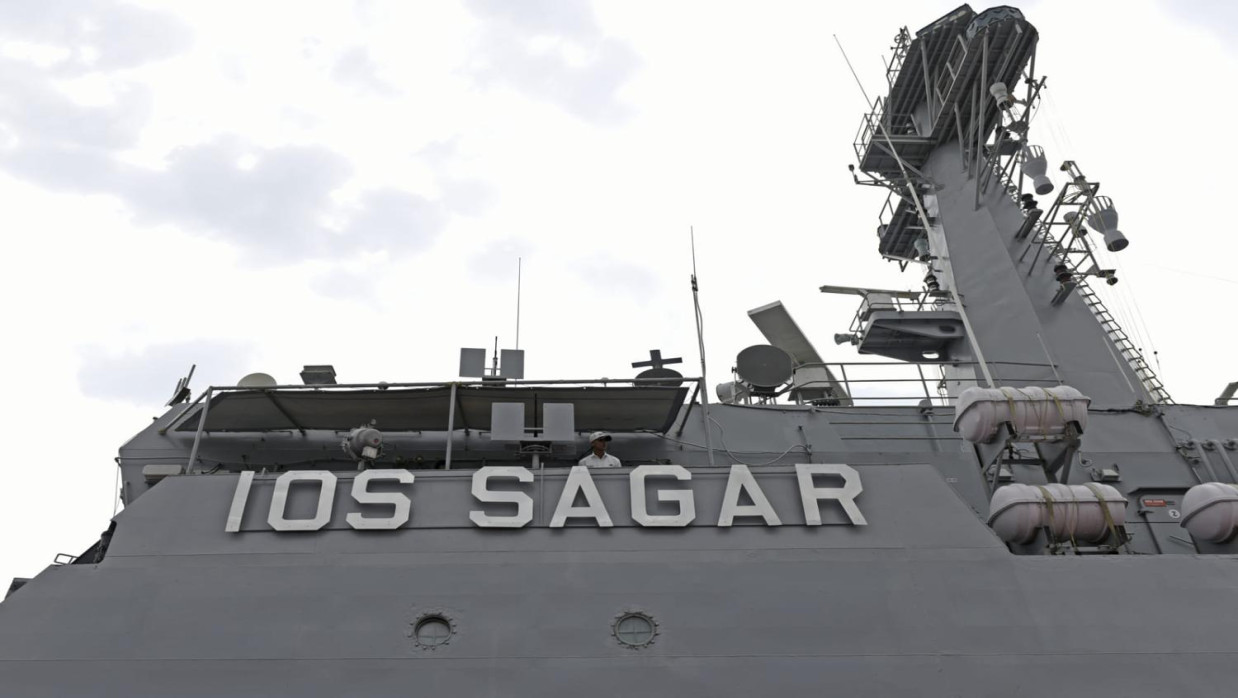
An Indian warship sailed from Mumbai last month as part of an operation dubbed Indian Ocean Ship (IOS) Sagar. On board, in addition to the Indian crew, were 38 personnel from 16 countries, for a deployment spanning the Maldives, Thailand, Indonesia, Singapore, Myanmar, Bangladesh and Sri Lanka.
This marked the second iteration of an initiative launched in 2025, with an expanded scope and a chance for New Delhi to intensify its regional outreach. The aim for IOS Sagar is to create a shared operational platform whose crew is itself a multilateral formation. Participating personnel underwent preparatory training at the Indian naval training establishments under the Southern Command in Kochi. This covered seamanship practices, maritime security concepts and naval operations as well as training to standardise communication procedures and safety protocols before sailing together for the duration of the deployment.
The interoperability being cultivated is practical and embedded in shared routines rather than just the joint communiqués that usually emerge from international exchanges. It allows the Indian Navy to impart knowledge to its partners, as well as a chance for India to learn from best practices across the region. For example, the Indian Navy can learn from the heavy automation that Singapore uses in running ships as well as from Sri Lankan proficiency in Visit, Board, Search, and Seizure (VBSS) strategies. More than other “sea rider” models which include foreign observers, the naval personnel operate as a cohesive unit aboard IOS Sagar.
ASEAN has shown increasing comfort with India as a security partner, distinct from concerns about entanglement in the US-China competition.
India’s intensified Southeast Asian engagement is both a response to China’s growing assertiveness in the Indo-Pacific and a reflection of India’s deeper appreciation of Southeast Asia’s pivotal role in regional geopolitics. The designation of 2026 as the ASEAN-India Year of Maritime Cooperation reflects this priority, along with official statements. China’s naval presence in the Indian Ocean has expanded, its research vessels operate with increasing frequency, and its defence partnerships with several ASEAN states have deepened in parallel with India’s own outreach. India’s response has focused on accumulating presence, deepening familiarity and building practical interoperability with regional navies. The scope and frequency of naval exercises have expanded, with engagements evolving to complex operational collaborations focused on anti-submarine warfare, maritime domain awareness, and humanitarian assistance and disaster relief. IOS Sagar is also a part of India’s renewed outreach to the Global South under the MAHASAGAR initiative announced by Prime Minister Narendra Modi in Mauritius in March 2025.

The IOS Sagar initiative also reflects a considered understanding of Southeast Asian strategic preferences. ASEAN has shown increasing comfort with India as a security partner, distinct from concerns about entanglement in the US-China competition. India’s value proposition in the region rests on this distinctiveness as it offers maritime capacity-building, interoperability and institutional engagement without the alliance obligations or ideological conditions that complicate partnerships with other major powers. IOS Sagar is central to this positioning – its focus on Exclusive Economic Zone surveillance, counter-trafficking, illegal fishing, and disaster response is oriented toward the functional maritime challenges that smaller Indian Ocean and ASEAN states prioritise.
Several constraints, however, remain in India’s broader Southeast Asian strategy. The economic dimension remains the most glaring gap, with structural imbalances persisting in trade and investment flows that potentially limit the sustainability of India’s regional influence in competition with China’s comprehensive economic engagement. Maritime cooperation cannot substitute for the economic density that underpins durable strategic partnerships.
Nor are the 16 nations participating in IOS Sagar a cohesive bloc. While India plays an important convening role, they include states with substantial security and economic relationships with China, states navigating their own territorial disputes, and states whose maritime priorities are primarily developmental. Sustaining their participation across future editions will require the initiative to remain responsive to this diversity of interests rather than consolidating around a narrower strategic agenda.
Whether IOS Sagar matures into a durable multilateral mechanism or remains a high-profile but episodic deployment will depend on the consistency of India’s commitment across editions, and on its capacity to demonstrate that the initiative serves regional maritime governance as much as it serves New Delhi’s strategic objectives. But the initiative’s long-term credibility will rest less on consistency of commitment than India’s willingness to share ownership – including rotating co-leadership among partner navies – to signal that IOS Sagar is a regional institution, not merely an Indian one.
The article appeared in the lowyinstitute
0 Comments
LEAVE A COMMENT
Your email address will not be published