

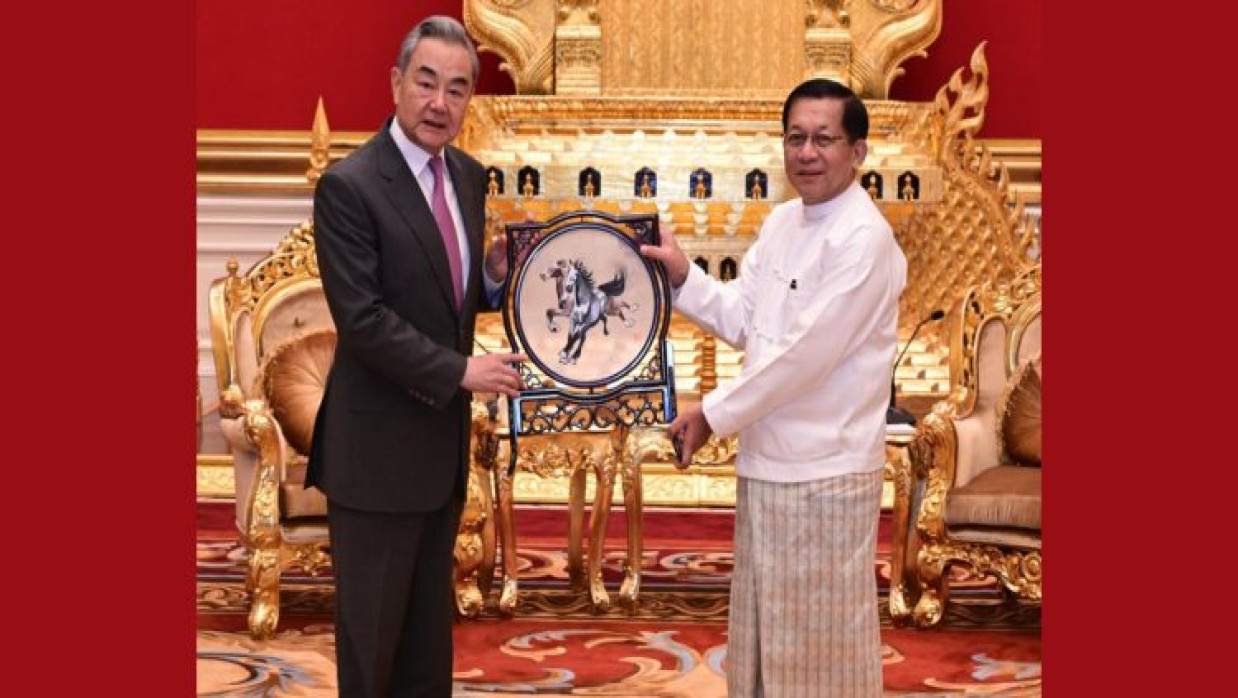
China has pledged to continue supporting Myanmar’s new pseudo‑civilian government led by Min Aung Hlaing, promising to stand firmly by the regime on the international stage and accelerate joint projects. Beijing expressed its backing for the generals during Chinese Foreign Minister Wang Yi’s official visit to Naypyitaw on Saturday.
Wang met separately with Min Aung Hlaing and Foreign Minister Tin Maung Swe. His visit was the second by a high‑level foreign delegation to Myanmar since Min Aung Hlaing installed himself as president, following Thai Foreign Minister Sihasak’s visit last week.
China’s top diplomat emphasized that Beijing would continue to support Myanmar internationally, backing its sovereignty, territorial integrity and stability. He pledged cooperation to ensure peace in border areas, facilitate trade and expand collaboration in energy, mining and agricultural technology. Wang pledged to continue to support Myanmar’s domestic peace process, and joint efforts to tackle online scam operations were also discussed, according to regime media.
“China will continue to speak up for Myanmar on the international stage and closely coordinate with Myanmar under the frameworks of the UN, China‑ASEAN [Association of Southeast Asian Nations] cooperation, and the Lancang‑Mekong Cooperation,” Wang was quoted as saying by the Chinese Foreign Ministry.
After assuming the presidency earlier this month, Min Aung Hlaing said in his inauguration speech that he intends to restore normal ties with ASEAN. The bloc has barred senior leaders of the military regime from regional summits since the 2021 coup for failing to honor its Five‑Point Consensus, which includes a call for a cessation of hostilities. Far from complying, the regime recently intensified its air campaign, driving up civilian casualties.
Wang’s visit is a boon for Min Aung Hlaing, who seeks international recognition for his presidency. While a handful of countries including China, Russia, Belarus, Thailand and Cambodia have offered congratulations, Western governments including the United States remain silent.
According to the Chinese Foreign Ministry, Wang and Min Aung Hlaing agreed to push forward with implementation of the China-Myanmar Economic Corridor (CMEC)—a component of Beijing’s international infrastructure-development scheme known as the Belt and Road Initiative—and expand cooperation on other projects. Min Aung Hlaing assured Beijing that Myanmar would not allow any activity within its territory that harmed Chinese interests.
Beijing has long pressed Myanmar to restart the controversial Myitsone Dam and guarantee the safety of Chinese personnel working in the country. The military regime has responded by forming committees to revive the dam and mobilize local support, while also advancing the Mandalay-Muse-Kyaukphyu railway project under the CMEC.
China’s pressure has already produced results in northern Shan State, where ethnic armed groups have halted fighting along the planned railway route. The project is designed to link Rakhine’s Kyaukphyu port with Yunnan Province, building a transport corridor alongside existing oil and gas pipelines.
Wang’s last visit to Naypyitaw was in 2024. At that time, Myanmar’s military junta was under pressure after suffering unprecedented defeats in northern Shan, including the fall of its Northeastern Command. Beijing’s support since then has helped the military regroup and claw back some lost territory. Eighteen months later, Wang’s return finds the regime in a stronger position, having regained ground and secured a lull in fighting in northern Shan.
Analysts say Wang’s latest visit underscores Beijing’s role as the regime’s most important diplomatic shield, even as Min Aung Hlaing continues to escalate airstrikes and offensives in defiance of ASEAN’s peace plan.
Many Myanmar people view China’s embrace of the generals with deep resentment, seeing Beijing as complicit in prolonging military rule and supporting the regime’s atrocities.
The article appeared in theirrawaddy

0 Comments
LEAVE A COMMENT
Your email address will not be published