

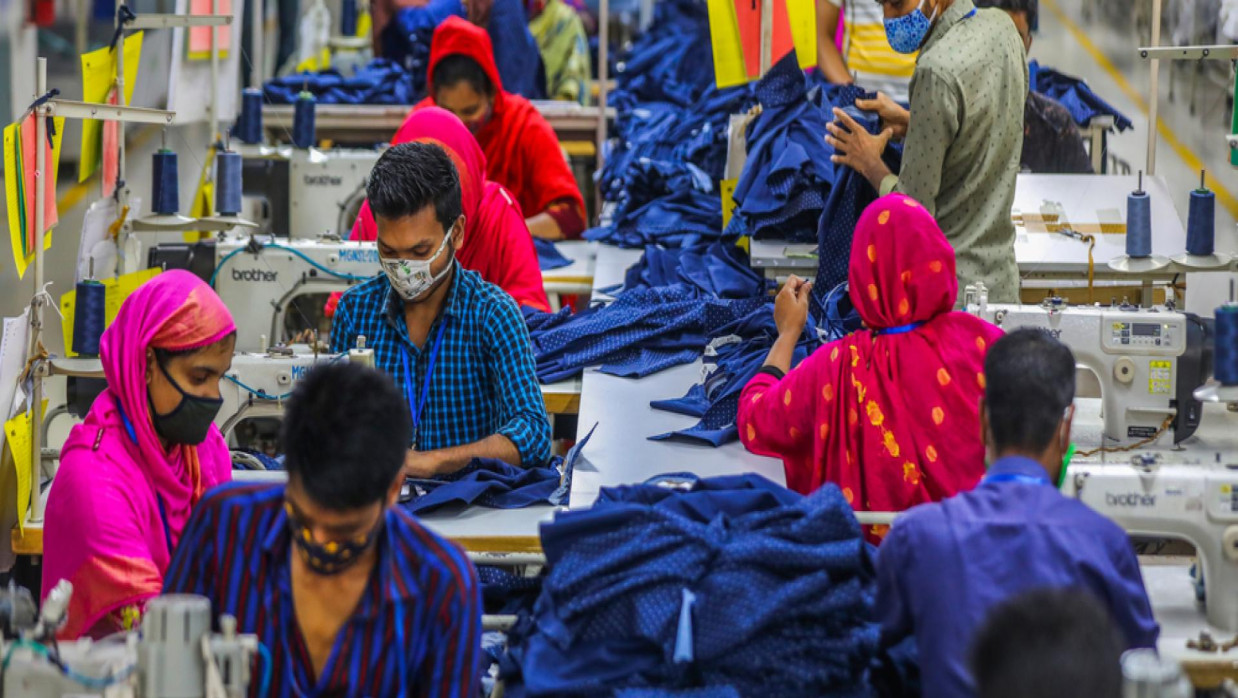
Bangladesh’s garment industry employs around 4 million workers. Their labour built something larger than an export sector – it built a tax base. The industry generates more than 80 per cent of the country’s export earnings and contributes roughly 11 per cent of its GDP. The taxes paid by workers and the wider economy they sustain fund a meaningful share of Bangladesh’s public schools and basic healthcare.
Over several decades, a country that once ranked among the world’s poorest has turned itself into a lower-middle-income economy that now meets the UN’s criteria for leaving the “least developed” category. The modern model of development worked. The question is whether any other country can replicate it in an era of artificial intelligence (AI).
This model rests on a specific sequence. Countries enter global supply chains by offering cheap labour. Employment generates household income. Income generates a tax base. The tax base funds public investment in health, education and infrastructure, which enables a gradual move up the value chain.
South Korea, Japan and China all followed some version of this path. Bangladesh followed it, too. It remains the most consistently proven path out of poverty for large populations and no other model has worked at anything close to the same scale.
AI is threatening to close that path – not by replacing garment workers with robots but by removing the reason factories moved to low-wage countries in the first place. As technologies such as AI-powered cutting machines and robotic sewing systems get cheaper, the cost gap between a worker in Dhaka and a machine in Guangdong narrows.
At some point, the logic flips. It becomes more rational to automate production close to the consumer market than to ship raw materials to a low-wage country and ship finished goods back. When that happens, the factories do not just shed workers. They stop coming altogether, and a government cannot tax a factory that was never built on its soil.
This is what makes AI different from earlier waves of automation. The threat is not mainly to jobs in existing factories, though that matters as well. The deeper threat is to the development model itself. The sequence that worked in the 20th century delivered more than tax revenue. Mass employment created household income, domestic consumption, skill accumulation and, over time, a middle class.
Theoretically, a country can collect taxes on products without employing many people, but that is not development. That is a resource economy, and the political instability of resource economies is well documented. The employment-to-redistribution chain is not just a fiscal mechanism; it is the social foundation on which stable states are built.
The global conversation about AI and jobs has a protagonist problem. Its main characters are software engineers, paralegals and financial analysts. These people have platforms and access to policymakers, and when they face displacement, it becomes a policy crisis. When the same structural force works its way through factory floors in the developing world, it does not register as an AI story at all.
The implicit reasoning in many developing countries reinforces this blind spot. The thinking is that AI disrupts white-collar knowledge work, and since they are still in manufacturing, they have time. That reasoning underestimates how quickly automation can erode a country’s competitive position before it eliminates jobs outright.
The AI governance conversation has been shaped largely by the countries that build and deploy the most advanced models, mainly focused on algorithmic bias, misinformation and loss of control. These are real risks, but they are the risks of societies that already have mature safety nets and diversified tax bases. The conversation has been broadening. India’s AI summit this year placed “impact” on the agenda, a welcome shift.
But even at its most expansive, the discussion centres on technology absorption and access, not on the structural threat to the employment-to-redistribution chain. The framing of AI governance as a US-China technology race distorts the picture further.
With hundreds of millions of manufacturing workers and a social safety net still under construction, China faces the same structural redistribution risk as many developing economies. The real divide is not between technology leaders and technology followers – it is between countries whose redistribution systems can absorb the coming shock and those that cannot.
The fiscal dimension reinforces this. Developing countries cannot easily replace lost labour taxes with corporate taxes on technology firms. Those firms tend to be foreign and have their profits booked elsewhere. The OECD’s global minimum tax reform was designed to curb profit-shifting, but it has no answer for a company that generates billions with a few dozen employees while its products eliminate thousands of jobs in countries that never see a share of its profits.
What can be done? Developing nations should push to place the fiscal impact of AI-driven labour displacement on the global agenda. They should seek a dedicated working group at the Group of 20 focused not on AI opportunity but on its structural impact on tax bases in labour-dependent economies.International tax frameworks need updating. And at the next major AI summit, the Global South should demand that the conversation address systemic risk to the redistribution structures on which social stability depends.
Bangladesh made it. For the countries still waiting, the question is not whether AI will eventually reach their factories – it is whether anyone will build those factories at all.
The article appeared in the scmp


0 Comments
LEAVE A COMMENT
Your email address will not be published