

Executive Summary
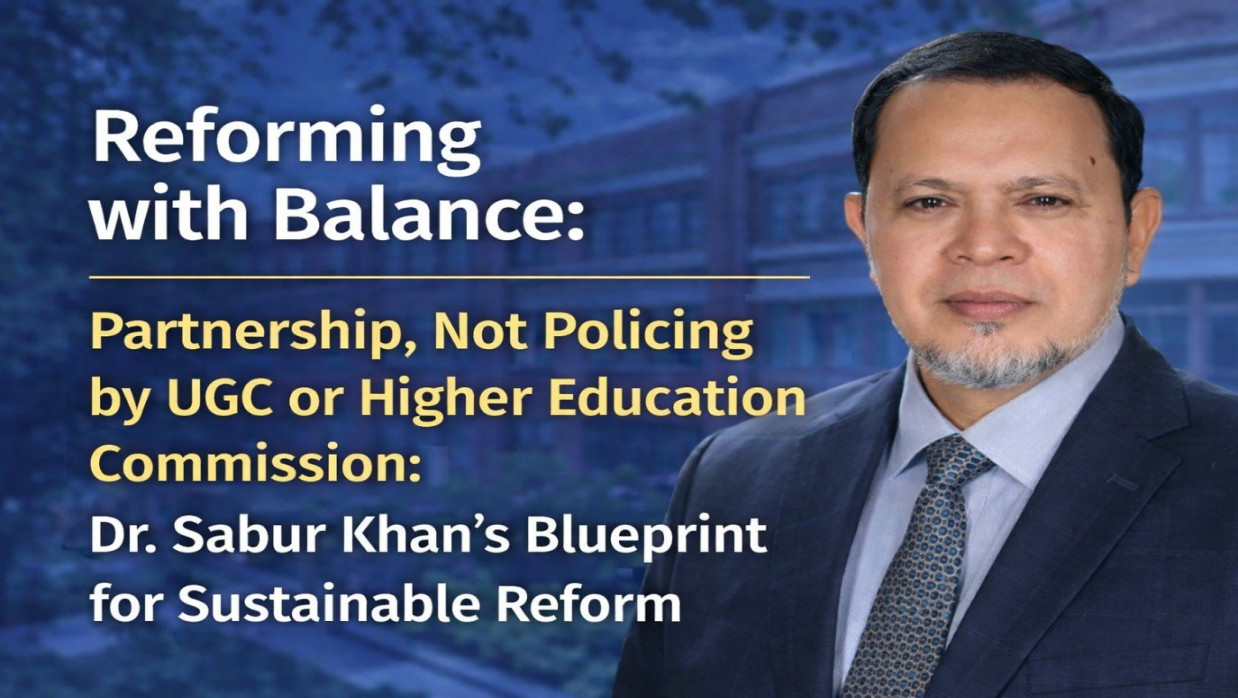
This substantive and forward-looking conversation between Dr. Sabur Khan, President of the Association of Private Universities of Bangladesh (APUB) and South Asia Journal offers a timely reflection on the proposed Higher Education Ordinance and its far-reaching implications for the future of private universities in Bangladesh. At a pivotal juncture in national education reform following the recent election, Dr. Khan presents a vision shaped by balance, partnership, and strategic modernization on behalf of APUB.
Throughout the dialogue, he advances to a clear and principled position: regulation is indispensable, but it must be proportionate, transparent, and outcome driven. Accountability, in his view, should reinforce not restrict institutional autonomy, innovation, and financial sustainability. A progressive regulatory architecture must align autonomy with measurable performance standards, embed due process protections, safeguard student continuity, and ensure that compliance mechanisms foster improvement rather than impose constraint.
Dr. Khan further underscores that private universities are not passive recipients of regulation; they are dynamic partners in national development. Their contributions to graduate employability, research advancement, entrepreneurial growth, social inclusion, and international collaboration are central to Bangladesh’s economic and intellectual progress. To realize this potential fully, he calls for evidence-based policymaking, inclusive stakeholder consultation, rational and proportional compliance frameworks, and shared financing models to support social equity.
This Q&A outlines a reform-oriented roadmap for building a globally competitive, socially inclusive, and financially sustainable higher education ecosystem. It embodies a constructive and collaborative ethos prioritizing dialogue over division, partnership over polarization, and strategic reform over rigidity.
At its heart, the message is both clear and compelling: Bangladesh’s higher education future will be strongest when government, regulators, and private universities work together as committed partners in advancing national progress and global excellence.Top of Form
1. Big-Picture Impact
SAJ: The draft Private University Ordinance 2025 proposes significantly stronger regulatory architecture for private higher education. From APUB’s perspective, what will be its most immediate structural impact on private universities academically, administratively, and financially?
Sabur Khan: The proposed Private University Ordinance 2025 introduces a significantly stronger regulatory framework. From APUB’s perspective, its immediate structural impact will be felt across three dimensions:
Academically, excessive centralization in program approval, leadership appointments, and compliance requirements may reduce institutional agility. Private universities have historically been more responsive to emerging disciplines and industry-aligned programs. If procedural layers increase without time-bound safeguards, innovation may slow.
Administratively, additional approval stages and overlapping oversight could create bureaucratic bottlenecks. Governance continuity depends on timely decisions regarding Vice-Chancellors, Pro-Vice-Chancellors, Treasurers, and academic bodies.
Financially, expanded compliance costs, audit structures, reserve obligations, and punitive provisions may disproportionately affect mid-tier and emerging institutions. Ultimately, any increase in regulatory cost risks being transferred to students through higher tuition fees.
APUB supports accountability and quality enhancement. However, regulations must be developed not restrictively and should protect student affordability and institutional sustainability.
2. Regulation vs. Autonomy
SAJ: Many private university stakeholders express concern about a potential over-centralization of authority, particularly in areas such as leadership appointments, program approvals, and financial oversight. How can the Ordinance be refined to protect institutional autonomy while ensuring accountability?
Sabur Khan: Regulation is essential, but it must be balanced. Accountability should not come at the expense of institutional autonomy. The regulation in higher education is both necessary and inevitable, but it must be carefully calibrated. Accountability, he argues, should never come at the expense of institutional autonomy. A sound regulatory framework must protect academic freedom, encourage innovation, and respect the unique missions of private universities, while still ensuring transparency and compliance with national standards.
In this spirit, APUB proposes a shift toward outcome-based regulation rather than excessive input control. Instead of micromanaging day-to-day operations such as administrative procedures, hiring decisions, or curricular minutiae institutions should be evaluated based on measurable performance indicators. These include student learning outcomes, research productivity, graduate employability, ethical governance, and adherence to statutory compliance requirements. Such an approach rewards results and institutional effectiveness, rather than procedural conformity.
APUB also calls for time-bound approval systems to eliminate bureaucratic delays that often hinder institutional development. Regulatory decisions concerning new programs, faculty appointments, infrastructure expansion, or research initiatives should be made within clearly defined deadlines. In cases where applications are denied, institutions should receive written explanations outlining specific reasons and required corrective steps. This would foster transparency, predictability, and mutual trust between regulators and universities.
Furthermore, APUB advocates for a risk-based supervision model. Institutions with strong academic records, sound governance structures, and consistent compliance histories should be subject to a lighter regulatory touch, allowing them greater operational flexibility. Conversely, institutions identified as higher risk due to governance concerns, financial instability, or academic deficiencies should receive closer oversight and targeted support. This differentiated approach ensures that regulatory resources are deployed efficiently and proportionately.
Finally, APUB underscores the importance of strong due process mechanisms within the regulatory system. Universities must have the right to a fair hearing before punitive actions are imposed, along with reasonable corrective windows to address identified shortcomings. Sanctions, when necessary, should be proportionate to the severity of violations and designed to encourage improvement rather than institutional destabilization.
In essence, autonomy and accountability are not opposing principles. They are complementary pillars of a mature higher education ecosystem. A transparent, principled regulatory architecture must allow both to coexist ensuring quality and integrity while preserving the independence that enables universities to thrive, innovate, and serve society effectively.
3. Leadership Selection & Governance Quality
SAJ: The draft introduces stricter criteria and procedures for appointing Vice-Chancellors, Pro-Vice-Chancellors, and Treasurers. Do you believe these provisions will raise governance quality, or do they risk creating administrative bottlenecks? What revisions would APUB recommend?
Sabur Khan: Stricter criteria for appointing university leaders can indeed elevate governance standards provided they are implemented with transparency, clarity, and administrative efficiency. Strong leadership is indispensable to institutional stability, academic integrity, and long-term strategic growth. However, when approval mechanisms become overly centralized or prolonged, even well-intentioned reforms can lead to administrative bottlenecks. Delays in appointing key leadership positions may result in operational uncertainty, weakened decision-making capacity, and institutional drift.
APUB therefore advocates for a balanced approach that strengthens quality without sacrificing functionality. First, the selection process should be grounded in transparent, merit-based criteria, supported by publicly available scoring rubrics. Clear benchmarks—covering academic credentials, leadership experience, research profile, governance competence, and ethical standing—would ensure that appointments are based on measurable qualifications rather than subjective discretion.
Second, decision-making must be time-bound. APUB recommends that approvals or objections be finalized within 30 to 45 days. Predictable timelines would prevent leadership vacuums and reinforce institutional continuity. In cases of delay or rejection, written justifications should be provided to maintain transparency and accountability.
Third, search committees should include both governance and academic experts to ensure a comprehensive evaluation of candidates. Such committees would benefit from balanced representation combining regulatory oversight with professional expertise so that leadership appointments reflect both compliance standards and academic excellence.
Additionally, robust conflict-of-interest safeguards must be embedded within the process. Clear disclosure requirements and recusal policies would protect the integrity of appointments and reinforce public trust in institutional governance.
Ultimately, while leadership quality is critical to the success of any university, procedural delays must not destabilize institutions. Reform should enhance governance capacity, not hinder it. A transparent, efficient, and merit-driven appointment framework can achieve both accountability and institutional stability.
4. Academic Innovation & Program Approval
SAJ: Private universities have often been more agile in introducing industry-aligned, future-oriented programs. Do you see any clauses in the draft law that might unintentionally slow innovation, and how can policy ensure both quality assurance and academic responsiveness?
Sabur Khan: Private universities have consistently demonstrated leadership in launching industry-relevant and future-oriented programs in areas such as artificial intelligence, data science, cybersecurity, health technology, and other emerging disciplines. Their agility has enabled them to respond quickly to labor market demands and technological transformation, often positioning graduates at the forefront of new economic sectors. This responsiveness has been one of the defining strengths of the private higher education sector.
However, if the draft law introduces rigid and multi-layered approval processes, particularly those requiring multiple sequential clearances before programs can be launched it risks slowing the pace of innovation significantly. In fast-evolving fields, academic programs must be designed and introduced within short development cycles. Prolonged procedural delays could render curricula outdated even before implementation, thereby undermining both competitiveness and relevance.
To address this concern, APUB recommends the inclusion of fast-track approval mechanisms for future-oriented and high-demand programs. Such a pathway would allow institutions with proven academic credibility and governance stability to introduce new programs within an accelerated review framework, while still maintaining essential quality standards.
Additionally, evaluation processes should rely on transparent, scoring-based assessment models rather than discretionary or subjective decision-making. Clearly defined criteria—covering curriculum design, faculty qualifications, industry partnerships, infrastructure readiness, and projected employability would promote fairness, predictability, and consistency in approvals.
APUB further suggests shifting the regulatory emphasis toward post-launch outcome audits rather than imposing overly restrictive pre-emptive controls. Institutions should be allowed to implement innovative programs under defined compliance parameters, followed by rigorous monitoring of measurable outcomes such as student performance, research integration, graduate employability, and employer feedback. This approach balances flexibility with accountability.
Finally, the policy framework should incorporate national systems for credit transfer and micro-credentials, ensuring that learners can accumulate modular qualifications and transition smoothly across institutions and disciplines. Such frameworks would align Bangladesh’s higher education system with global trends in lifelong learning and digital credentialing.
In essence, quality assurance must reinforce not suppress academic responsiveness. A regulatory structure that supports innovation while safeguarding standards will ensure that universities remain engines of progress in an era of rapid global academic and technological evolution.
5. Financial Sustainability & Compliance Burden
SAJ: The Ordinance introduces detailed provisions on funds, audits, reserve requirements, and penalties. How might these affect the financial sustainability of mid-tier and emerging private universities, and what policy safeguards are needed to prevent compliance costs from undermining access and affordability?
Sabur Khan: Financial governance and accountability are indispensable to maintaining trust in the higher education system. However, compliance mechanisms must remain proportional and context sensitive. If regulatory burdens increase uniformly without differentiating between large, well-established institutions and smaller or mid-tier universities the latter may face significant sustainability pressures. Excessive audit layers, rigid reserve requirements, and high compliance costs could divert scarce resources away from teaching, research, scholarships, and infrastructure development.
For emerging and mid-sized universities in particular, financial resilience is often closely tied to tuition revenue and gradual growth trajectories. Imposing uniform regulatory expectations across institutions of varying capacities may unintentionally disadvantage those still building endowments, expanding faculty strength, or investing in academic innovation. In such cases, the cumulative impact of compliance costs could restrict institutional development and, ultimately, reduce access and affordability for students.
APUB therefore recommends proportional compliance requirements based on institutional size, performance history, and financial capacity. Institutions with strong governance records and consistent compliance should not face the same administrative intensity as those identified as higher risk. A differentiated model would ensure accountability while preserving institutional viability.
In addition, the regulatory framework should prioritize digitalized audit and reporting systems to reduce redundancy and administrative duplication. Streamlined digital platforms for financial disclosure, documentation submission, and regulatory reporting would enhance transparency while lowering operational costs. This modernization would benefit both regulators and institutions by improving efficiency and minimizing bureaucratic friction.
APUB also proposes a graduated penalty structure that follows a logical progression beginning with warnings, followed by defined corrective windows, then proportionate fines, suspension where necessary, and cancellation only as a last resort. Such a tiered approach ensures fairness and encourages remediation rather than abrupt destabilization.
Furthermore, policy harmonization is needed regarding taxation policies and reinvestment in education. Clear guidelines that allow universities to reinvest surplus funds into academic development, research, scholarships, and infrastructure would strengthen institutional sustainability and reinforce their educational mission.
Ultimately, financial stability is inseparable from accessibility. When universities remain financially sustainable, they are better positioned to maintain reasonable tuition rates, expand scholarship opportunities, and invest in academic quality. Sustainability and quality are not competing objectives they are mutually reinforcing pillars of a robust higher education ecosystem.
6. Student-Centric Outcomes
SAJ: From employability and internships to credit transfer and outcome-based education, the draft law places students at the center rhetorically. In practice, what policy adjustments are required to ensure students genuinely benefit rather than face disruptions during regulatory transitions?
Sabur Khan: While the draft law appropriately positions students at the center of its language and intent, rhetoric alone is insufficient. The true measure of student-centered reform lies in the safeguards embedded within implementation. Regulatory transitions, however well-intentioned, can create uncertainty if not carefully managed. Therefore, policy must ensure that students’ academic progression, degree integrity, and career trajectories remain protected at all times.
APUB strongly recommends the inclusion of mandatory student protection clauses that guarantee credit recognition and degree continuity, regardless of institutional or regulatory changes. Students who have invested time, effort, and financial resources in their education must not face disruption due to administrative restructuring or policy revisions. Legal clarity regarding the validity of earned credits and the recognition of awarded degrees is essential.
In situations where a program faces suspension or regulatory review, structured teach-out plans must be mandatory before any final decision is enforced. Institutions should be required to provide clear pathways for currently enrolled students to complete their programs within a defined timeframe or transition seamlessly to equivalent programs without academic or financial penalty. Such measures ensure continuity and prevent abrupt educational disruption.
The policy framework should also strengthen formal industry–academia integration requirements. Internship pipelines, collaborative research opportunities, industry advisory boards, and career-placement partnerships should be embedded into program design. This ensures that outcome-based education translates into tangible employability advantages rather than remaining a theoretical objective.
Furthermore, structured grievance redress systems must be institutionalized at both the university and regulatory levels. Students should have accessible, transparent channels to raise concerns regarding academic disruption, credit transfer issues, or administrative decisions. Clear timelines for resolution and independent oversight mechanisms would reinforce trust and accountability.
Finally, graduate employability tracking should be incorporated as a key performance indicator (KPI) within the regulatory framework. Monitoring employment outcomes, career progression, and employer satisfaction would provide measurable evidence of institutional effectiveness and align educational objectives with national workforce needs.
At its core, reform must protect those it intends to serve. Students must never suffer as a consequence of regulatory transitions. A well-designed policy architecture will ensure that academic quality improves, institutional accountability strengthens, and student opportunity expands simultaneously.
7. Equity, Scholarships, and Social Responsibility
SAJ: The Ordinance mandates reserved seats and financial support for disadvantaged groups. How can the government and private universities share responsibility in financing these social obligations so that equity goals are achieved without weakening institutional capacity?
Sabur Khan: Social equity in higher education is not merely an institutional obligation—it is a shared national responsibility. Expanding access to disadvantaged communities strengthens social mobility, promotes inclusive economic growth, and reinforces the moral foundation of a nation’s education system. Private universities have already contributed significantly in this regard by offering merit-based and need-based scholarships, tuition waivers, and financial aid packages to thousands of deserving students each year.
However, if additional mandatory quotas and financial commitments are imposed without a shared financing framework, the burden may strain institutional capacity particularly for mid-tier and emerging universities. While the intent of equity provisions is commendable, sustainability must be carefully considered. Universities rely heavily on tuition revenue to fund operations, faculty development, research, and infrastructure. Excessive unilateral obligations could unintentionally weaken the very institutions tasked with advancing inclusion.
APUB therefore recommends a co-financed model of equity implementation. One key mechanism would be government matching grants for scholarship programs. Under such a framework, public funds would match institutional contributions for disadvantaged students, effectively doubling the impact of each scholarship while distributing responsibility fairly between the state and private institutions.
In addition, tax incentives for scholarship funding could encourage greater philanthropic participation and institutional investment in student support. Allowing universities to reinvest funds allocated to scholarships through favorable tax treatment would reinforce long-term sustainability and encourage expanded access initiatives.
APUB also advocates for the development of national student loan schemes designed specifically to support disadvantaged and first-generation learners. Affordable, low-interest, and income-contingent repayment models would empower students to pursue higher education without placing unsustainable financial pressure on universities alone.
Finally, transparent tracking systems should be established to monitor the enrollment, retention, graduation rates, and post-graduation outcomes of disadvantaged students. Public accountability in reporting would ensure that equity initiatives are effective, measurable, and continuously improved.
In essence, equity cannot be achieved through mandates alone. It must be co-financed, strategically structured, and collaboratively implemented. Only through shared responsibility between government and private universities can social inclusion goals be realized in a manner that strengthens rather than weakens institutional capacity.
8. Enforcement, Penalties, and Due Process
SAJ: Several stakeholders worry about the breadth of punitive powers, including program suspension and certificate cancellation. How can enforcement mechanisms be redesigned to emphasize corrective reform, due process, and proportionality, rather than fear-driven compliance?
Sabur Khan: Regulation in higher education should be a catalyst for improvement, not a source of institutional anxiety. While enforcement powers are necessary to maintain standards and protect public interest, their design and application must reflect principles of fairness, proportionality, and procedural justice. When punitive measures are perceived as abrupt or excessive, they can create a climate of fear that discourages innovation and undermines institutional morale. Effective regulation should strengthen institutions through reform, not weaken them through uncertainty.
APUB therefore advocates for enforcement mechanisms that prioritize corrective compliance windows before penalties are imposed. When deficiencies are identified, institutions should first be given a clearly defined opportunity to address shortcomings within a reasonable timeframe. This approach promotes remediation and capacity-building rather than immediate punishment.
Equally important is the requirement for mandatory hearings and written reasoning before any major regulatory action is taken. Institutions must have the right to present evidence, clarify misunderstandings, and respond to allegations in a structured forum. Written decisions outlining the factual basis and legal reasoning for actions taken would reinforce transparency and accountability, ensuring that enforcement is grounded in objective standards rather than discretionary judgment.
APUB also recommends the establishment of independent appeal mechanisms. An impartial review body would provide institutions with a fair avenue to contest regulatory decisions, thereby enhancing trust in the system and safeguarding institutional rights. The availability of appeal processes strengthens the legitimacy of enforcement actions and protects against arbitrary outcomes.
Furthermore, sanctions should be strictly proportional to the severity and nature of violations. Minor administrative lapses should not trigger severe institutional penalties, while serious breaches of academic or financial integrity should be addressed firmly and appropriately. A graduated sanction model aligned with the gravity of non-compliance would promote fairness and encourage consistent regulatory application.
Crucially, student continuity guarantees must be embedded before any institutional action such as program suspension or certificate cancellation is enforced. The protection of currently enrolled students must remain paramount. Teach-out arrangements, credit transfer options, and degree completion pathways should be secured to ensure that students do not bear the consequences of institutional regulatory issues.
Ultimately, fear-driven compliance weakens the educational ecosystem by fostering caution over creativity. Reform-driven compliance, grounded in due process and proportionality, strengthens institutions and enhances public trust. A balanced enforcement framework will uphold standards while preserving stability, fairness, and academic integrity.
9. Role of APUB in Policy Co-Creation
SAJ: What formal role should APUB play in the ongoing revision, implementation, and monitoring of the Ordinance so that private universities are treated not merely as regulated entities, but as partners in national higher education development?
Sabur Khan: APUB must be formally recognized as a strategic stakeholder in both the formulation and implementation of higher education policy. Private universities constitute a substantial and dynamic segment of the national higher education ecosystem. Their contribution to access expansion, workforce development, research, and innovation positions them not merely as regulated entities, but as active partners in shaping the country’s academic and economic future. Sustainable reform requires collaboration, consultation, and shared ownership.
To institutionalize this partnership, APUB proposes the creation of a Joint Reform Committee comprising representatives from the Ministry, the University Grants Commission (UGC), APUB, industry leaders, and respected academic experts. Such a multi-stakeholder body would ensure that policy revisions are informed by practical insights, operational realities, and labor market demands. It would also foster consensus-building and reduce policy friction during implementation.
In addition, structured implementation taskforces should be established to develop Standard Operating Procedures (SOPs), streamline regulatory processes, and design digital workflows. These taskforces would translate legislative intent into operational clarity, ensuring that compliance mechanisms are efficient, transparent, and technologically modernized. Collaborative design at the implementation stage would prevent ambiguity and minimize unintended administrative burdens.
APUB further recommends the establishment of governance mediation mechanisms to address Board of Trustees (BOT)-related disputes before escalating to the courts. Early-stage mediation platforms, facilitated by neutral experts, would promote resolution through dialogue rather than litigation. This approach would preserve institutional stability while safeguarding governance integrity.
Moreover, institutional performance dashboards aligned with national Key Performance Indicators (KPIs) should be jointly developed. These dashboards would track measurable outcomes such as student success, research productivity, graduate employability, equity participation, and financial sustainability. Transparent, data-driven monitoring would shift the regulatory culture from compliance monitoring alone to performance enhancement and continuous improvement.
Ultimately, private universities must be viewed as collaborators in national development. When engaged as partners rather than adversaries, they can contribute constructively to policy refinement, implementation efficiency, and long-term sectoral growth. A participatory governance framework will strengthen trust, align shared objectives, and ensure that the Ordinance evolves into a catalyst for collective progress in higher education.
10. Forward-Looking Vision
SAJ: If this Ordinance is revised thoughtfully, where do you see private universities in Bangladesh five to ten years from now in terms of global competitiveness, research contribution, graduate employability, and social impact? What three policy corrections are most urgent to realize that vision?
Sabur Khan: If the Ordinance is revised with strategic foresight and implemented with balance, Bangladesh’s private universities could emerge over the next five to ten years as regionally competitive institutions with growing global visibility. They have already demonstrated agility, adaptability, and a willingness to innovate. With the right regulatory environment, they can strengthen academic standards, enhance international accreditation efforts, and attract partnerships that elevate their standing within South Asia and beyond.
In the sphere of research and innovation, private universities have the potential to become meaningful contributors to national knowledge production. By investing in applied research, industry collaboration, and technology-driven solutions, they can support economic diversification and address pressing social challenges. A supportive policy framework would encourage faculty research productivity, research grants acquisition, innovation labs, and commercialization initiatives that integrate academia with industry.
Graduate employability could become one of the defining strengths of the sector. Through outcome-based curricula, structured internship pipelines, and close industry engagement, private universities can position their graduates as workforce-ready professionals equipped with both technical competence and soft skills. This would not only benefit students but also strengthen Bangladesh’s human capital development and global labor market integration.
Furthermore, private universities can evolve into active participants in international collaboration building exchange programs, joint research initiatives, dual-degree arrangements, and cross-border innovation networks. Such engagement would broaden academic horizons and foster global exposure for both students and faculty.
Beyond academic metrics, these institutions can serve as catalysts for entrepreneurship and industry transformation. By nurturing start-up ecosystems, supporting innovation incubators, and promoting social enterprise models, private universities can contribute directly to job creation and economic resilience.
To realize this vision, however, three policy corrections are most urgent. First, autonomy must be balanced with accountability through outcome-based regulation rather than procedural micromanagement. Institutions should be evaluated on measurable performance indicators—such as learning outcomes, research output, and employability while retaining operational flexibility.
Second, due process protections and robust student safeguards must be embedded within the regulatory architecture. Enforcement mechanisms should prioritize fairness, transparency, and continuity of education to protect institutional stability and student interests alike.
Third, financial sustainability must be ensured through rational compliance requirements and shared social responsibility frameworks. Proportional regulation, digital efficiency, co-financed equity initiatives, and harmonized taxation policies will help maintain institutional viability while advancing inclusion.
If these corrections are thoughtfully implemented, private universities in Bangladesh can transition from being growth-driven institutions to globally engaged, research-oriented, and socially impactful pillars of national development.
Post-Election Expectations
We respectfully look to the new government formed following the 12 February election with hope and confidence that it will approach higher education policy with balanced judgment, strategic foresight, and inclusive consultation. Reform in this critical sector cannot succeed through unilateral decision-making; it must be shaped through meaningful engagement with all stakeholders.
Higher education is a shared national enterprise. Its reform must therefore involve collaborative participation from the Ministry, the University Grants Commission (UGC), APUB, university leadership, faculty members, students, parents, and industry leaders. Each of these voices brings valuable perspectives whether in governance, academic standards, employability, equity, or innovation. Sustainable reform depends on harmonizing these perspectives within a coherent and forward-looking policy framework.
A globally competitive and financially sustainable higher education system cannot emerge in isolation. It must be built on dialogue, partnership, transparency, and evidence-based policymaking. Policies grounded in data, comparative global benchmarks, and local realities will ensure that Bangladesh’s higher education sector not only meets national aspirations but also competes confidently in the regional and international arena.
Bangladesh’s private universities stand ready to collaborate constructively in the national interest. They are prepared to contribute ideas, expertise, and institutional commitment to a reform process that strengthens quality, expands access, and enhances global relevance. Through cooperative leadership and shared responsibility, the country can build a higher education ecosystem that serves both present needs and future generations.

0 Comments
LEAVE A COMMENT
Your email address will not be published