


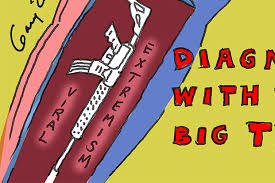
Terrorist networks have increasingly leveraged social media platforms as powerful tools for advancing their agendas. These digital spaces enable rapid dissemination of content, allowing groups to craft narratives that distort reality, amplify grievances, and cultivate support. By spreading misinformation campaigns, such organizations often seek to portray themselves as victims or defenders of a cause, thereby gaining international sympathy. At the same time, their propaganda frequently overlooks or downplays the violence they inflict on local communities, focusing instead on external adversaries. This approach not only recruits new members but also sows division and confusion globally.
The misinformation tactics used by the terrorists are advanced to influence the minds of the citizens. These are the creation and amplification of fake stories by using bots, fake accounts, and organized campaigns. An example of disinformation is emotionally charged information intended to elicit a response, such as fear, anger, or surprise, which is easier to transmit than factual information. Studies have shown that fake news on websites such as Twitter (now X) spreads 6 times faster than the truth and reaches many more people, as it is new and emotional.
An illustrative case is the Islamic State (ISIS), which, at its peak, produced high-quality multimedia propaganda to convey a message of power and invincibility. ISIS used social media to post videos, pictures, and texts that exaggerated their activities and misrepresented their enemies. In 2014, observers estimated that ISIS followers were running at least 46,000 Twitter accounts, which they used to coordinate a flood of posts on major events. Such stories enhanced the stories that portrayed ISIS as liberators, which disregarded the brutal methods used by the group on civilians.
Social media has been used by separatist terrorist organizations like the Balochistan Liberation Army (BLA) and Baloch Liberation Front (BLF) to disseminate disinformation in places such as Balochistan, with alleged foreign support of India. These organizations use counterfeit accounts and networks to advance anti-state messages, misrepresent the historical truth, and present their violent activities as rightful opposition. Investigations have shown that organized operations use fake profiles to spread propaganda, such as false statements and news, to attract support from international audiences. These are tactics of larger campaigns as terrorist networks use digital platforms to spread grievances without revealing their contribution to local instability.
In the same manner, Al-Shabaab and the Islamic State in Somalia (ISS) have also used Facebook to propagate extremist ideology in their local languages by posing as legitimate media outlets in Africa. These attempts include disinformation campaigns that steal discourse and distribution via unmoderated Telegram channels. In a report published in 2024, it was pointed out that the number of disinformation campaigns has nearly increased four times on the continent since 2022, with militant Islamist groups in West Africa using closed networks to recruit and disseminate messages. In the world, organized social media misinformation campaigns have been recorded in at least 81 countries, and every year, the number of state-sponsored and individual campaigns has been on the rise.
These tactics have been further improved by the implementation of artificial intelligence (AI). Misinformation is more believable and scalable with the help of generative AI, as groups such as Al-Qaeda and ISIS affiliates have used these technologies to generate posters, translate propaganda, and create deepfakes. In times of war, like in Gaza, AI-generated images of alleged victims have been shared to increase emotional appeal and create anarchy.
One of the main goals of such campaigns is to attract international sympathy through the depiction of terrorist networks as oppressed groups struggling against unjust systems. This entails manipulating facts to highlight perceived injustices and downplay the group's culpability. As an illustration, Russian-associated disinformation campaigns in Syria were directed against the White Helmets, a humanitarian group, and branded them as terrorists who had connections with Al-Qaeda and ISIS. These have been reinforced by bots and trolls, reaching 56 million people on Twitter during the most important news events in 2016 and 2017. By portraying rescuers as threats, the narratives undermined their efforts and gave reason to attack them, which eventually led to the killing of more than 210 White Helmet volunteers since 2013.
In Balochistan, such terrorist organizations as the BLA have used social media to create a narrative that would gain international sympathy by positioning their actions as a rights movement, which in many cases are supposedly supported by India through disinformation networks. These attempts are accompanied by organized online campaigns to disseminate false information, including fake news and propaganda to make the groups perceived as the victims of oppression and seek international support. It has been reported that these types of networks engage hundreds of fake outlets and accounts that amplify selective stories to sway public opinion worldwide.
During the 2016 U.S. election cycle, disinformation spread with fake stories, including those about Hillary Clinton and ISIS, created 8.7 million engagements, more than top stories of major news sources. Facebook had estimated that 126 million of its users viewed Russian-promoted material, and Twitter had found 2,752 accounts linked to Russia that tweeted 1.4 million times. These attempts capitalized on social differences to foster empathy for other accounts, which, in most cases, aligned with extremist agendas.
Platforms have also been used to recruit extremists, who 65% of the extremists using Facebook between 2005 and 2016 to spread views and action. This number increased to 87% in 2016, which demonstrates the transition to digital propaganda that portrays violence as righteous resistance. Al-Shabaab has been innovative in East Africa by establishing pseudo-media pages to spread its ideology and attract followers through customized content that appeals to the global audience.
One of the most notable aspects of terrorist propaganda is the selective absence of damage to local people. Tales tend to attract attention to outer enemies and paint the group as the guardians, thus dismissing the atrocities perpetrated against the civilians in their areas of operation. In the case of ISIS, propaganda focused on conquests and caliphate-building, although it seldom discussed the mass displacement, mass executions, and enslavement of local populations in Iraq and Syria. Rather, content idolized fighters and recruited by assuring empowerment, pushing internal violence stories to the back.
In Baluchistan, terrorist organizations such as the BLA and the BLF, which have been reported to have Indian support, spread messages on social media that glorify their assaults and minimize the effects on local citizens. These networks disseminate false information through platforms without regard to the death and disruption they cause to communities and instead rely on external accounts to sustain sympathy. For example, assaults on infrastructure and human life are promoted as heroic, while the damage to local economies and lives is not included in their online campaigns.
In Africa, where Russia funds 80 disinformation campaigns against more than 22 countries, the stories reinforce anti-Western moods at the expense of local destruction through allied militant forces. In Nigeria, militant Islamists recruit via the communal violence they fuel, but use Telegram to disseminate messages in local languages, which makes them appear as the protectors against foreign influences.
This selective framing is evident in hashtag campaigns and AI-generated content, where groups like ISIS produce materials that highlight "victories" without acknowledging civilian casualties. A Mercy Corps report notes how disinformation in Syria portrayed humanitarian actors as threats, leading to targeted violence while ignoring the broader human cost. Such tactics not only distort facts but also erode trust in factual reporting, allowing networks to maintain sympathy abroad.


0 Comments
LEAVE A COMMENT
Your email address will not be published