

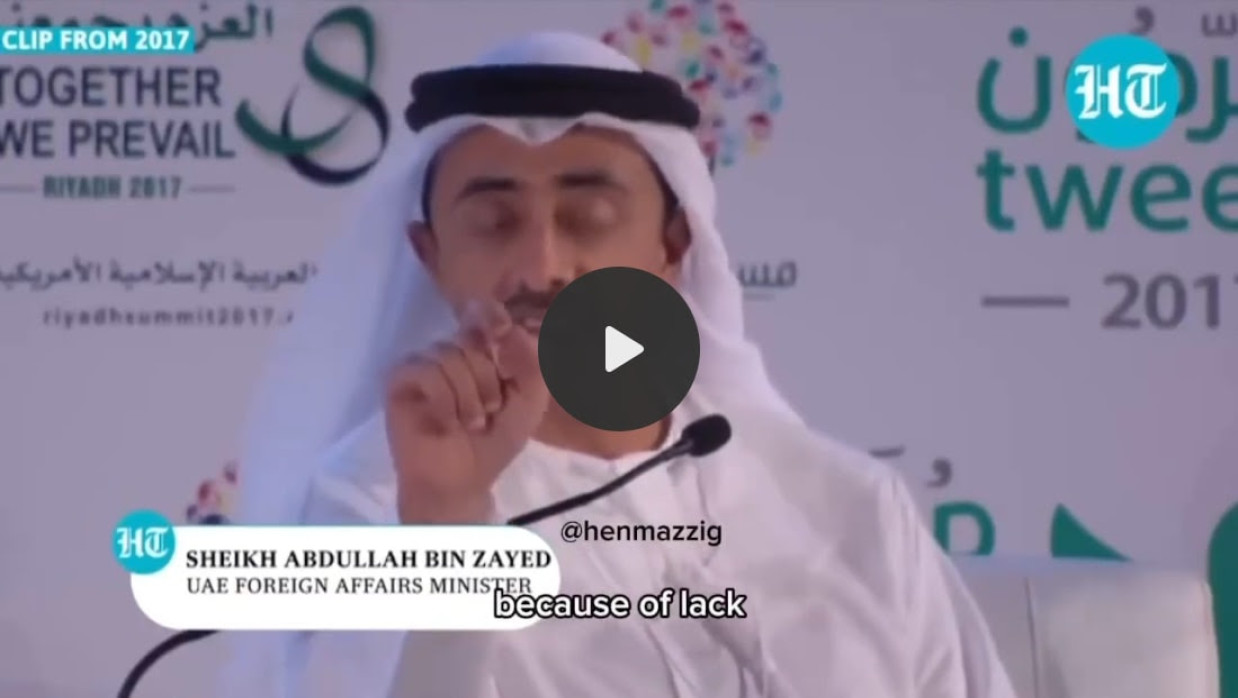
Back in 2017, United Arab Emirates Foreign Minister Abdullah bin Zayed warned that Europe underestimated the threat of political Islam.
”There will come a day that we will see far more radical extremists and terrorists coming out of Europe because of a lack of decision‐making, trying to be politically correct, or assuming that (the Europeans) know the Middle East, and they know Islam, and they know the others far better than we do…I’m sorry, but that’s pure ignorance,” Mr Bin Zayed told that year’s World Economic Forum gathering in Davos.
Fast forward to today, with Jean-Luc Melenchon, leader of the left-wing opposition party, France Unbowed (LFI), warning that the UAE was encouraging “discrimination, hatred or violence” in France.

Mr. Melonchon issued his warning as his party, the largest in the French parliament, complained to the public prosecutor that the UAE was fuelling anti-Muslim sentiment.
“LFI has become a target of the Emirates,” Mr. Melenchon wrote on his blog.
Mr. Melenchon asserted that the UAE was using his party, which is critical of Israel, supportive of the Palestinians, and refuses to label Hamas as a terrorist organisation, as a prop in its global campaign against the Muslim Brotherhood.
Critics have accused the LFI and Rima Hassan, a controversial Palestinian French LFI European Parliament deputy, of cooperating with Islamists, including the Brotherhood.
The LFI’s complaint breaks with the French political elite’s willingness to spare the UAE scrutiny because the Gulf state projects itself as a standard bearer of a socially liberal but politically autocratic interpretation of Islam, its economic and financial clout, and close ties to French president Emmanuel Macron and France’s right-wing political forces.
The LFI filed its complaint weeks before Saudi Arabia drew a line in the sand, demanding the withdrawal of Emirati forces from Yemen, where it supported secessionists in the name of countering Islamist political violence.
The complaint, like the escalation of hostilities in Yemen, highlights longstanding differences in Emirati and Saudi attitudes towards political Islam and the Brotherhood, even though both countries have designated the group as a terrorist organisation.
Obsessive in its countering of political Islam and the Brotherhood, the UAE views them as an existential threat to stability at home and across the globe. For its part, Saudi Arabia has been more willing to cooperate with the group in Yemen and elsewhere when convenient.
The LFI complaint lifts the veil on a battle in France over which Middle Eastern countries’ influence operations constitute the foremost threat.

An investigatory committee submitted to parliament a report documenting Iranian influence operations in France, weeks before the French opposition party targeted the UAE.
The report by conservative think tank France2050 asserts that Iranian diplomatic and cultural institutions have maintained a “structured system of infiltration” in France for decades.
Authored by journalists, historians, and former intelligence officials, the report described the Iranian embassy in Paris as “the European anchor of the (Islamic) Revolutionary Guards’ influence operations.”
Citing European intelligence sources, the report identified embassy staff as operatives of Iran’s intelligence ministry and the Quds Force, the Islamic Revolutionary Guards Corps’ foreign operations branch.
The report argued that the European Union’s failure to designate the Guards as a terrorist organization allowed its operatives “to travel, fundraise and coordinate freely across Schengen countries.”
The LFI’s complaint suggests that a recent controversial 75-page report on Muslims in France was part of an Emirati “influence operation” and ”served as a platform for discourse inciting discrimination, hatred or violence,” emphasising that “since its publication, several Islamophobic acts have been reported.”

The report by the French Institute of Public Opinion (Ifop) asserted that France was witnessing “a phenomenon of ‘re-Islamisation’ and a “worrying increase in adherence to Islamist ideology” as well as “an intensification of religious practices, a hardening of positions on issues of gender mixing, and a growing sympathy for radical currents of political Islam.”
The Institute conducted the survey on behalf of Écran de Veille (Screen Watch), a French-language magazine published by Global Watch Analysis, a subsidiary of UK-based Countries Reports Publishing, that toes the UAE’s anti-Islamist, anti-Brotherhood line.
In 2023, leaked emails associated Algerian journalist Atmane Tazaghart, a former France 24 editor, who acts on behalf of Countries Reports Publishing, with a UAE-funded campaign to discredit French and other European activists, journalists, and politicians, including Mr. Melenchon, former French presidential candidate Benoît Hamon, researchers at the French National Centre for Scientific Research, and former Le Monde Diplomatique editor Alain Gresh.
Mr. Tazaghart told French newspaper Liberation that Countries Reports Publishing had stopped funding Screen Watch in “2022 or 2023.” His LinkedIn profile identifies him as Screen Watch and Global Watch Analysis’s editor.
The emails implicating Mr. Tazaghart were part of a cache of 78,000 leaked internal documents that laid bare the dark side of the UAE’s promotion of its staunch anti-Islamism and the length the Gulf state was willing to go to counter the trend.

The documents revealed the UAE’s hiring of Alp Services, a Swiss company, operated by 79-year-old former intelligence agent Mario Brero, specialised in what he described as ‘dark PR.’
Alp joined a painstakingly created network of consultancies, public relations firms, think tanks, and individuals who either worked directly for the UAE or sympathised with its agenda.
Dis- and misinformation scholar Marc Owen Jones recently described what he views as a coordinated social media campaign by pro-UAE influencers.
“What looks like a spontaneous cohort of influencers is better understood as a tightly interlinked media ecosystem - one that blends dis-influencers, pseudo-news outlets, AI-assisted publishing, and institutional platforms to manufacture credibility and launder political narratives into western discourse,” Mr. Jones said.
“At the centre of this ecosystem sit some commentators with a documented history of circulating disinformation and spreading UAE-aligned propaganda,” he added.
Mr. Brero’s strategy was to “discredit targets by discreetly and massively distributing embarrassing information,” using fake social media profiles, websites, and email addresses, journalists, and tendentious whisper campaigns.”
He called his employees “mercenaries with ethics” and dubbed the targets “a mafia-like network.” In some instances, Mr. Brero characterised targets as “openly critical” of the UAE but “not directly Muslim Brotherhood.”

Mr. Macron’s office concluded that the Ifop report “clearly establishes the anti-republican and subversive nature of the Muslim Brotherhood” and “proposes ways to address this threat,” even though the report said that at most 1,000 of France’s 5-7 million Muslims were formal members of the Brotherhood and that Brotherhood-affiliated groups operated only 139 or seven per cent of France’s 2,300 mosques and 21 of the country’s 74 Islamic schools.
Mr. Macron’s embrace of the France2050 report reaffirmed his identification of Islamists and the Muslim Brotherhood as the enemy in line with UAE policy.
Speaking in the French city of Mulhouse in 2017, Mr. Macron asserted that Islam’s legal code, as interpreted by Islamists, supersedes the laws of the French Republic and accused them of advocating “Islamist separatism” and “Islamist supremacy.”
“In the Republic, we cannot accept that we refuse to shake hands with a woman because she is a woman. In the Republic, we cannot accept that someone refuses to be treated or educated by someone because she is a woman. In the Republic, one cannot accept school dropouts for religious or belief reasons. In the Republic, one cannot require certificates of virginity to marry,” Mr. Macron said.

Credit: Middle East Eye
Anwar Gargash, a confidante of UAE President Mohammed bin Zayed endorsed Mr. Macron’s approach at the time.
Mr. Macron “does not want to see Muslims ghettoized in the West, and he is right. They should be better integrated into society. The French state has the right to explore ways to achieve that,” Mr. Gargas said.
Much of Mr. Macron’s thinking appears to have been informed by French Muslims who maintain close contact with both the French and Emirati governments, including Hakim El Karoui, the French-born son of an anthropologist of Islamic law and nephew of a former Tunisian prime minister.
Mr. El Karaoui has long advocated an undifferentiated view of political Islam, the notion of Islamists being secessionists or separatists, and the belief that Middle Eastern funding and political manipulation of faith, rather than domestic and economic factors, primarily drive support for political Islam.
An advisor to former French prime minister Jean-Pierre Raffarin, university lecturer, investment banker, geographer, and author of several reports on Islam in France, Mr. El Karoui has projected the UAE as a model of best practice in countering political Islam and fostering a moderate form of the faith.
“I think the Emirates have a major role, because they have never contributed to the spread of political Islam, but rather spearheaded the fight against this very ideology,” Mr. El Karaoui said in 2019.
Dr. James M. Dorsey is an Adjunct Senior Fellow at Nanyang Technological University’s S. Rajaratnam School of International Studies, Contributing Editor to WhoWhatWhy, and the author of the syndicated column and podcast, The Turbulent World with James M. Dorsey.


0 Comments
LEAVE A COMMENT
Your email address will not be published