

.png)
Image credit: SAJ archives
31 December 2025, Dhaka
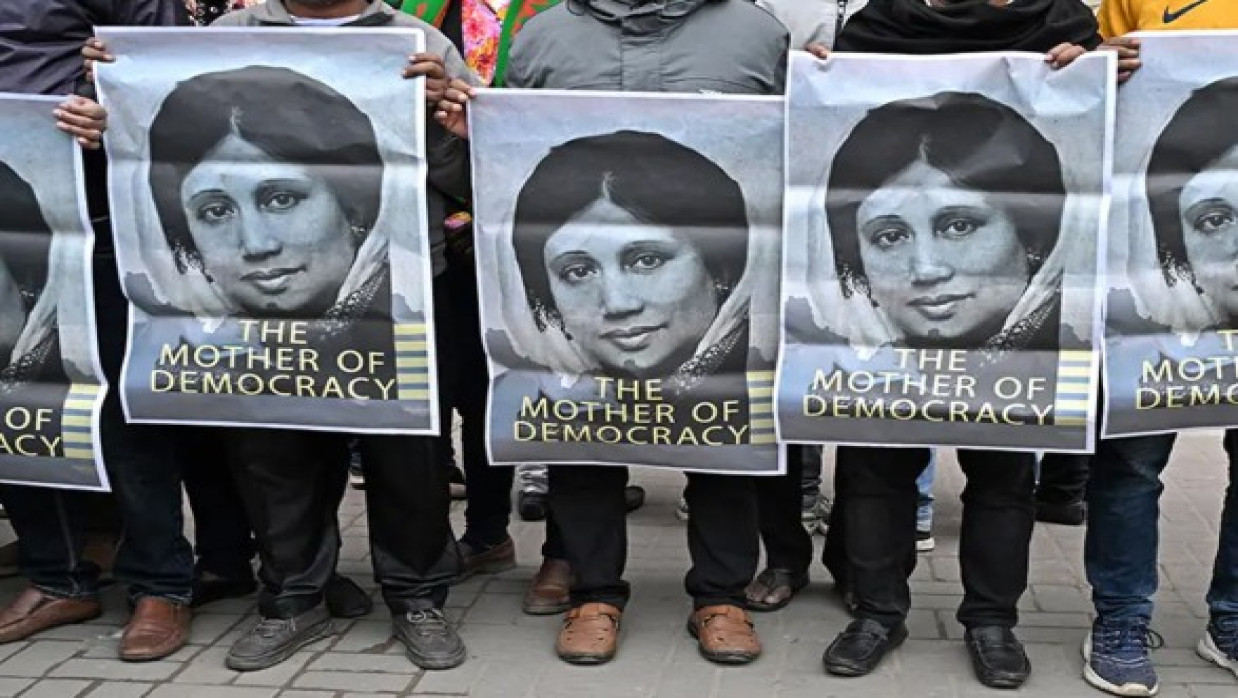
The last day of 2025 felt different. As I sat in my room on the top floor of the building where I live in Dhaka, the mood in the city was not the one usually seen before the countdown to New Year’s Eve. The city was quiet, and people seemed subdued and somber. Thousands of people from across the city and outer districts had gathered outside our building. They kept streaming to the area on foot as they came to pay their last respects to Begum Khaleda Zia and offer her a ceremonial farewell.
Khaleda Zia, a former Prime Minister of Bangladesh, passed away in the early morning hours on 30 December at a hospital in Dhaka, after a long period of ill health and a challenging last few years. With her death, Bangladesh not only lost one of its most powerful politicians since independence, but it also bid farewell to an era. Earlier in the day, her body had been brought to this ceremonial complex near the Parliament buildings to lie in state before its funeral procession and final rites. I tried to get out in the street to be closer to the procession, but could not, as people were filling the roads from all sides – older men with walking sticks and prayer caps, women with rosary beads, students in uniforms, and young and old simply standing in silence. I quickly realized that it would be impossible to get close to the streets, so I went back to my rooftop and decided to watch it all from there. What a sight it was. Thousands and thousands of people had come, and the density of people was such that from the rooftop, one could not even see the edges of the sea of mourners.
Khaleda Zia died yesterday at 6:00 a.m. in a Dhaka hospital. A period of national mourning was declared, and offices and other official work were shut down on 31 December. New Year’s Eve parties and celebrations at hotels, restaurants, and clubs were also called off, as the whole nation chose mourning over celebration.
As I watched the funeral procession on the rooftop, my thoughts went back more than 40 years, to the same venue at a funeral in May 1981 of another head of the government of Bangladesh, President Ziaur Rahman. I saw his funeral on 30 May 1981, in which he was assassinated. I was in Dhaka at that time, and my family and I had arrived from the United States that very day, arriving at the Dhaka airport early in the morning. We also watched the procession carrying his body to the burial site, behind the Parliament complex.
The outpouring of emotion at the death of Khaleda Zia yesterday was overwhelming and moving, on television as well as on social media. Eulogies and reminiscences were continuous on TV, and social media was also full of praise and tributes. I witnessed not one but two state funerals for the two most impactful national leaders of Bangladesh after independence, both of whom made lasting changes to the country’s governance, development trajectory, and role in the world.
It is also interesting to note that almost everyone, regardless of political alignment, spoke with genuine appreciation of the fact that Begum Khaleda Zia was known to be mild-mannered, reserved, and soft-spoken. She is also known never to have indulged in public mockery or demeaning of her political opponents, which, sadly, is a significant tradition of Bangladeshi politics.
It is an honor and a humbling experience to have witnessed, from my rooftop, the last rites of two of the most iconic figures in Bangladesh's political history. As I watched the crowds from the rooftop, I also took some photographs, not as a record but more for myself, to remember. I had seen with my own eyes not only the funeral of the former President of Bangladesh, Ziaur Rahman, who died a violent death in 1981, but also the final rites of his widow, Begum Khaleda Zia, who died of natural causes in 2025. Not many of us get to see such things in our lives, or over such a spread of years.
Ziaur Rahman was one of Bangladesh’s most transformative leaders. He came to power after the Liberation War of 1971, but his early career was as a soldier in the War of Independence. He became popular as a disciplinarian who could get the war-ravaged, famine-stricken, and factionalized nation moving forward towards unity and recovery. He reoriented foreign policy, reached out to Southeast Asia and the Middle East as well as to the West, pursued a pragmatic approach, opened the economy to private enterprise, emphasized self-reliance and rural development, and introduced multiparty politics after a one-party rule by the Awami League.
He laid the foundations for a new kind of Bangladeshi nationalism, built around sovereignty, faith, culture, and national independence from external forces and influence. He also rehabilitated the armed forces, restoring discipline and morale after a period of factional violence, and left a decisive imprint on the nation.
In the months following Zia’s death, his wife, Begum Khaleda Zia, was thrust into national politics almost against her will and despite her own lack of any political experience or interest. She came to the forefront and eventually became a leader in her own right, serving three non-consecutive terms as Prime Minister of the country. She is the first woman Prime Minister of Bangladesh, and one of the first female heads of government in the Muslim world to be elected by the people.
Her premierships are associated with the return of parliamentary democracy in Bangladesh in 1991, with the introduction of a caretaker government system to oversee free and fair elections, with a marked expansion in female education and increased roles for women in public life, and with significant improvements in food security, microfinance, and export-led growth, particularly through the ready-made garment sector.
Khaleda Zia’s political life was not without controversy, acrimony, conflict, and confrontation, as one would expect in a deeply polarized and partisan country like Bangladesh. She was at the center of national political battles, and there was no love lost between her and her principal rivals in the Awami League and the Bangladesh Nationalist Party. But even those who criticized and opposed her in politics, including in the most vitriolic ways, have acknowledged that she bore misfortune, injustice, and adversity in silence. Despite repeated imprisonments, house arrest-like conditions, exile-like isolation, health shocks, and multiple long-term legal travails, Khaleda Zia bore her fate quietly and with a measure of stoicism, and she did not attack others in the same way that she was repeatedly attacked.
As I stood on the rooftop, as the sun set on 31 December 2025, Bangladesh was quiet on New Year’s Eve. The people paused and mourned the passing of an era. The last rites of Khaleda Zia were also a remembrance of Ziaur Rahman. I cannot say that this was the end of 2025 I had imagined or planned for at year’s end. I could not help but feel a deep sense of gratitude for having lived through these past 44 years and for having been in the same city for the last rites of the two most defining leaders of the country after independence. I know I will remember it and reflect on it for the rest of my life.

0 Comments
LEAVE A COMMENT
Your email address will not be published