

Image credit: The International Press Institute (IPI)
How post-Hadi violence, media arson, and a lynching are being weaponized to delegitimize a democratic transition, and why careless narratives risk igniting a regional crisis
In Memoriam: A Nation in Mourning, a Society Under Strain
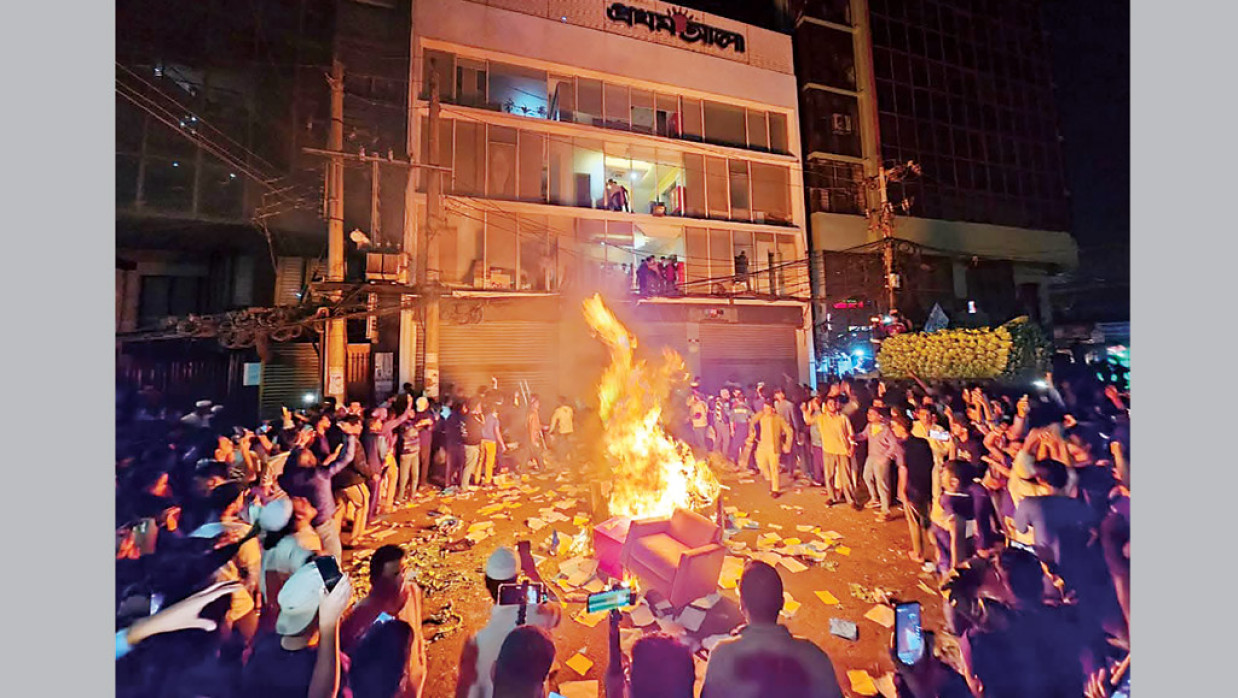
The violence, arson, and lynching that have accompanied the widespread grief and political upheaval since the murder of Osman Hadi have taken Bangladeshis to one of the most critical and volatile points in the country’s recent history. What began as a grief-stricken, human solidarity movement against injustice has, in some parts of the country, morphed into a campaign of criminal violence: the torching of newspaper offices and the vandalization of media outlets across the country, and, most horrifically, the lynching and immolation of a young Hindu man. This is a repulsive crime, an act of abject barbarity, and in no way protest, nor resistance, nor indeed politics. As such, it should be unequivocally and unambiguously condemned. However, condemnation alone is no longer sufficient to address the more profound crisis Bangladesh now faces.
What the country is also witnessing is an insidious battle over narratives, one in which the criminality on its streets is being aggressively leveraged to obscure responsibilities, ascribe blame, and manufacture political legitimacy. At the center of this is one deceptively simple but powerfully political word: mob.
The careless and willfully opportunistic invocation of this term by domestic and diasporic opponents of Bangladesh’s interim government, on both sides of the border, poses a real danger to any democratic transition in Bangladesh, threatening to weaponize a moment of fragility to justify repression at home and interference abroad, as well as the freezing of the regional status quo, which risks enshrining both of these dangerous impulses.
It bears repeating: Criminal acts are real. Their targets, consequences, and legacies are as well. But so too is their exploitation.
Mobocracy, Opportunism, and Instability: The Interest in Chaos
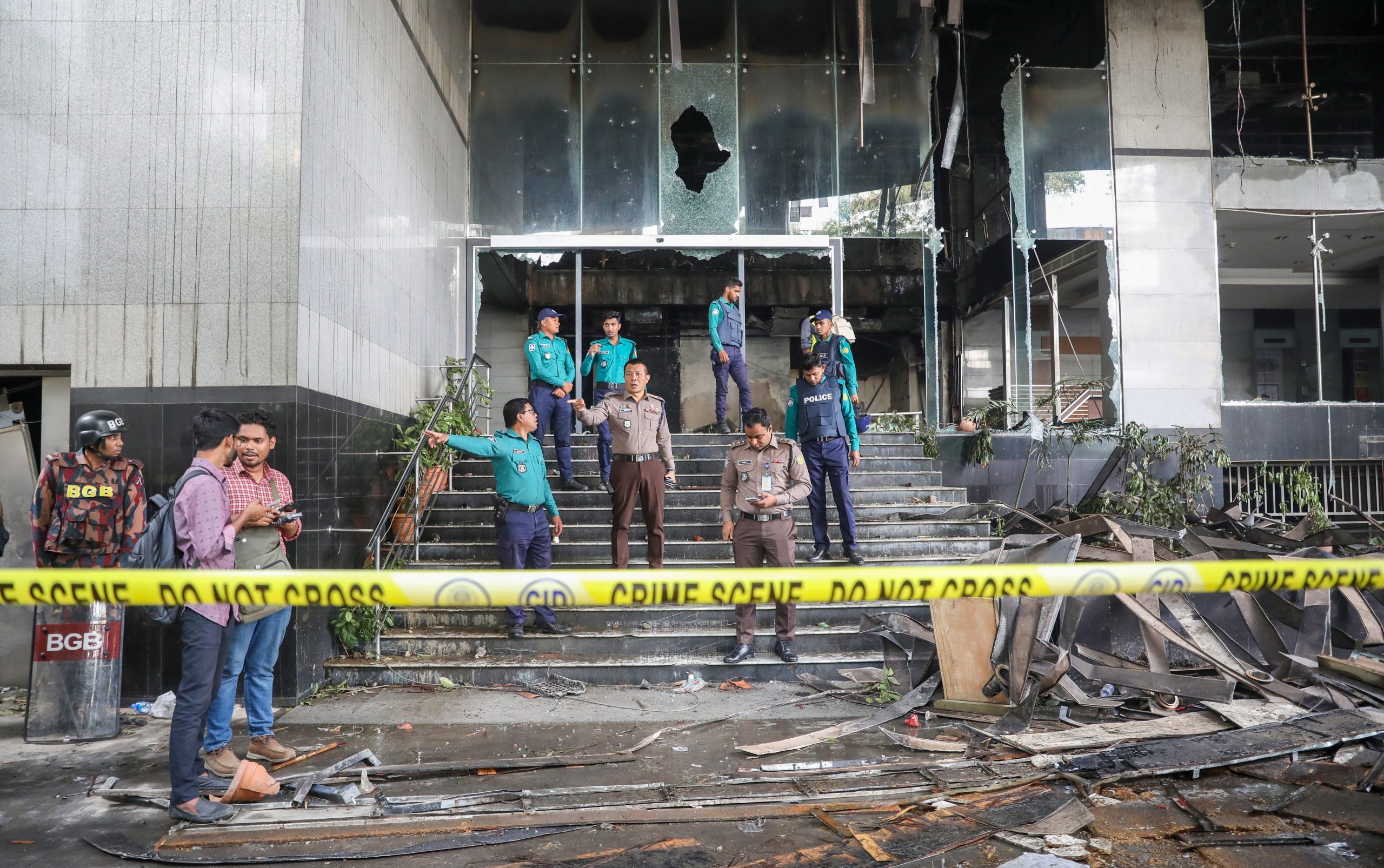
The lynching of a Hindu garment worker by a mob of provocateurs accusing him of blasphemy is an atrocity that must be punished. The arson attack on the offices of Prothom Alo and The Daily Star, two of Bangladesh’s most well-respected, prominent, and independent journalistic institutions, is an assault on press freedom that should be answered with the full force of the law. These were not symbolic gestures. People were working in those buildings. Lives were put at risk. Terror was the objective.
But if there is a question to be asked about these attacks and what they signify, it is not only about what happened, but who stands to gain from what is being said about them.
Political chaos is a resource for one actor in particular: the remnants of Bangladesh’s Awami League government. To those figures, disorder is not simply a nuisance; it is strategic. Chaos helps to buttress the argument that Bangladesh cannot function, that it cannot transition to a democratic normalcy, in the absence of authoritarian controls. It is this central claim of the Awami League’s communications strategy in exile, one which has a vocal platform, access to political patronage, a vast ill-gotten reserve of wealth, and the informational space that results from operating from Indian soil. In that space, the League has ramped up, over the past few weeks, its message: that Bangladesh is burning, that there is no government, no order, that elections, the solution offered by their opponents to counter these narratives, would amount to empowering the rioters, the arsonists, the mobs.
The specter of instability is, to some degree, a rhetorical resource for Indian interests as well. In the discourse of New Delhi, Bangladesh constantly teeters between Islamism and India, with stability serving as a function of Bangladeshis abasing themselves in supplication to Delhi. It is this long-standing stereotype of Bangladeshis perennially heading, if left to their own devices, to Islamist shores, which provides the framework for Indian policy narratives towards Bangladesh. This framework is now being weaponized.
The Case of Nurul Kabir: Evidence of State Paralysis?
The most sobering of those voices speaking on this moment is the editor of New Age, Nurul Kabir, and the president of the Editors’ Council. In an interview with Prothom Alo, Nurul Kabir raised a powerful, moral charge against state paralysis in the face of both the violence in Dhaka and the arson of the press institutions with which he is closely associated.
Mr. Kabir is not someone who casts a conspiracy charge lightly. He recounts here the experience of frantic phone calls to ministers, advisers, and officials as fire raced through the building in which many colleagues were trapped. He details the disquieting response: “instructions were given, but nothing was done on the ground,” he is told. “The office people were called back in embarrassment.” Crucially, when asked in these frantic minutes when the fire services would be mobilized, these authorities had to concede they had “to contact them.” It was only when Kabir, himself, arrived at the site that assistance was mobilized, by which time damage had been done.
His conclusion is clear, if it were not already apparent: either the government has failed to mobilize against the arsonists because of a section that was actively complicit in the arson, or the government as a whole has failed to respond. This is a damning indictment, not of an ideological proximity to the arsonists, but of a failure of the state, an abdication of responsibility from a government in the face of an attack on life, on institutions, and on the rule of law itself.
This is a striking testimony. It is perhaps even more so for his observation, in light of it, that the attackers did not bear any organic link to Bangladesh’s mainstream political, intellectual, or journalistic movements. When they were provoked to point out that the attack was being carried out by individuals who shouted slogans including “Awami League” and “Sushil,” these could be chanted only as curses, stripped of meaning. It was not politics. It was plain nihilism.
The Word “Mob” as Political Description or Delegitimization?
In that rhetorical choice lies the whole crux of the matter. For some mobilizing in Bangladesh, it is no longer enough to describe unlawful crowds as mobs, mobs as violators, or mobs as violent Islamists. The word has become a political accusation.
The use of the term mob, in today’s discourse is a totalizing and indiscriminate one, one in which no distinction is made between criminals, professional provocateurs, grieving citizens, angry protesters, and religious fanatics; one in which mobs are both lawless and a justification for silencing public deliberation and political participation writ significant. The moment society is described as a mob, the mobilization of that society is, in turn, portrayed as a dangerous proposition; democracy seems reckless, and authoritarianism begins to seem prudent.
In short, this is an old colonial trope, one long used to describe everything from anti-imperial movements to all postcolonial dissent. In the present context, it is being used as a strategy, both domestically and cross-border, to suggest that, in the post-Hasina era, Bangladeshis are ungovernable or are incapable of self-governance without strongman rule.
This is false and dangerous.
Mob Rule: The Argument and the Warning
Indian Congress MP Shashi Tharoor’s remarks on “mob rule” in Bangladesh illustrate the bifurcated, ambiguous, and ultimately perilous crossroads at which Bangladesh and India now stand. As someone quick to highlight Hindu-Muslim tensions within India, to demand the invocation of national security laws against pro-CAA protestors and those sympathetic to them, who has applauded Bangladesh’s transitional government for its restraint and statesmanship in the face of a nascent majoritarianism and the post-Hadi grief movement, as well as their relative tolerance of domestic political speech, his concern at the lynching of a Hindu citizen, and the threat it poses to democratic normalcy, is entirely understandable, even laudable. No democrat can be indifferent to this moment in Bangladesh.
Yet his remarks also, problematically, betray an asymmetry of standards at work, one in which Indian tolerance of mob lynchings, attacks on journalists, religious rioting, assaults on democratic institutions, and the encroachment of majoritarian authoritarianism has gone with far weaker outcry, far weaker penalties, and far weaker accountability than what is being demanded of Bangladesh in the present moment, yet is being rapidly reframed as a regional security issue, Bangladesh’s most serious national security crisis since 1971.
For Indian media amplification of this violence has followed a dangerous and predictable template: to describe, despite all evidence to the contrary, isolated crimes as systematic, to present their occurrence as proof of an Islamist takeover underway in Bangladesh, and to ignore, through disproportionate moral silence, widespread condemnation of the attacks, as well as, for all that is being said of Hefazat politics as the core of the problem, the provocation of this violence by non-state actors. The result is predictable: public outrage in India and an emboldening and entrenchment of hardline attitudes on both sides of the border, with groups like the Vishwa Hindu Parishad incendiary as ever, painting the lynching of a young Hindu man not as an abhorrent crime in need of justice but as the proof of a civilizational threat and incitement to mobilization in reaction to it.
Islamists Are Not Bangladesh’s Mobocracy
Drawing a clear distinction between Islamist ideology and mobocracy is crucial. This lynching of a Hindu young man, while a horrific atrocity, was not governance. It was not an act of theology, nor popular will, and certainly not popular mandate. It was murder. The police, the law, and the Bangladesh government must ensure that those identified as culpable are prosecuted swiftly and publicly. Anything less will rightly serve to delegitimize the state.
But to then, in turn, describe these crimes as evidence that “Islamists are taking over Bangladesh” is a willfully disingenuous and facile sleight of hand. The Islamist parties, it bears repeating, do not run the interim government. They do not have the authority to deploy riot police or to use the prisons. They were not the ones who ordered the torching of newspaper offices. Bangladesh is facing, instead, a combustible confluence of criminal networks, spoilers, and an already weak state apparatus, not an Islamist putsch.
The Awami League and the Long Silencing of Dissent
The Awami League’s rhetoric in the present context is as contemptible as it is cynical. It was itself, in the last 15 years of authoritarian rule, responsible for the extrajudicial killing of its critics, the silencing of dissent, the enforced disappearance of opponents and dissidents, of journalists and academics. It was the League that won elections through fear, not consensus; silence, not peace.
The Narrative Temptation: Playing into Regional Fire
A Bangladesh-India confrontation would serve neither country’s interests, but the current responses from both sides risk only exacerbating it. The Indian establishment, in its sheltering of Awami League figures and political leaders, its amplification of selective outrage, and its toleration of this ill-informed, inflammatory rhetoric, risks, deliberately or not, fanning the flames of this regional fire.
Pressure and humiliation are never merely productive responses from the addressee. It almost always produces counter-pressure and backlash. The interim government in Dhaka, however, must also avoid the opposite mistake of confusing the deferral of legitimacy with the absence of legitimacy. Violence must be condemned, not tolerated. Journalists must be protected, not marginalized. Minorities must be made secure and safe from harm, and those who attack them must be made to feel that their political cause does not grant them immunity from the law. Failure to do so would rightly be read as complicity. Such ambivalence cannot be an option at this late hour.
Calibrating Language, Restoring Institutions
Bangladesh now faces two paths: one towards authoritarian regression in the name of fear, the other towards the rocky, imperfect road to democratic normalcy and institutional repair.
The first step on that road is one of linguistic precision. We must reject the careless deployment of inflammatory language in the media. Not every crowd is a mob, not every political demonstration is mob rule, not every critic is an extremist, and not every criminal is a true believer in any ideology. Language is power; language sets the register for policy.
The second step must be one of justice, visible, swift, and impartial, of both those who have lynched, burned, and terrorized, and of those who incite, fund, and shelter this violence, from inside and outside of the country. The third, for regional actors, is to step back from escalation. Bangladesh does not need to be lectured to, but requires the space to begin the long, hard work of institutional repair, to come to terms with the crime and, finally, to move forward.
Osman Hadi’s murder is already a terrible and irredeemable loss. Let us not, in our memory of him, let us not reduce Bangladesh to a caricature of mobs, of chaos and ungovernability, let us not give up on its fragility, real and risk-accepted, and let us not allow that fragility to be weaponized by the vested interests of an entrenched, outgoing elite and its regional patrons into a project of communal hatred and division. Bangladesh deserves better. It deserves this moment of dangerous and extraordinary vulnerability, fragile as it is real, to transition to something better than where it came from, and to govern itself with dignity.


0 Comments
LEAVE A COMMENT
Your email address will not be published