As geopolitical tensions realign global power centres, the trilateral forum of Russia, India and China (RIC) is seeing renewed diplomatic interest. While Moscow has expressed optimism about reviving the grouping and Beijing seems to support the idea, New Delhi has walked a cautious tightrope between signalling openness and managing its strategic autonomy.
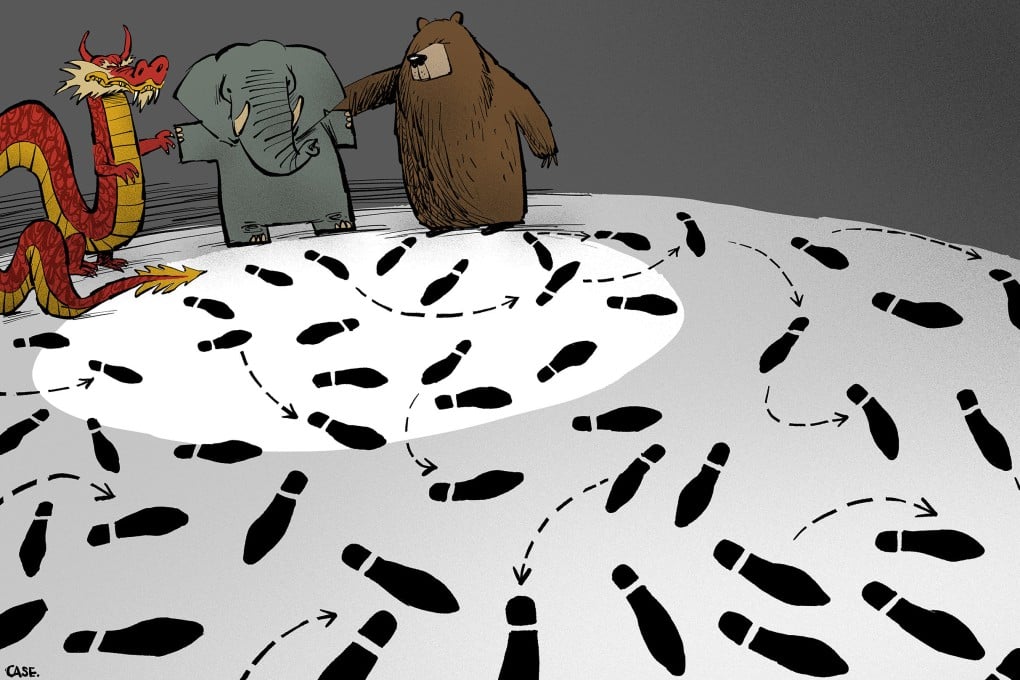
Against the backdrop of an increasingly transactional and multipolar world, the question arises: Can the elephant, the dragon and the bear truly dance together again, or is this just strategic choreography shaped by necessity?
For Moscow, the RIC revival serves a dual strategic purpose. Isolated by the West over the Ukraine war and facing sweeping sanctions, Russia finds itself increasingly dependent on Asian partnerships to sustain its economy and counter international isolation. Russia sees the triumvirate as a low-cost yet high-visibility stage to show it has partners who hold weighty stakes in Asian stability. Russian Foreign Minister Sergey Lavrov’s call for RIC revival in June reflects Moscow’s diplomatic imperative as well as projects it as a regional mediator.
RIC offers Russia a multilateral forum to demonstrate non-Western solidarity, and this revival has the potential to strengthen the Brics bloc, which is of utmost importance for Russia to counter Western institutions such as the Group of 7 (G7) and the International Monetary Fund. Moscow arguably stands to gain the most from reviving RIC, leveraging the platform to reaffirm its Eurasian influence while subtly balancing its deepening reliance on China.
This latter relationship, though mutually beneficial, has raised concerns about growing asymmetry. RIC would allow Moscow to engage both India and China on an equal footing, reinforcing its image as an independent power, maintaining strategic flexibility and reducing the risk of being overshadowed by China in a bilateral setting.
Will India and China’s new border deal lead to long-term peace in the disputed Himalayas?
China’s support for RIC’s return is neither sentimental nor symbolic. When asked about RIC at a press briefing, Foreign Ministry spokesman Lin Jian indicated that China-Russia-India cooperation was essential for regional stability. However, China is focused on the People’s Liberation Army’s modernisation goals and potential Taiwan-related contingencies. As Beijing sharpens its focus on maritime priorities, it is keen to stabilise its continental flank with India, with which relations have remained tense since the 2020 Galwan Valley clash.
China likely sees the RIC revival as a diplomatic lever to avoid multi-front economic complications amid the US-China trade war and tensions with Europe. Additionally, it would serve as a signal to the Global South that China still champions inclusive, multipolar institutions, as well as a flexible channel to test India-China rapprochement without committing to a full bilateral reset – something that would require resolving questions around their shared border, a key priority for India.
China’s engagement with India remains layered. While its support for India’s counterterrorism efforts in response to the US designating The Resistance Front a terrorist organisation indirectly put pressure on Pakistan, Beijing has also subtly signalled coercion to India. Recent moves, such as hampering India’s auto sector with rare earth export controls and halting shipments of speciality fertilisers used by India’s agriculture sector, show China still has the upper hand with its economic tools. Last month, it was reported that Apple supplier Foxconn asked over 300 Chinese workers in India to return home.
Trump to impose 25% tariff on India from August 1, plus ‘penalty’ for Russia ties
In this context, an RIC revival could be something of a respite for India, which has long advocated for a more multipolar Asia. Amid growing friction between its Western partners and long-time friend Russia, Delhi finds itself increasingly boxed into making difficult diplomatic choices. US President Donald Trump’s 25 per cent tariffs on Indian exports – which he partially justified by citing Delhi’s continued purchases of Russian oil and weapons – only add to the pressure. Forums such as RIC offer India a platform to maintain strategic balance, resist selective coercion and uphold its autonomy.
Even if only in the context of a “consultative format”, India supporting an RIC revival would send a signal of its desire for strategic autonomy. While India manages ties with the US, the RIC platform would allow New Delhi to preserve diplomatic space with Russia and keep open channels with China. Notably, India has resumed issuing tourist visas for Chinese nationals after a five-year pause, announced the restarting of direct flights to China and tentatively opened its electronics sector to Chinese investment with a new joint venture between Dixon Technologies and China’s Longcheer Intelligence.
Delhi’s cautious approach is particularly important as the announcement of Trump’s tariffs on India – which came into effect on August 1 – could create delays in efforts to seal a US-India trade deal. That requires India to avoid overtly antagonising anyone on either side while weighing both geopolitical and economic concerns.
Russian Foreign Minister Sergey Lavrov, right, and his Indian counterpart Subrahmanyam Jaishankar shake hands during a news conference following their talks in Moscow on November 8, 2022. Photo: Reuters
Beyond being a matter of trilateral interest for the nations involved, an RIC revival carries resonance for the broader Global South. With many nations watching the G7 and Brics from the sidelines, RIC offers a pragmatic, issue-specific alternative that emphasises dialogue over confrontation. Its resurrection would send a signal that Asia’s major powers are willing to engage even if they disagree amid a model of strategic realism over ideological alignment. Even in a limited form, it can foster regional stability and predictability amid global uncertainty.
The dragon, the bear and the elephant might never dance in perfect sync, but they no longer need to do so. The new realism that defines their interactions is sufficient for this moment in Asian geopolitics. As today’s world becomes more multipolar but remains fragmented, efforts to revive RIC reflect a renewed necessity to stabilise Asia’s strategic landscape and reduce bilateral friction.




0 Comments
LEAVE A COMMENT
Your email address will not be published