


www.hrw.org/
“The Fear Never Leaves Me”
- “The Fear Never Leaves Me”
- Map of Bangladesh
- Map of BDR Pilkhana Headquarters, Dhaka
- Summary
- Methodology
- I. The Bangladesh Rifles
- II. The February 25-26 Mutiny
- III. Abuses against Suspected Mutineers
- IV. Due Process and Fair Trials Concerns
- V. Recommendations
- Acknowledgements
DOWNLOADS
Download the report in Bengali
“The Fear Never Leaves Me”
July 4, 2012 News Release
Bangladesh: Torture, Deaths of Jailed Mutiny Suspects
Torture, Custodial Deaths, and Unfair Trials after the 2009 Mutiny of the Bangladesh Rifles
Map of Bangladesh
Map of BDR Pilkhana Headquarters, Dhaka
Summary
The Mutiny
Abuses against BDR Suspects
Bangladesh’s International Law Obligations
Key Recommendations
Methodology
- The Bangladesh Rifles
- The February 25-26 Mutiny
Government and Army Investigation Reports
III. Abuses against Suspected Mutineers
Torture and Custodial Deaths
Case of Mohammad Abdul Rahim
Case of Mozammel Hoque
Case of Habildar Mohiudin Ahmed
Case of Nurul Amin
Case of Mohammad Abdul Jalil Sheikh
Case of Nasruddin Khan
Case of Nulamin Sardar
Case of Sepoy Al Masum
Case of MA
Case of Kamrul Hasan
Case of Kaching Marma
- Due Process and Fair Trials Concerns
Case of Manuel de Perise
Case of Hasi Gomez
Case of Furid Marak Costa
Case of Abu Kasim Sigdal
Case of Nasmul Hudua Chowdhury
Case of Babul Sangma
Case of Abul Kasim Majumdar
- Recommendations
To the Government of Bangladesh
To Donors and Other Influential Members of the International Community
Acknowledgements
Related Content
July 4, 2012 News Release
Bangladesh: Torture, Deaths of Jailed Mutiny Suspects
Mass Trials Violate Right to Fair Trial for Accused in 2009 Violence
Map of Bangladesh
Click to expand Image
Map of BDR Pilkhana Headquarters, Dhaka
Click to expand Image
Summary
This report examines what happened in the aftermath of the February 2009 mutiny by members of the Bangladesh Rifles (BDR) during annual celebrations attended by senior military officials in Dhaka. Fifty-seven army soldiers, including a number of top army officers, and more than 74 people in total were killed when BDR mutineers opened fire in a crowded hall on February 25 and in clashes over the next 33 hours. Bangladesh authorities have a duty to investigate and prosecute the perpetrators of these horrific killings. They also have a duty to respect the rights of suspects and accused persons. In this, they have failed miserably.
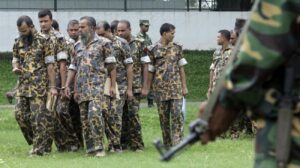
In the immediate aftermath of the mutiny and in the weeks and months that followed, security forces detained more than 6,000 BDR members. Detainees reported systematic torture and mistreatment, both as punishment and to obtain confessions. At least 47 detainees reportedly died in custody. While some died of natural causes, in many other cases Human Rights Watch and others have obtained clear evidence of torture, or other mistreatment leading to death. Many of the abuses were allegedly carried out by members of the notorious Rapid Action Battalion (RAB).
The government’s prosecution of literally thousands of BDR members, most of them rank-and-file soldiers, has been characterized by serious due process violations, including the extraction of statements under duress, lack of meaningful access of the accused to counsel, and mass trials which strain the judicial system’s capacity to ensure fair trials for each and every accused. All soldiers in a given unit are tried together, regardless of how many accused are from that unit. This is of particular concern in cases that carry the death penalty as a possible punishment.
Human Rights Watch knows of no steps by the government to investigate or prosecute anyone for acts of torture or mistreatment of detainees after the BDR mutiny.
The Mutiny
In late February 2009 the Bangladesh Rifles were preparing for their annual three-day celebration, known as “BDR week,” an occasion when high ranking officers and jawans (rank and file BDR members; the term means soldier in English) mingle, hold discussions, parade, put on lights and armaments shows, and celebrate with a large party. Traditionally, senior government officials attend the celebrations, and on February 24, 2009, the new prime minister, Sheikh Hasina, made her appearance.
The next day, February 25, was Darbar, one of the central events in the celebrations. It takes place in Darbar Hall, the large central building in the BDR headquarters in Pilkhana. At this event, the highest command of the BDR is present to discuss matters of concern with the jawans. This is often the only time that a jawan comes into contact with the highest levels of the BDR. All BDR members at Pilkhana barracks are expected to attend the Darbar, as are all senior BDR officers, many of whom are drawn from the ranks of the army.
In 2009 tensions were high between the BDR and the army. BDR members had longstanding grievances about lower pay and benefits, the secondment of army officers as senior BDR officials, limiting the possibility of promotions among BDR officers, and the fact that BDR members were not allowed to participate in lucrative deployments on UN peacekeeping missions. In addition, BDR members resented the way the“Dal-Bhat”project under the 2007-2009 caretaker government had been implemented. Through this project the BDR provided food at affordable prices to the public in the face of high inflation. Some BDR soldiers believed that army officers had personally pocketed the profits from the “Dal-Bhat” project, instead of putting the money back into services for the BDR as intended.
Weapons are not allowed in the Darbar ceremony. But on February 25 many BDR members managed to enter the building secretly armed. After the program started, the director general of the BDR began addressing the gathered jawans about their grievances. At around 9:30 a.m., a BDR member raised his gun and pointed it at the senior army officers present. There is confusion at this point about how many shots were fired and by whom, but at this cue other armed jawans inside Darbar Hall stood up, while other armed jawans entered from outside. A wave of killings began in the hall and barracks, with BDR jawans either holding army officers hostage, or else simply shooting the officers dead. Not all BDR jawans took part. Many of them tried to save the army officers, some fled, and some hid.
By the time the mutiny ended, as noted above, 74 persons were dead, including 57 army officers. Among them was Shaquil Ahmed, the director general of the BDR. Photos later emerged of the aftermath of the mutiny, showing dead bodies and extensive pools of blood, both in the hall and outside. Many bodies had been thrown into makeshift mass graves. Some bodies had been shoved down sewers. The photos from inside Darbar Hall created a vivid image of army officers being surrounded and executed in cold blood during what was supposed to be an almost sacred moment in BDR culture, a moment of trust between the high command and their subordinates.
A RAB battalion reached the gates of Pilkhana about 45 minutes after the mutiny started, but did not receive authorization to enter. The army, in consultation with the government, sent tanks and personnel to quell the situation. The air force sent in a helicopter which hovered above Pilkhana, ready to respond. However, the prime minister forbade them to enter the barracks, fearing a further bloodbath and favoring a negotiated settlement with the mutineers. In the wake of the settlement, BDR jawans returned to their barracks, and no action was taken against them. The prime minister’s decision not to attack the barracks may have saved lives, but it was heavily criticized by many in the army, who wanted to use massive force to avenge the massacre. In the ensuing months there were regular rumors of a military coup, and the new government was destabilized.
Abuses against BDR Suspects
Human Rights Watch has obtained copies of two official reports on the mutiny. One was commissioned by the government, the other by the army. Both reports say that the mutiny had been planned. The government report faulted the intelligence services for not knowing about the mutiny in advance, since the growing dissension in the BDR ranks had been known to the army and intelligence services long before the new government took power. The army report faulted the government for not allowing the security forces to use force, and rejected the notion that any fault lay with the intelligence services.
While the mutiny received only a short burst of international attention, it was an enormous event in Bangladesh, and had serious consequences for the relationship between the army and the new Awami League government. But little attention has been paid in Bangladesh or abroad to the fate of those arrested for participation in the mutiny.
Thousands of detainees still remain in custody at the time of writing. All are facing mass trials that will likely not meet international fair trial standards. Some face the death penalty if convicted.
The case of Mohamed Abdul Jalil Sheikh, for example, illustrates the treatment of some of the accused after arrest. Sheikh was injured during the mutiny and taken to Pilkhana barracks hospital that day. During the nine days of his hospitalization, he was treated well, but he then disappeared. His wife and family finally discovered after two months that he had been taken by RAB and army intelligence to the offices of RAB-1 in Dhaka.[1] According to his son, Mohammad Rahibul Islam, Sheikh said that during those two months he was severely tortured:
My father had trouble talking to me about it, it was still too painful for him to remember. He told me that they hung him upside down from the ceiling and he was beaten regularly, all the nails were ripped out of his fingers and toes, and he was subjected to electric shocks.
Sheikh reported being kept largely blindfolded. He said he figured out he was at RAB-1 when going to the toilet or to the barber. Sheikh told his family that 10-12 other BDR soldiers detained with him were treated similarly.
At the end of April Sheikh was charged under the criminal code as being one of the planners of the mutiny. Following the charges, he was transferred to Dhaka Central Jail, where he remains. Both of his legs are paralyzed, seemingly permanently. Due to his torture, he has no control over his bladder or bowel movements. According to his relatives, he is suffering from memory loss and severe depression.
The government was on notice from the outset about allegations of torture and custodial killings. Human rights groups, including Human Rights Watch, made their findings public as early as March 2009. Doctors at hospitals talked to the media anonymously about the injuries they were finding on people who had died in custody. Family members gave interviews to the media describing the state of the bodies of those who died. A cable obtained through Wikileaks shows that the US ambassador had raised this concern with government officials as early as May 3, 2009. One official, Local Government Minister Syed Ashraful Islam, said that the government shared these concerns and were trying to obtain civilian rather than military control over the trials of the accused.
Most of the more than 6,000 detainees were given very little information about the reasons for their detention. Many families recounted not knowing for long periods where their husbands or fathers were, often for months at a stretch. The BDR gave them no answers, and a trek through local jails yielded no results.
Mass trials against the accused are being conducted under the BDR’s own mutiny laws and the Bangladeshi Criminal Code. Trials under the mutiny laws are largely concerned with issues such as disobeying orders, unlawful possession of weapons, or failure to report to duty. These trials are conducted by a specially appointed BDR tribunal. The minimum penalty under the mutiny laws is 4 months, and the maximum penalty is 7 years.
Charges under the criminal law concern graver offenses, such as murder, treason, or possession of explosive substances. The maximum sentence is death.
Mass trials require by their very nature a judicial system which is trained and capable of ensuring a fair trial for each accused. Human Rights Watch interviews with family members of the accused and with defense lawyers show that these mass trials are replete with due process violations. The charge sheets often run into thousands of pages, making it virtually impossible for the accused to prepare individualized defenses. Some of these cases involve hundreds of accused being tried at the same time, which places a tremendous strain on the right to an expeditious and fair trial.
Very few of the families Human Rights Watch interviewed were aware of the exact charges or evidence against the accused. Most families said that they had not hired lawyers. Few knew that they had the right to counsel at the government’s expense. Some of the families interviewed said that they did not believe that hiring a lawyer would serve any purpose, since they did not expect the government to provide fair trials.
The detainees’ lack of access to counsel is a serious concern. From the time they were arrested in February 2009 until December 2010, the accused in the mutiny cases were not allowed to consult with their lawyers. Since then, they have been allowed a 20-minute consultation at the beginning and end of each court day, and a 30-minute consultation during the course of the hearing.
Many of the accused in both the military and civilian cases have no legal counsel. The few lawyers involved in the cases have complained to Human Rights Watch that it is impossible to provide an effective defense to each accused with so many clients, and so little time to talk to each. According to the prosecutor’s office, some defendants share their lawyers with as many as 12 others in the same case. In addition to the concerns about time for consultations, the potential for conflict of interest is significant, as evidence that could prove one person’s innocence could indicate another’s guilt.
The possible use of capital punishment in the criminal trial of 850 BDR members heightens concerns over the fairness of the process.
Bangladesh’s International Law Obligations
Bangladesh is a state party to the International Covenant on Civil and Political Rights (ICCPR), which contains tenets central to ensuring fair trials. While the government of Bangladesh must investigate the mutiny to ensure justice for victims and survivors, it must do so in compliance with its obligations under the rights of the accused to fair trials. Article 14 of the ICCPR guarantees that all accused are equal before courts and tribunals, while Article 14(3) lists the various guarantees that must be extended to the accused in order to comply with international law. These include the right of the accused to be informed in detail about the charges, to have time to prepare the defense, and to have counsel of choice. These rights are exceedingly difficult to implement in mass trials. The ICCPR’s fair trials standards apply in both civilian and military courts. A key ICCPR requirement is that the court be independent and impartial, which can be very difficult with military trials.
Evidence obtained under duress is inadmissible under international human rights law. Article 15 of the UN Convention Against Torture and other Cruel, Inhuman, or Degrading Treatment or Punishment, requires Bangladesh, as a state party, to ensure that any statement made as a result of torture not to be used as evidence, except as evidence against someone accused of having committed torture. It must also ensure that it investigates and takes appropriate action, including prosecution and redress to victims, for any torture or mistreatment meted out to the accused by its officials.
Key Recommendations
Human Rights Watch calls on the government of Bangladesh to:
- Establish an independent investigative and prosecutorial task force with sufficient expertise, authority, and resources to rigorously investigate and, where appropriate, prosecute all allegations of unlawful deaths, torture, and mistreatment of suspects in the BDR mutiny, regardless of the perpetrator’s rank or institutional affiliation.
- Disband RAB and create a non-military unit within the police or a new institution, which puts human rights at its core to lead the fight against crime and terrorism.
- Take genuine and meaningful steps to address the longstanding epidemic of torture and mistreatment by RAB, DGFI, and other security services.
- Ensure that international standards of fair trials and due process are accorded to each accused in the BDR trials.
Methodology
This report is based on dozens of Human Rights Watch interviews with families of members of the BDR accused of taking part in the mutiny, members of the BDR, soldiers and officers in the army, government officials, prosecutors, lawyers, human rights workers, and journalists. Interviews for the report were conducted in June and September 2011, and updated by email and phone. We conducted 65 interviews in all, 29 with family members of the accused.
In addition to the two official reports described in the summary above, we also consulted press articles and reports, prepared by human rights groups and other investigative bodies.
Human Rights Watch worked closely with Odhikar and Ain-O-Sailesh Kendra, human rights NGOs based in Dhaka, in documenting these cases. Both groups have worked on documenting reports of torture and custodial deaths of the BDR accused since the mutiny.
Many family members of the accused were afraid to have their names published for fear of reprisal or mistreatment. In those cases we have changed the names to protect their identity, and have used random initials.
While in Dhaka, Human Rights Watch twice sought an interview with the director general of the BDR. Although he expressed a willingness to meet, in both cases he ultimately said he was too busy.
Interviews with the families and some lawyers were conducted in Bengali through the assistance of an interpreter. Interviews with others were conducted in English.
In this report, when referring to the events of 2009 we use the term BDR, as this was the name of the institution at that time. When referring to information that describes the institution both before and after the name was changed, we use the term BDR/BGB.
I. The Bangladesh Rifles
The Bangladesh Rifles (BDR), renamed the Border Guards Bangladesh (BGB) in 2009 after the February mutiny, is a uniformed security force under the authority of the Ministry of Home Affairs. The BDR/BGB has been in existence as a border force under various names since about 1870. From the end of British colonialism in 1947 until independence in 1971, it was known as the East Pakistan Rifles. After 1971 it was renamed the Bangladesh Rifles.
The BDR/BGB’s principal responsibility is to defend the country’s 4,427 kilometer border with India and Burma, and serve as the first line of defense against any intrusions. The force also assists law-enforcement agencies in anti-smuggling operations, investigating cross-border crimes, maintaining law and order on request from the army or the Home Ministry, and relief and rehabilitation work.
The force has a strength of 67,000 personnel across the country, with a total of 61 battalions and approximately 12 sectors organized across four regions. The government plans to expand this force in the near future. The BDR/BGB is headquartered in central Dhaka in the Pilkhana barracks, the primary site of the mutiny.[2]
The BDR/BGB does not fall under the authority of the Ministry of Defense, but the commanding ranks of the forces are drawn from the army. The head of the force is called the director general and is chosen from individuals who have attained the rank of major general in the Bangladesh army. All other senior officers are similarly deputed from the army. These army officers serve a few years in the BDR/BGB before returning to the army. In general, the army officers in the BDR/BGB are considered to be among the best officers in the country. For army officers, the BDR/BGB has long been considered a prestigious posting. A former director general of the BDR explained to Human Rights Watch that being deputed from the army to other security forces signifies great faith on the part of the army towards those officers.[3]
Ordinary rank and file BDR soldiers are referred to casually as jawans, which simply means soldier in Bengali. About 100 officers in the BDR/BGB are promoted from within the force itself, although the highest rank they could have achieved before the mutiny was called deputy assistant director (DAD), considered the equivalent of a captain in the army. One of the post-mutiny reforms is to allow members of the force to attain the rank of deputy director, equivalent to the rank of a lieutenant colonel in the army.
That BDR personnel could not attain the highest ranks within their own service, had been a contentious issue for many years preceding the mutiny. Serious protests over this issue occurred in 1972 and 1990. Governments at the time promised to address the grievances, but failed to do so. Reform of the BDR was never a priority for various governments, in part because the BDR was a small force.
According to a former Director General of BDR, the BDR remained under the command of a senior military officer because various previous governments feared that it would turn into a corrupt force, like the police, if the BDR were not led by a senior military officer. In addition, the army did not want to cede its role in control of the BDR.[4]
Discontent continued to simmer within the BDR. The lifestyle of the army officers deputed to the BDR further fuelled discontent. Many enjoyed what was considered by BDR personnel to be a lavish lifestyle, well beyond the means of the average BDR officer or soldier.[5] A more recent grievance related to the“Dal-Bhat”project under the 2007-2009 caretaker government. This project was intended to administer food at affordable prices to the public in the face of high inflation. It was widely believed by jawans that army officers had personally pocketed the profits from the“Dal-Bhat” project instead of putting the money back into services for the BDR.[6] Tensions from that project were still very fresh in early 2009. Reports from the day of the mutiny show that the director general of the BDR had been publicly addressing this issue, and giving his assurances that the money had not been misappropriated when the firing started.[7]
BDR jawans also felt discriminated against because they were not allowed to participate in UN peacekeeping missions, a much cherished posting which creates the opportunity to earn higher wages in foreign currency. The reasons for this exclusion appear to have been arbitrary, as under post-mutiny reforms BGB members have been sent on peacekeeping missions. According to family members, BDR jawans generally felt like “second-class citizens” compared to army soldiers. Some of the complaints were intangible: many families complained of being made to feel inferior to army families, said that their children felt looked down on by the army children, and noted that seating arrangements at dinner tables always made them feel less than equal. [8]
II. The February 25-26 Mutiny
Exactly what happened at Pilkhana barracks on February 25-26, 2009, may never be known. To piece together as accurate an account as possible, Human Rights Watch conducted dozens of interviews with witnesses and family members of the accused, and consulted numerous published accounts, including two government reports. We received many different accounts about what happened, and in what sequence. We strive in what follows to present the most objective account we can based on all of these sources.
In the two months before the mutiny, members of the BDR had been in discussions with government officials whom they hoped would be open to resolving their longstanding grievances. Members of the BDR hoped that the new government would be more open to talks to resolve these issues than previous governments.[9]
Investigations by a government committee and the army after the mutiny suggest that about 25-30 BDR members were representing the BDR rank and file at the discussions. It is unclear exactly who was acting on behalf of the government, and what authority they had. The Report of the Government Investigation Commission (RGIC) names two members of parliament, Sheikh Salim and Mohammed Taposh, as persons representing the government, but they appear to have been conduits to the Home Ministry rather than authorized negotiators on behalf of the government. According to the RGIC, at the time of the mutiny there had been no progress in the discussions.[10]
Various sources told Human Rights Watch that a few days before the mutiny, leaflets were passed out by BDR soldiers rejecting the government’s proposals and urging other BDR soldiers not to give in.[11] The RGIC states that the leaflet contained the following demands: the immediate withdrawal of all army officers from the BDR; an increase in pay, allowances, and rations; BDR jawans to be allowed on UN peacekeeping missions; a face-to-face meeting with the prime minister; and redress for Operation Dal-Bhat.[12] Defense counsel and witnesses told Human Rights Watch that the BDR negotiating team held a private meeting the night before the mutiny, although this has not been confirmed by any participants.[13]
According to the government investigating committee, those who planned the mutiny intended to hold the army officers hostage until their demands were met.[14] In addition to their own weapons, they allegedly procured additional weapons from outside the BDR barracks.[15]
In late February the barracks and staff were prepared for their annual three days of celebration, known as “BDR week,” a time when high ranking officers and rank and file soldiers mingle, hold discussions, parade, put on armaments shows, and celebrate with a large party. Traditionally, the prime minister and other high ranking government officials are invited for part of the celebrations.[16] The new prime minister, Sheikh Hasina, attended BDR festivities on February 24, the evening before the mutiny.[17]
One of the central events in the celebrations is known as the Darbar. It takes place in Darbar Hall, the large central building in the Pilkhana complex. At this event, the highest command of the BDR is present and discusses matters of concern with rank and file soldiers. It is often the only time that an average soldier comes into contact with the highest levels of the BDR command. The event is intended to signify a tradition of closeness and unity between all members of the BDR. All soldiers at Pilkhana barracks are expected to attend the Darbar, as are all senior staff; some senior staff from outlying duty stations also attend.
The mutiny began during the Darbar ceremony around 9:30 a.m. on February 25. Typically no firearms are allowed into the hall during the Darbar ceremony, but on this morning many soldiers managed to enter the building heavily armed.
As noted above, the violence started when the director general was addressing the gathered soldiers about their grievances regarding the “Dal-Bhat” program.[18] According to most accounts, a soldier raised his gun and pointed it at the senior army officers. There is confusion at this point about how many shots were fired by whom, but some blank shots were fired. At this cue, other armed jawans inside Darbar Hall stood up. The doors opened and other armed jawans entered. In the panic and confusion, several soldiers inside Darbar Hall fled the scene.[19]
A wave of killings began, with BDR jawans either holding army officers hostage or else simply shooting the army officers dead.[20] By the time the mutiny ended 33 hours later, 74 persons were dead, including 57 army officers. Among them was Shaquil Ahmed, the director general of the BDR. In addition to army officers, six civilians were killed, including the wife of the director general and some visiting friends.[21]
The photos that emerged after the mutiny were disturbing. Dead bodies and blood were strewn about the hall and outside on the grounds. Many bodies had been thrown into makeshift mass graves. Some bodies had been shoved down sewers. The photos from inside Darbar Hall suggested that army officers had been surrounded and executed in cold blood during what was supposed to be an almost sacred moment in BDR culture, a moment of trust between high command and their staff.
The BDR rebels did not stop at killing army officers. Many went on a campaign of plunder and looting, going to the officers’ quarters and stealing whatever valuables they could find. They also set several houses and cars on fire.[22]
It is important to note that not all BDR jawans took part. Many tried to save the army officers, some fled, and some hid.[23]
It is widely rumored that many of the women in the family quarters were raped, or sexually assaulted. The government commissioned report stated that the mutineers were guilty of “outrages upon the modesty of women.”[24] Prosecutors say they have chosen not to look into these allegations in order to “protect the reputation” of the victims.[25]
News of the mutiny quickly spread, as the Pilkhana barracks have family quarters and many family members were still at home that morning. Family members called their fathers or husbands at Darbar Hall to find out what was happening. Many BDR families, and BDR retiree families, live in the adjacent neighborhoods. As family members and jawans fled the violence, news spread through these neighborhoods, where many sought shelter. Fairly quickly, the nation was glued to TV and radio, watching the gripping saga unfold.[26]
Initially, the Director General of the BDR phoned the prime minister, the heads of the army, the Directorate General of Forces Intelligence (DGFI, military intelligence) and the Rapid Action Battalion (RAB), seeking immediate intervention.[27] A RAB battalion reached the gates of Pilkhana about 45 minutes after the mutiny started, but did not receive authorization to enter.[28] The army, in consultation with the government, sent tanks and personnel to quell the situation.
However, the prime minister forbade them to enter the barracks, fearing a further bloodbath. The Pilkhana barracks are located in the center of Dhaka and border a densely populated neighborhood. There are five entrances to the barracks, and the main entrance looks out onto a wide avenue. The other gates open onto narrower lanes adjacent to civilian dwellings and shops.[29]
The army contingent remained stationed outside, ready to respond. Between these forces, all five gates at Pilkhana were covered. The air force sent in a helicopter which hovered above Pilkhana, similarly ready to respond, and another army contingent was sent to the nearest hospital in the nearby Dhanmondi neighborhood. The police commissioner cordoned off the area and had reserve police units waiting to back up any army action. However, because it is a densely populated neighborhood, the police cordon was not particularly effective.[30] Individuals interviewed by Human Rights Watch in adjacent neighbourhoods described being surprised at how easy it was to get around, and to approach the barracks during the mutiny.[31]
The arrival of the security forces arrayed outside the barracks heightened tension within the barracks. Armed BDR jawans started shouting that the army was trying to take over as the negotiating committee had warned in leaflets before the mutiny, and that BDR members should resist an army takeover. This call played into the resentment that BDR jawans felt towards the army. Jawans raided the armory, distributed weapons to other jawans, and took up positions inside the gates.[32]
Witnesses report that armed jawans started going door to door through the family quarters of the BDR staff looking for those who were hiding, or not participating in order to force them to participate. Human Rights Watch talked to several families who claimed that they saw their husbands or fathers taken at gunpoint from their apartments by other soldiers to join in the mutiny.[33]
Through the use of mobile phones, jawans called the BDR barracks in other areas and spread the news that the army was taking over, and that they should arm themselves. Although there were no massacres in other barracks, in several the armory was raided by BDR jawans who panicked and believed that an attack was imminent. In some areas, the BDR jawans erected barricades on the roads to stop the army from approaching. There was some firing at some barracks, but the level of violence was modest. There were no fatalities in these other areas, although some soldiers were injured by stray bullets.[34]
Prime Minister Hasina opened up channels of communications with the BDR rebels inside the barracks, initially by dropping leaflets from a helicopter into the barracks, inviting them to negotiate. Sometime after noon, a small team including a state minister, Jahangir Kabir Nanak, and the chief whip of the Awami League, Mirza Azam, went to BDR gate number 4, carrying a white flag. They discussed setting up a meeting between a BDR delegation and the prime minister to negotiate an end to the mutiny.[35]
In the late afternoon, a group of about 14 BDR soldiers, including some deputy assistant directors (DAD), went to meet Hasina. It is not clear whether those sent to negotiate were part of the core group of those who planned the mutiny. Some family members of the DAD’s claimed to Human Rights Watch that they had been unwilling participants, forced by the mutineers. After a few hours, Hasina agreed to a general amnesty for all BDR soldiers who had not committed killings during the mutiny, if they laid down their arms and returned to their duty stations. The BDR negotiators also agreed to release the women and children trapped inside the barracks. There was a general agreement that the BDR grievances would be looked at seriously by the government, but there appears to have been no agreement on the longer list of issues raised by the BDR.[36]
When the BDR negotiators returned to Pilkhana, the armed jawans refused to accept the agreement, arguing that it needed to be officially gazetted before they would believe it. They also demanded that Hasina agree to remove all army officers from the ranks of the BDR before they would lay down their arms. Another round of negotiations was then started, this time with Home Minister Sahara Khatun. Around 1 a.m. on the morning of February 26, Khatun and some other ministers went to Pilkhana barracks. They were allowed inside for further discussions, which stalled. Khatun did manage to get some hostages, and family members released while she was there.[37]
Several more rounds of negotiations followed. Some reports suggest that Hasina ordered the army and RAB to take action in the early afternoon of February 26, but called it off in hopes of a negotiated agreement. Hasina gave a speech broadcast on national radio and television at 2:30 p.m. on February 26, in which she ordered the mutineers to lay down their arms, calling on them not to force her to take harsh measures. Shortly after, the rebels agreed to surrender if they could have another meeting with Khatun. The two sides finally managed to reach a settlement at around 8 p.m. on February 26. The terms were the same as those agreed upon the day before: a general amnesty for those who had not committed any killings, and a promise to consider seriously the demands set forth by the mutineers.[38]
The BDR soldiers put down their weapons, which were then taken by police. Those who had fled were urged to return, and promised amnesty. Over the course of the next few days, most BDR soldiers reported back to duty at Pilkhana barracks. Although arrests did not begin for a few months, all soldiers who reported back were confined to barracks. Those who returned reported that, after a few days, work proceeded as normal, with regular routines re-established at Pilkhana and outlying barracks.[39]
Many in the army were furious at not being allowed by Hasina to enter the barracks. Having survived arrest by the caretaker government, and an attempt by the army to engineer her exile and disqualification from politics, she was sensitive to her party’s longstanding tense relationship with the army. Possibly she believed that authorizing the use of force by the army in such a heavily populated area could lead to an even larger bloodbath. While some in the army wanted to shell the cantonment, Hasina refused to allow an assault, according to both the government and army inquiry reports described in detail below.
Soon after the mutiny, the government commissioned a 10-person inquiry team. The commission was led by former Home Ministry Secretary Anis Uz Zaman Khan, and included other government functionaries and the director general of RAB. The commission submitted its report on May 21, 2009. Although it was not made public, a summary of its contents was released to the media. The summary does not go into much detail, but states that the mutiny had been planned by BDR soldiers who felt their longstanding grievances had not been answered. Human Rights Watch has obtained a copy of the entire report. Its contents confirm the outline of events we recount above.
Government and Army Investigation Reports
The Report of the Government Investigation Committee (RGIC) states that the committee was unable to determine the identity of the individuals who planned the mutiny and set it in motion.[40] The committee also found that many mutineers took up arms spontaneously, either because they believed the propaganda that the army was taking over, or because they were coerced or found it expedient to do so.[41] The report emphasizes the lack of cooperation it received from the various security forces in the country, including DGFI and RAB. It states that a proper examination of the events and the causes and consequences remains impossible because of the lack of cooperation provided by the investigative branches of the security forces. Furthermore, the committee noted that because they “did not have proper tools, technology, and technique for questioning the suspected persons to reveal the truth, almost no person presented or brought to the Committee for questioning provided any important information or proof.”[42]
The RGIC contains a scathing attack on the various military and civilian intelligence agencies for not uncovering the planned mutiny, especially in light of all the security work that had been done prior to Hasina’s visit to Pilkhana barracks the day before. It says this was made worse by the fact that leaflets had been distributed publicly just days before the mutiny expressing discontent towards the continued presence of army officers. The report implies that the security agencies did not do a thorough job in securing Pilkhana ahead of the prime minister’s visit, feeding into a popular belief that the mutiny had been planned by the army to unseat the new government.[43]
The report further suggests that the security forces mishandled the situation, pointing out that the first RAB unit reached Pilkhana within less than an hour of the beginning of the mutiny, and yet was unable to contain the damage, suggesting that the committee members did not agree with Hasina’s decision to aim for a negotiated settlement. Although the security forces were covering all the Pilkhana gates, the report points out that many of the mutineers were able to flee the barracks. The report also criticizes the army for not having a plan to rescue the women and children trapped inside the barracks.[44]
The RGIC found several “ultimate” reasons other than BDR grievances as motives for the mutiny, although the evidentiary basis for these findings is not clear. The report states that the motives included creating a bad reputation for Bangladesh as a terrorist nation, threatening the sovereignty of the country, destabilizing the country’s borders, destroying the reputation and capacity of the army, and portraying Bangladesh as a failed state.[45] These findings seem to echo the popular narrative about the mutiny, offered without evidence, which has it that unnamed outside forces with some interest in destabilizing Bangladesh deliberately created a rift between the army and the BDR, and were ultimately responsible for the mutiny.[46]
The report recommends speedy court martials, honors for those “martyred” in the mutiny, and an investigation into the failure to gather intelligence about the planned mutiny. In the longer term, it calls for a restructuring of the BDR, ensuring that compensation schemes across the various security forces are equitable, and for stricter hiring practices for the paramilitary forces, particularly in light of allegations that the BDR recruits were drawn along party lines or based on nepotism.[47]
The report also contains a sharp attack on the role of the media during the mutiny. According to the report, journalists who were gathered at Pilkhana to cover the events broadcast information handed to them by the BDR mutineers. This one-sided account of events, the report states, served only to incite panic and confusion in the outlying barracks. The report implies that some aspects of the media community were sympathetic to the BDR or perhaps even acting as agents of some nefarious outside force intent on destroying Bangladesh. [48]
The army insisted on establishing its own investigative committee. A 20-person army team conducted an investigation, but the army did not make the results public. Human Rights Watch has obtained a copy of this report. [49] It contains revealing information about the army’s relationship with the BDR . The report, officially titled “ An Opinion, ” states that BDR jawans were misguided and ill-informed about their grievances. Regarding Operation “Dal-Bhat,” the army report states that some BDR jawans were “corrupt” and making money on the side. It said that the jawans were angry that the army command had learned of their scheme and put an end to it. The report states, both with regard to Operation “Dal- Bhat” and in general, that the “honesty and dutifulness” of the army officers gave BDR jawans less opportunity for corruption, and “as a result, their grievances increased to a great extent.” [50]
The army report faults the government for not having taken a stronger line against the BDR before the mutiny. It does not admit that any of the BDR grievances were serious. The report says that BDR soldiers who profited illegally from Operation “Dal-Bhat,” were not punished severely enough and were presenting demands based on falsehoods. The report states that BDR complaints about differentials in pay, promotion, education, and other benefits between the army and the BDR were simply not true, and were concocted by the mutineers in order to win over support from the jawans. The report also, seemingly contradictorily, faults the Home Ministry for not realizing how serious the BDR grievances were.[51]
The army report does not go into great detail about the events at Pilkhana during the mutiny. Instead, it attempts to examine the underlying background of how the mutiny happened. It rules out any terrorist involvement, but suggests that political forces, including individuals who might have been angry with the army’s role during the caretaker government, were amenable to support a revolt against the army. The report identifies several outside individuals, including a known arms smuggler, as responsible for helping plan and support the mutiny. As to the government-commissioned report’s criticism of intelligence failures, the army report states that the entire intelligence unit of the BDR supported the mutineers, and concealed information from the army and other intelligence agencies. [52] There is no acceptance in the report that the army could or should have acted any differently in the lead-up to the mutiny.
The army report claims that had the security forces been allowed to intervene, fewer lives would have been lost. RAB-2, it claims, was at Pilkhana gates early on, at a time when events were still transpiring in Darbar Hall, and before the BDR jawans had managed to secure the gates. It states that RAB-2 was ready and equipped to go in, but did not receive the go-ahead from RAB headquarters. The report also points out that the army itself was deployed to Pilkhana and stationed outside by 10:50 a.m., but the delay in approval from headquarters squandered precious time and allowed the BDR jawans to put up resistance at the gates. A plan prepared by the army after noon, which involved a joint attack by the army, RAB, and the air force, had to be shelved because the prime minister and others were busy with negotiations.[53]
Although the army report describes the home minister’s actions in entering Pilkhana barracks to negotiate as “displaying extreme courage” and “praiseworthy,” it went on to criticize her: “[T]he respected minister did not have enough idea about armed revolts, and she went there to suppress the mutiny without adequate preparation, therefore the respected home minister could not take effective action regarding surrender of arms.”[54] At another point, describing an initial foray by Hasina to negotiate, the report states: “The members of this team could not take any timely and effective step as they did not have any previous experience of suppressing any revolt or any clear ideas about military affairs.”[55]The report also complains about the fact that the law allows only a maximum of 7 years’ imprisonment for mutiny.[56]
The United States Federal Bureau of Investigation (FBI) offered to assist in the investigation. FBI officers were in Dhaka investigating the mutiny within days. Their findings, some of which are now available through Wikileaks, reveal that some members of the new government believed in conspiracy theories involving grand designs to destabilize Bangladesh. As a result, US officials wrote, members of the government were unwilling to look into domestic causes for the mutiny, such as longstanding BDR grievances, and the failure of successive governments over many years to address them.[57]
In the course of our research, many people across various sectors of society told us they believed that the events of February 25-26 were not the result of a simple mutiny. Many believed that sinister foreign agents were, for unspecified purposes, trying to destabilize and demoralize Bangladesh and weaken its borders.[58] The army report, in referring to the allegations that a well-known arms smuggler was involved in the mutiny, points out that his phone records indicate that he had placed many phone calls abroad in the period leading up to the mutiny. The report does not draw a conclusion from this fact, but leaves the suggestion of foreign interference hanging as a possible cause of the revolt.[59]
III. Abuses against Suspected Mutineers
After the mutiny, there was strong disagreement between the security forces and the government about what to do with the mutineers. The army argued that the mutineers should be prosecuted under the Army Act, which carries much heavier penalties than those allowed under the BDR Act. Others, including the chief prosecutor, argued for a two-pronged approach: to try mutiny under the BDR Act, and to try the murders and other serious crimes under the Bangladeshi Penal Code.[60] In the end, the prime minister agreed to the two-pronged approach.
However, before BDR members were arrested and charged, many of them were detained and interrogated by different security forces. The BDR soldiers who returned to Pilkhana after the mutiny were forced to remain outside in a field near the Pilkhana barracks where they were kept under effective detention for several days. According to witnesses, some reportedly were beaten, slapped, and verbally abused by army officers. Others said that there was not enough food or water but that there was initially no physical mistreatment.[61]
A combination of security forces, including the army, DGFI, RAB and NSI, sometimes working together and sometimes separately, questioned the BDR soldiers. Initially, all were allowed to return to work.
Detentions and interrogations began a few days later as part of an investigation into the main perpetrators of the mutiny. Mass arrests began shortly thereafter.
Torture and Custodial Deaths
Reports quickly emerged of severe torture of those detained and a high number of custodial deaths. A study conducted by Odhikar, a leading and reputable human rights NGO based in Dhaka, states that at least 47 BDR personnel died while in custody.[62] While some died of natural causes, many appear to have died from torture. Odhikar conducted its own fact-finding into these cases, and interviewed family members and consulted medical documentation when available in each of these cases.
Human Rights Watch knows of no cases in which the government has ordered investigations into deaths in custody. Soon after the mutiny, the government was on notice about allegations of torture and killings in custody. Human rights groups, including Human Rights Watch, made their findings public, doctors at hospitals raised concerns to human rights groups (albeit anonymously), and family members gave interviews to the media describing wounds consistent with physical abuse on the bodies of those who died.[63]
A cable dated May 4, 2011, shows that the US ambassador, James Moriarty, raised concerns with government officials. According to the cable, the ambassador stressed the importance of“credible”investigations and a“transparent legal process.” His government interlocutor, Minister for Local Government Syed Ashraful Islam, responded that he“shared these concerns and… had argued in cabinet for a civilian trial for these accused.” Moriarty also raised concerns about reports of deaths in custody.[64]
Torture is used routinely by security forces in Bangladesh[65], even though Bangladesh is a state party to the international Convention Against Torture. Human Rights Watch and others have long documented the systematic use of torture and deaths in custody in Bangladesh by its various security agencies, including by RAB, DGFI, and army intelligence. Sheikh Hasina’s government, which

0 Comments
LEAVE A COMMENT
Your email address will not be published