

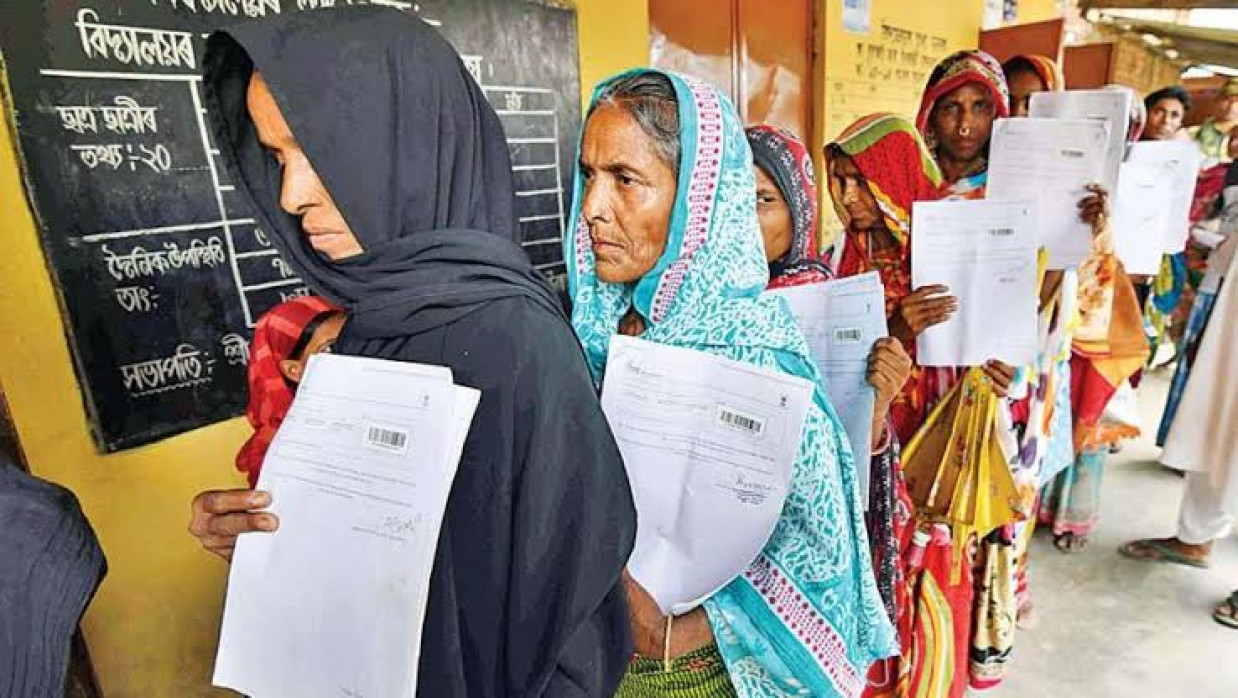
With the recent eviction of Bengali Muslims in Assam, the destruction of mosques, and the deportation of people believed to be migrants to Bangladesh, this isn't only an immigration issue. There are many questions being raised about what makes someone Indian, equality under the Constitution and religion, and what type of nation India wants to be. As the world becomes more polarized, we can see how quickly social ties and shared history can be weaponized against each other.
According to news articles from Assam in October 2026, over 1100 families were evicted from forest areas in Nagaon, Hojai, and Golaghat districts within two days. Most, if not all, of the families were Bengali Muslims. It was stated in Daily Ittefaq that 10 mosques were destroyed during this time. The Government of Assam stated that it was clearing squatters from government and forest land. This brings up the question of how the government came to the conclusion to target these certain people and why only a religious group was affected. What effect will this have on the people who have lost their homes?
With all the current issues going on in India regarding its citizens and citizenship. We have to look at all of this with that in mind. NRC, CAA, and voter ID cards have sparked a large debate on who should be considered Indian and who shouldn't.
This affects not only India, but Bangladesh as well. With the refugee crisis that Bangladesh has been dealing with for years. People are being sent over the border who may or may not be Bangladeshi. This could put both countries in a very tense situation. Not only economically, but also through water issues along rivers and borders.
Assam's Eviction Campaign and the Politics of Land
Land and migration have played a significant role in Assam's politics over the past century. As agriculture expanded under the British regime, people began migrating from Bengal to the Brahmaputra Valley. The British also recruited labor under the taungya method. They were allowed to grow crops under trees for a limited period. Over many years, descendants have built villages but may lack clear title deeds for many reasons, such as missing old land records, changes in demarcation, and forest rules.
These are some of the factors that relate to the current eviction scenario. Villagers argue they have lived there for generations or for long periods. The state says they are illegally encroaching. This brings us to the next point: just because someone lives in a particular area doesn't mean they own it. But we should at least check whether they deserve it or give them a fair chance.
Hundreds of people were evicted over a few days in October 2026. Forces were sent to demolish houses and places of worship. Reports state that mosques were demolished as well. Again, this depends on what kind of land they were on and whether there was any prior order. Also, how did they handle similar cases of other religions?
Forest conservation is a noble idea that the state can take care of. With increased agricultural activities and migration, people are clearing forests. We can use this to our advantage by maintaining the forest.
However, we need to ask if these evictions are happening based on religion. Are the evicted being given enough time to relocate? These are some questions that need to be answered.
With 19000 families reportedly being evicted from government land in Assam over the course of the BJP's 10-year tenure. It would be wise to see how many of these families were Muslim. Mass eviction can cause extreme poverty and take away children from school.
The Historical Roots of Assam's Citizenship Anxiety
One cannot really understand the political climate in Assam today without knowing what happened during the Assam Movement. It lasted from 1979 to 1985 and began when people believed that, due to immigration, Assam was becoming overpopulated by non-natives. It also affected Assam's language and politics.
In 1985, the Assam Accord was signed, stating that those who crossed the border after March 24th, 1971, would be considered. The date was significant because it was around the time Bangladesh separated from Pakistan. Many refugees fled the violence in East Pakistan.
Many feared that these people who came to India were driven by religious beliefs. But that was not the only fear that drove Assamese nationalism. People also feared losing their language and jobs. This led many Bengali Hindus and Muslims to fight over the issue.
Over time, more and more Hindus became involved in this conflict. Many Bengali Muslims began to be accused of being immigrants. Even though some have lived in Assam for years.
Miya has been used as an insult towards Bengali Muslims who live in Assam. Some people have taken the word Miya and made it a point of pride. So, it all depends on how you use it.
What happens when people start assuming someone is a foreigner based on their language or religion? Many Indian citizens speak Bengali. Some might have immigrated to India before Partition; others could be immigrants. They should not all be lumped together and assumed to be foreign.
By law, their Indian citizenship should be determined.
The NRC, Citizenship Amendment Act, and Unequal Belonging
Assam's last NRC was published in August 2019. Of the applicants, around 1.9 lakh names were excluded from the final list. This was done to find out which citizens deserve to stay as Indians and who cannot provide proper documentation linking them to the set date.
This showed that it is very difficult to decide who is a citizen in our country, where we have people living in poverty. Migrants, floods, etc. have also played a major role in why some people have lost their documentation.
Most of these people were women, farmers, and poor people who could not provide correct information about their history. People of both religions were left off the list. So, we cannot say that this is only an issue that Muslims have to face.
Also, being off the NRC does not mean a person is a foreigner. There are many other ways and rights that one can use to prove they are an Indian.
Another issue that came into play was the 2019 amendment to the Citizenship Act. It gave certain Hindus, Sikhs, Buddhists, Jains, Parsis, and Christians the chance to get citizenship if they had migrated to India before the cut-off date from Afghanistan, Bangladesh, and Pakistan.
People who support this act believe that it will help protect people who have been persecuted in Islamic countries. Others feel that by leaving out Muslims, we are separating religion. This should not be an issue in India.
This leads us to believe that people who speak Bangla and are Muslim are scared of what can happen. If they are not given the opportunity to prove that they are Indians, maybe because of religion.
Another issue arises when you look at the electoral roll. Many people are removed from the electoral roll because they cannot show documentation, Though they are still Indian citizens. By taking them off the electoral roll, we are stripping them of their right to vote.
If someone does not know where to turn for help and cannot afford to hire an attorney, then they can suffer many times over by being forced to show their bloodline. Where they live. Who they are and if they are a citizen.
As mentioned before, some families may not be able to afford the cost of proving that they are Indian.
The Human Cost of Administrative Exclusion
While discussions on citizenship issues tend to take place within the realm of law and demographics, the greatest effects on people are felt in their daily lives, with an ongoing period of limbo.
Someone who works in construction far from home may one day be asked to prove where their family came from. An older woman may find out that she doesn't match the records made when she was born or her voting records. Many families could have papers stating they are citizens of their country and still be taken into custody. Officials search to determine whether they are citizens.
Human Rights Watch has also documented this issue. In the months of July 2025 and June 2026, Human Rights Watch stated that India was sending Bengali-speaking Muslims back to Bangladesh. Some of them were Indian citizens. These reports stated that people were being detained. They were forced to board buses to the India-Bangladesh border line. And left at both the Indian and Bangladeshi checkpoints.
What these incidents show us is the difference between enforcing laws on foreigners in your country and stripping someone of their citizenship. Of course, governments should enforce their laws on those who are entering their country illegally. But they should use methods that allow for people to prove that they are citizens.
When these problems occur, it usually falls on the poor. A person's name may change over time. Records may not be accurate because of a lack of resources. Or, if someone lived in a flood zone, records may never have existed for that person.
Someone who lives in this constant fear will always have to prove they are a citizen. They have to prove they belong in their own country.
This also can lead to political ramifications. People who know their citizenship may be questioned. They will not seek aid from the government. They will not call the police when they need help. They will not participate in politics or stand up against injustice.
People will feel insecure about their citizenship, and this can affect politics.
Border Push-Ins and the Erosion of Bilateral Trust
If the migrants that India deems to be illegal migrants are pushed into Bangladesh without an agreed nationality identification process between both countries then this issue becomes international.
Bangladesh has protested this several times since May 2025. This has been known as a push-in by India. India believes that it has the right to deport those that have entered its country illegally. Bangladesh says that it should be allowed to deport people after identifying that they are Bangladeshi citizens.
This makes a big difference. If someone can speak Bengali, is Muslim, and/or has relations to Bangladesh, that does not make them Bangladeshi.
In June 2026, Human Rights Watch said that Bangladesh border guards stopped 21 push-ins with over 200 people. These numbers are only for the first half of the month. Some families were left on the border line while the 2 countries argued over who they belonged to.
These events can create dangerous situations. Families could be exposed to bad weather or have no shelter at all. They may not know what to do. Altercations between border guards can get out of hand.
There should be a better way to identify people who cross into another country illegally. Instead of ignoring the situation.
Neither country should use these people as pawns in their argument.
Nationalism, Electoral Politics, and the Construction of Outsiders
Citizenship will continue to be debated for many reasons in current Indian politics.
With the ascent of the BJP, we have seen the growth of Nationalism that includes Hinduism as a central part of the Indian Civilization. Supporters of this ideology believe they are righting past wrongs and representing what India stands for. Those who oppose feel that this brand of nationalism is taking the form of majoritarianism, which dilutes secular values.
Migration can be a potent political tool. Multiple issues are involved, such as jobs, overpopulation, security, and national identity.
Bangladeshi immigrants have been brought up as a talking point many times in Assam and West Bengal. This can be justified, as any country should keep proper records of its citizens and control migration.
But once a citizen becomes labeled as Bengali and Muslim, they are automatically considered foreigners.
Whether that person has ever been questioned about their citizenship status or not, they can be branded as foreign just to gain votes.
India relies on many of these migrants to feed its workforce. Many poor citizens leave their villages to work in metropolitan cities. So how do you treat the Bengali worker who speaks a similar language to our neighboring country and follows the same religion?
There are more victims than those who are being taken out of India. Many face social stigmatization and harassment.
India, as a democracy, should learn the difference between keeping tabs on immigration and questioning its own citizens based on ethnicity.
The Rohingya Precedent and Its Limitations
Bangladesh serves as an example of what can happen in our region with the Myanmar Rohingyas.
Rohingyas have been denied their citizenship rights for many years. They have also faced discrimination in travel, education, and political participation. This has led to their lack of recognition as a nationality since Myanmar enacted its Citizenship Law in 1982, and to further persecution and military action, which resulted in mass migration in 2017.
Unlike Myanmar, India has laws and institutions that safeguard against this kind of injustice. We have courts and elections to challenge the government if needed.
So we should not compare what is happening in Assam to Myanmar.
However, it shows what can happen when you start questioning people's citizenship. People will live in fear of being displaced.
If people start using ancestry, religion, and language to measure whether someone belongs in a country, citizens can always be viewed as foreigners.
This can be avoided with strong institutions and governments that prevent discrimination.
Bangladesh's Diplomatic Dilemma
Bangladesh must protect its country and interests while ensuring border issues don't cloud its relationship with India.
The 2 nations are closely linked economically, historically, and geographically. India is one of Bangladesh's biggest trade partners, and Bangladesh allows for easy transit and connectivity to India's northeast states.
India will also need to work with Bangladesh on energy issues, border disputes, terrorism, and managing rivers.
With the Ganges Water Sharing Treaty set to expire on 12 December 2026, it will be vital for Bangladesh and India to keep lines of communication open. An October 2026 report by the National University of Singapore Institute of South Asian Studies found significant ambiguity about whether the treaty will be renewed. Questions about sharing and domestic politics will also play a role.
If border issues continue to worsen, it may become difficult for the two countries to discuss these matters.
Bangladesh needs to ensure that people involved in disputes are not handed over to their country, but it also needs to remain cordial with India on economic topics.
Diplomacy should not require hushed-up human rights issues or globally accepted norms. Just as criticizing India's government's actions should not translate to hate towards Indians.
There is a difference between a country, its movements, and its people.
Restoring Legal Accountability and Regional Cooperation
These institutions must change to create a more sustainable solution.
India must give those it believes to be foreigners a chance to prove their citizenship/immigration status. Access to lawyers, impartial tribunals, and avenues for appeal are all necessary. Especially when documents are contested.
India should open up the way these lands are being cleared in Assam. Land clearing can go hand in hand with proper notice, non-discrimination, settlement where claims are proven, and support for displaced citizens.
India and Bangladesh need to work together to verify citizens' nationality, set guidelines on which documents will be accepted, and establish a timeline for these processes.
By working together, we can allow our border forces to communicate more effectively. This way, if a disagreement does occur between the B.S.F. and B.G.B., citizens are not caught in the middle.
Human rights organizations and legal experts can also help. They can create awareness of what is happening and help people seek justice.
Clearing of forests and deportation of foreigners should never take the place of due process.
The Future of Belonging in South Asia
What we are currently seeing play out in Assam can be attributed to one problem. One that affects all of modern-day South Asia.
The subcontinent has seen partition. Migration, war, and political change. People have always lived across what are now international borders. They have been separated by lines drawn by people that they don't know.
Assamese Bengali Muslims fall into this category. They will always be associated with Bangladesh, but being an Indian Citizen doesn't take away their citizenship. Nor does Bangladesh have illegal migrants just because immigration laws have been used discriminatorily.
We need to address both.
As a democratic country, India should strive for equal citizenship and rule of law. Not only the ability to control its borders. Bangladesh will also benefit from healthy relations and proper border control with its biggest neighbor.
It's not when countries decide to regulate their borders and public property. It's when we start blurring the line between those who should be deported and people who shouldn't be.
Once language and religion are used as forms of identifying a foreign national, your ancestral ties are not enough to keep you from deportation.
South Asia has already experienced the devastating consequences of political systems that divide populations into legitimate insiders and unwanted outsiders. Its future stability will depend on resisting the temptation to repeat that history.
A nation demonstrates its strength not by making vulnerable communities perpetually prove their belonging, but by ensuring the law protects everyone entitled to its protection.


0 Comments
LEAVE A COMMENT
Your email address will not be published