

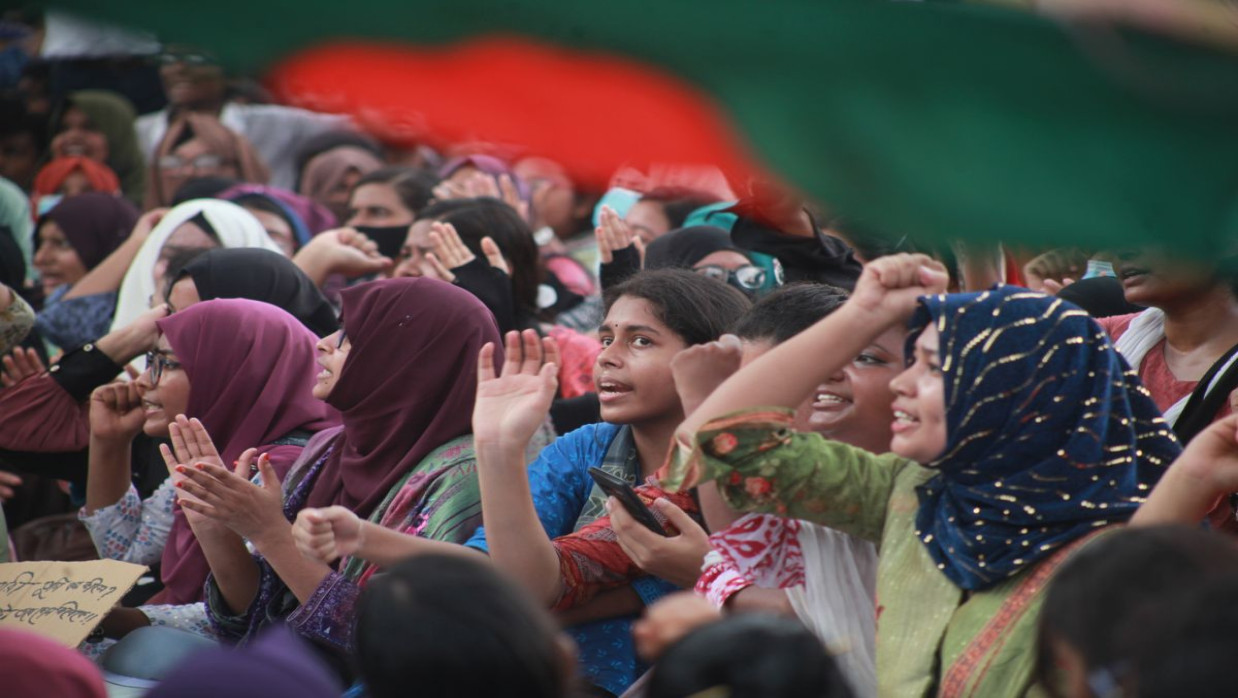
Ever since the establishment of the state in 1971, Bangladesh has been plagued by numerous coups, mass uprisings, and changes in the constitution. Bangladesh still has a long way to go to achieve the dreams we set out to accomplish when we first gained our freedom. That being democracy, equality, and the rule of law for all citizens of our nation. Bangladesh has once again proven itself capable of overthrowing unjust political forces but unable to build the structures to keep them away.
When we look at Bangladesh's democratic history, we see this problem again and again. Governments fall, new constitutions are made, and politicians take office with visions of improving our country. But the issue always comes back to who holds the majority of political power. Bureaucracy, power, and money always end up in the hands of those in higher positions.
What does it truly mean to be a democratic country? Just because a country may hold elections, does that make it a democracy? Do we need to see a more equal distribution of power, political rights, and free speech?
We can ask these questions about Bangladesh, but most countries in South Asia face similar issues in their democracies. Whether it is high levels of bureaucracy, politics run by family bloodlines, military rule, religious divides, or widening wealth gaps among citizens, we face these problems every day.
The Persistence of Bureaucratic Autocracy
A major hindrance to democracy in Bangladesh is the existence of Amlatantro or Bureaucratic autocracy. In simple terms, it is a system in which bureaucratic organizations and upper-class people control state affairs but are not accountable to the masses.
Administration plays an important role in running any country. It helps provide stability, ensure laws are carried out, and help manage state properties and services. However, it can become anti-democratic, and these bodies are often used for authoritarian purposes.
Our bureaucracy came from the British rulers and then later Pakistan. During their time, they only wanted to control our country politically and economically. They never cared about our ability to have a democratic society with power evenly spread among its citizens.
When we became free, we were given our own state, but the system's mentality did not change.
The government has long used bureaucracy, police forces, and powerful business houses to maintain its grip on power. Political affiliations, favors, and corruption have tainted these institutions and allowed them to act according to a political agenda. As a result, we have not been able to develop a truly neutral and efficient government.
This violates several principles of our constitution, such as equality before the law, equal protection of the law, and impartiality. By using these institutions for political gain, we weaken our democracy, diminish public trust, and compromise the rule of law.
We can start by ensuring our civil services, police, and other state agencies are non-political. We can ensure our hiring process is fair and allows capable, qualified people to fill these positions. Proper oversight and transparency will help us create a fair system of government. If our government is free from politics, it will benefit our country as a whole.
Democracy Cannot Be Reduced to Elections
As Bangladesh's history shows. Elections do not always ensure a democracy.
While elections elect leaders, many other factors contribute to democracy. These include freedom of speech, fair government agencies, multiple political parties, equal citizens, and the ability to change your government non-violently.
One can maintain elections and prevent these other aspects from happening. You can restrict opposition parties from competing fairly. You can also bias public offices and limit the press through money or political power.
This gives you a state with constitutional legitimacy, but not one that represents the will of its people.
Under Bangladesh's time as part of Pakistan, we saw what could happen if these things were done. With Ayub Khan's implementation of basic democracy in 1959, the country moved away from electing national-level officials. This allowed the central government to maintain control and prevent East Pakistan's majority from gaining political power.
After the general elections in 1970, we saw what could happen if a country did allow its people to vote for national officials. After winning a majority in Pakistan's National Assembly, the Awami League was unable to assume power, and this led to our liberation war.
So, as we can see, you can only hold elections so long and still not allow people to change their government.
But there are also things that should not be done when your party wins an election. Taking power from your opposition, gaining control over government agencies that should remain neutral, and preventing your opposition from running again.
All these aspects need to be protected to ensure a true democracy.
Constitutional Reform and the Concentration of Political Power
The topic of constitutional reform gained more attention after the July-August 2024 student movement and the subsequent change in government.
The overthrow of the Sheikh Hasina regime created an opportunity to revisit how institutions were set up, allowing more and more power to be vested in the Executive.
The interim government led by Muhammad Yunus introduced constitutional reforms, culminating in the July National Charter in 2025. The charter recommended constitutional changes to the state, judiciary, elections, civil service, police, and anti-corruption bodies.
The BNP came to power under Tarique Rahman after the February 2026 general election. The BNP gained a large number of seats in parliament. Alongside the election, a referendum on constitutional reform was also passed.
This presents an opportunity, but the two could also work against each other. If we have a strong enough parliament to bring about major changes, it also has the power to dilute these institutions.
So, we need to find ways to share power among the different offices of the constitution. But we also need to ensure no office holds unchecked power.
We can learn many lessons from our own history. Presidents Sheikh Mujibur Rahman, Ziaur Rahman, and Hussain Muhammad Ershad all presided over periods when the country was governed by presidential rule. Although they served at different times, we saw problems that can arise from too much power.
Parliamentary rule was restored in 1991, a victory for the country. However, this did not stop a dominant prime minister from emerging.
The question is not whether we should have a president or a prime minister; it is about checking executive power.
Many reforms are needed to stop arbitrary decisions and prevent state bodies from falling under party rule.
Article 70 and the Independence of Parliament
Few constitutional provisions illustrate Bangladesh's democratic contradictions more clearly than Article 70.
The provision has historically required a member of Parliament elected on a political party's nomination to vacate the seat if they resign from that party or vote against it in Parliament.
Its original justification was political stability. Bangladesh's constitutional architects sought to prevent defections and the manipulation of parliamentary majorities that had contributed to political instability elsewhere in South Asia.
However, the provision has also imposed extraordinary constraints upon legislative independence.
A representative elected by citizens may be unable to oppose party leadership on legislation without risking the loss of parliamentary membership. Consequently, the executive can exert substantial control over legislators in the governing party.
Parliamentary debate becomes less consequential when party directives effectively determine voting outcomes.
Reform must nevertheless recognize the competing danger of unrestricted political defections. South Asian political history contains numerous examples of legislators changing allegiances in exchange for office, patronage, or financial inducements.
A balanced solution would preserve party discipline on confidence motions and essential budgetary matters while permitting greater independence on ordinary legislation, parliamentary investigations, and constituency concerns.
Such an arrangement could strengthen legislative accountability without encouraging opportunistic changes of government.
Electoral Representation and the Debate over an Upper House
Bangladesh's traditional first-past-the-post electoral system presents another important democratic challenge.
Under this arrangement, the candidate with the most votes in a constituency wins the seat, even without securing an absolute majority.
The system provides a direct relationship between representatives and geographical constituencies. It is relatively straightforward and allows voters to identify the individual responsible for representing their locality.
However, it can produce substantial differences between a party's national vote share and its parliamentary representation.
A political party may obtain a commanding legislative majority without receiving a corresponding majority of votes nationwide.
Proportional representation offers an alternative by distributing parliamentary seats more closely in line with the votes political parties receive.
Its potential advantages include broader representation, opportunities for smaller political movements, and reduced exclusion of minority political viewpoints.
Yet proportional representation also creates challenges. Party-list systems can strengthen centralized party leadership, weaken geographical accountability, and produce coalition instability.
The July National Charter proposed a bicameral Parliament with an upper chamber of 100 members selected through proportional representation. The precise distribution of authority between the chambers and the procedures for implementing reform have remained important subjects of political debate.
Concerns about establishing an upper house reflect a legitimate fear that institutional complexity may reinforce elite control rather than improve democratic representation.
An upper chamber dominated by party nominees or political appointees could become an additional mechanism of patronage.
Conversely, a carefully designed second chamber could improve legislative scrutiny, broaden representation, and provide a counterweight to an excessively powerful executive.
The decisive consideration is not whether Bangladesh has one chamber or two. It is whether the proposed institutions increase citizens' influence over government and reduce opportunities for arbitrary political control.
The Liberation War and the Unfulfilled Promise of Equality
Bangladesh's democratic aspirations cannot be separated from its historical struggle for independence.
The Language Movement of 1952, the political mobilizations of the 1960s, the electoral mandate of 1970, and the Liberation War of 1971 formed a connected struggle against political exclusion, cultural discrimination, and economic inequality.
The demand for independence emerged not merely from competing national identities but also from the unequal distribution of state power and economic opportunity.
East Pakistan's demographic majority did not translate into corresponding influence over national decision-making. West Pakistan retained disproportionate control over economic resources, administrative authority, and military power.
The Liberation War therefore represented a struggle for political dignity and the right of a population to determine its collective future.
The constitutional principles adopted after independence reflected these aspirations.
However, the historical legacy of liberation has frequently become an instrument of partisan political legitimacy. Competing political movements have claimed exclusive authority to interpret the national struggle, sometimes treating disagreement with their interpretation as disloyalty to the country itself.
Such practices diminish the independence movement's inclusive character.
Respect for the Liberation War should not require allegiance to a particular political party. Its democratic significance lies in the principles of popular sovereignty, equality, dignity, and freedom from arbitrary rule.
The 2024 uprising should similarly be understood within the country's longer tradition of resistance to political exclusion.
It does not replace the historical significance of 1971, nor does 1971's legacy diminish the legitimacy of later demands for democratic accountability.
Both experiences raise the same enduring question: how can the sacrifices of popular movements translate into institutions that protect citizens after revolutionary mobilization ends?
The Forgotten Lessons of the Revolt of 1857
The 1857 uprising against British colonial authority offers another important historical perspective on the relationship between revolution, political legitimacy, and social transformation.
British colonial narratives often described the uprising as the Sepoy Mutiny, emphasizing its origins in parts of the colonial military.
Some later historians labeled it the first war of independence.
Both theories have problems.
Sepoys, dispossessed kings, landlords, mullahs, and common men fought it. Each had different reasons for fighting. They were all against the British exploitation of India and its people, but some wanted to gain back what was taken from them by British rule.
Whether it was religious tensions, discontent in the army, annexations, or British meddling, these were all reasons people rose up against the British.
So, we can't call it a Nationalist movement, nor can we say it was just a movement against losing power to the British.
Bengal's intelligentsia also felt mixed feelings about the revolt. Many liberal-minded Bengalis saw this negatively because they knew that if it succeeded, more old ways of life would return.
We can take lessons from this event for Bangladesh's current state of affairs.
Mass uprisings will never be based on a single ideology; they will consist of many people who share similar views on some aspects, but not all.
They could rise up to fight against one dictatorship only to split apart over ideas of an Islamic state or a capitalist system.
We must learn from history that not everything that comes out of mass uprisings is positive.
Many mass uprisings during British times were called mutinies. By labeling things as such, they diminished
A mature democratic society must examine historical events without surrendering to either colonial interpretations or politically convenient nationalist mythology.
Youth, Student Politics, and the Challenge of Democratic Renewal
The student-led mobilization of 2024 demonstrated the continuing importance of young people in Bangladesh's political development.
Student activism has occupied a central position in the country's modern history, from the Language Movement to the mass uprising of 1969 and the democratic movements against military rule.
The generation that came of age after 2000 has experienced a political environment markedly different from that of earlier generations.
Digital communication, expanding educational participation, unemployment pressures, and growing awareness of global political movements have shaped its expectations.
Protests over quota reform before the 2024 revolution were about more than just government jobs. Protesters grew frustrated with being shut out of politics, dictatorial practices, and limited opportunities for everyone.
However, winning a protest does not mean you can lead a country democratically.
Similar issues will arise for student unions and political parties. They will need to maintain internal democracy, openness to various ideologies, sound finances, and a willingness not to sell their cause for political gain.
Students can play a major role by building institutions that outlive them. As previous generations have done through patronage.
If we praise students for standing up against these injustices but do not allow for free student union elections, we defeat the purpose of why students were able to protest in the first place.
Language, Regional Inequality, and Democratic Exclusion
Citizens have to know what is going on in their country, not just have a vote. They need to understand current issues and be informed about government affairs.
Why is English used so frequently in some aspects of our political elite?
English is not our national language; it is widely used throughout Bangladesh. From higher education to global trade, English plays a role in many areas.
There's nothing wrong with learning English or speaking it for global business.
The problem is that citizens of Bangladesh can't understand what is being discussed in English if they don't have the proper education.
We need to allow the Government to translate all of its policies. Whether it's about constitutional amendments, spending, or other political matters. Along with Bangla, we need to support the languages our minorities speak.
Another issue that affects democracy is geography.
By investing most of our businesses, jobs, and schools in Dhaka, we have created an unequal spread across the country. This not only puts pressure on the city, but also on our democracy.
Constitutional changes will not help balance out our economy. We need to give local governments more funding and invest more in rural areas. Businesses should be built across different areas of Bangladesh, and tax money should be distributed fairly.
Otherwise, our political power will stay centralized no matter who we elect.
External Influence, Religious Politics, and Democratic Sovereignty
Countries around Bangladesh pay attention to what's happening in the country politically. Mainly India, since it is greatly affected by what happens in Dhaka.
Some may view these changes as an increase in Islam gaining power in Bangladesh or a less secular nation. Or that the country may turn toward other countries.
These are things to worry about, but they shouldn't be seen that way. There is extremism that occurs in religion and fear-mongering towards certain races and groups.
But there are more reasons for change in Bangladesh than just being more secular. Authoritarian rule, poverty, and lack of political opportunity.
Democratic sovereignty requires that citizens determine their political future without coercion from domestic authorities or external powers.
It also requires protecting religious minorities, freedom of conscience, and equal citizenship regardless of political or religious affiliation.
Neither secularism nor religious identity should become a justification for suppressing legitimate democratic participation.
Foreign governments have legitimate interests in regional stability, cross-border security, trade, and minority protection. However, these interests should not translate into attempts to determine which political forces are entitled to govern Bangladesh.
A stable relationship between Bangladesh and its neighbors must rest upon mutual respect, noninterference, and recognition of the country's democratic sovereignty.
The Danger of Revolutionary Repetition
History shows this has happened before in Nepal, Iran, and even Europe. Once you bring down a political system, establishing another isn't always easy.
Sometimes, after revolutions, the old power structures remain in place. The same privileges and institutions that used oppression remain.
After the French Revolution, Napoleon came, and then the kings returned. When Iran had their revolution, they got rid of a king and replaced it with something similar to how we currently have things set up in our government today.
It may not happen in Bangladesh, but it's worth considering. Just because we overthrow a corrupt government doesn't mean we will establish democracy forever.
What happened in Bangladesh with the last election has put democracy in a precarious position. Bangladeshis got democracy back, but what happens with the Awami League? Should we continue to exclude them from our political sphere? What about all the crimes committed under their rule? Will we prosecute them for infringing on people’s rights?
Justice is needed for these crimes. But we shouldn't be punishing people as a whole for one leader's actions.
We need to find justice, but we can't forget everything that happened either.
The legitimacy of a democratic transition ultimately depends upon whether it establishes rules that apply equally to governing parties, opposition movements, and ordinary citizens.
Democracy as a Continuing National Responsibility
Bangladesh will know true democracy only if we develop institutions that govern our political life, not the political party in office.
These changes must be reflected in our Constitution. Our Parliament should act as an institution that checks and balances laws. Courts need to be free from political dominance. The administration needs to work for the people, not the ruling party. Local governments need more power, and elections must allow political contestation.
Political culture must also develop to allow opposition and dissent. Accepting defeat in an election is part of a democracy.
As we have learned many times in our political history. Changing rulers does not equal changing a country into a democracy.
From 1857 to 1952, 1971, 1990, and 2024, each of these movements arose from different circumstances but shows the dynamics of rulership and revolt.
Successive governments should not appropriate their legacies as exclusive political property.
Bangladesh has repeatedly demonstrated the courage and determination required to challenge authoritarian power. Its greater historical challenge is to establish a political system in which democratic rights do not depend upon the goodwill of individual leaders or the periodic intervention of mass movements.
The real achievement of democratic transformation would be a Bangladesh in which citizens no longer need extraordinary mass uprisings to defend ordinary constitutional rights.
That remains the unfinished promise of the nation's democratic revolution.


0 Comments
LEAVE A COMMENT
Your email address will not be published