

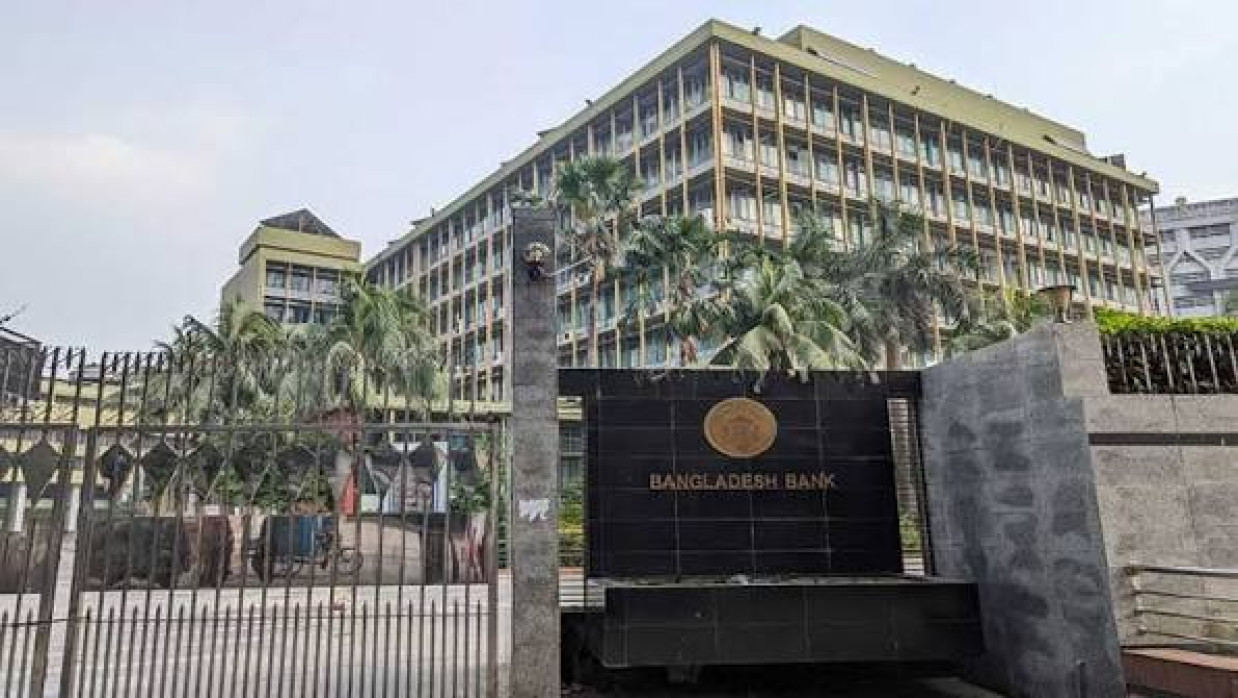
The removal of a reform-minded central bank governor, the accumulation of more than Tk 6 lakh crore in non-performing loans, and enormous public assistance to distressed banks raise a fundamental question: will Bangladesh dismantle the financial networks that flourished under previous governments, or merely transfer their privileges to another political establishment?
Bangladesh is going through one of its biggest banking crises. It has affected not only the banking sector but also our democracy. This is due to political lending, inadequate monitoring of the banking sector, and the rescheduling of loans to favored companies. Massive corporate lending and bank looting have put many commercial banks at a heavy loss. Losses that will have to be borne by common people who keep their money in banks, business houses, and eventually the exchequer.
The July-August movement of 2024 gave us hope that we could end this cycle of politicians controlling banks. After the fall of Sheikh Hasina's government, people expected the hidden banking losses to come to light, loan defaulters with political connections to be identified, and money to be recovered from them. Bangladesh Bank was brought back on track.
Prof. Muhammad Yunus's government came to power with many flaws in our banking sector hidden under the rug. By appointing economist Dr. Ahsan H. Mansur as Bangladesh Bank Governor in August 2024, they tried to rectify some of these problems and stand up to powerful commercial interests.
But after the BNP-led government, led by PM Tarique Rahman, returned in February 2026, we have once again started to wonder whether these problems will ever be solved. By dismissing Bangladesh Bank Governor Dr. Ahsan H. Mansur 9 days after taking office and replacing him with a businessman, Md. Mostaqur Rahman, we see the shadow of political interference.
This is concerning because our banking crisis is not only due to a poor economy but also to a banking sector long under political influence. Whether it's getting loans from banks, owning a bank, a lenient attitude from the regulator, or how loan defaulters are dealt with.
If these relationships remain intact, the change of government may ultimately accomplish little more than replacing one set of financial beneficiaries with another.
The Removal of Ahsan H. Mansur: A Turning Point in Banking Reform?
He served as governor from 14th August 2024 to 25th February 2026. He helped identify hidden non-performing loans in the banking system, imposed strict regulations, reorganized failed banks, and investigated some prominent businessmen for their involvement in fraud.
S Alam Group, Beximco, and many others were implicated in this issue. They had built huge exposure during the previous government.
This issue became political. Many business houses took loans from banks without collateral or a proper justification for how they would repay the money. They were able to take such large exposures from banks due to their strong relationships with the ruling party.
On 25th February 2026, the government sacked him. Minister Amir Khasru Mahmud Chowdhury stated that the new government wants to work according to its agenda, so he was replaced. The government made no official announcement stating that Dr. Ahsan Mansur committed any malpractice while serving as governor.
Any government has the right to set an economic agenda after coming to power. But the central bank should not be treated that way. It oversees commercial banks and helps keep our money safe. It should be impartial to every bank and not be involved with politicians.
Replacing a central bank governor during a time of banking crisis will create uncertainty in the banking industry. Especially if the replacement is associated with banks that have exposure or with those businesses.
So, one can only ask why the government replaced him. Was it just to follow their economic plan, or because the businesses that benefited from the money have enough power to pressure the government?
We can't confirm that these businesses have played any role in firing Dr. Ahsan Mansur. But we can assume that they did. The government should give us a clear answer on how the new governor will benefit the banking sector.
A New Governor and the Question of Conflicts of Interest
Md Mostaqur Rahman's appointment attracted criticism because of his business background, political associations, and the borrowing history of Hera Sweaters, the garment manufacturing company where he had served as managing director.
Reports indicated that the company had approximately Tk 86 crore in outstanding borrowing from Mutual Trust Bank and that the loan had previously been classified as nonperforming before being rescheduled. Other reports cite a slightly higher amount, reflecting differences in reporting dates and loan balances.
Rahman was also reportedly associated with the BNP's central election steering committee.
Transparency International Bangladesh questioned whether appointing a politically connected businessman with a history of company-linked loan rescheduling could compromise Bangladesh Bank's independence.
It does not mean that an organization's management committed any offense if the company failed. Restructuring a loan is a normal banking procedure. One should also not assume someone to be corrupt because of their political affiliations.
But a central bank governor should keep some distance from the business he regulates.
The question is whether he has declared all his businesses. If so, has he handed over management of those businesses and taken the necessary steps to avoid conflicts of interest with previous lending institutions, borrowers, and political ties?
His appointment was challenged through a writ petition in the High Court, which was dismissed. Although this case has been closed, other policy issues remain regarding the central bank's position.
Our country can't rely on our banking system being appointed to meet minimum criteria. It must meet the standard we expect from a central bank.
The Scale of the Banking Disaster
The financial figures reveal the magnitude of Bangladesh's banking deterioration.
By June 2026, nonperforming loans had reached approximately Tk 606,555 crore, equivalent to 32.78 percent of outstanding banking-sector loans. This means that nearly one-third of all bank lending was classified as nonperforming.
The amount rose from Tk 588,704 crore in March 2026 to Tk 611,555 crore, an additional Tk 22,851 crore in just three months.
The crisis is heavily concentrated. Ten banks accounted for approximately Tk 439,527 crore of the sector's nonperforming loans, representing more than 72 percent of the national total.
This indicates the issue was not evenly spread across all banks in Bangladesh. Some banks have suffered heavily due to overexposure. Poor management and political connections, along with negligence in recovering money from customers, contributed to this.
As of June 2026, Islami Bank Bangladesh had non-performing assets of Tk 98914 crores, more than half of its total loan amount.
Janata Bank, which is government-owned, had about 75728 crores in bad loans, accounting for nearly three-fourths of its loans.
First Security Islami Bank had an even more alarming non-performing loan ratio of about 97 percent, while Union Bank's ratio was close to the same level.
These figures are not simply accounting irregularities. They represent financial assets that may never be fully recovered.
If most of a bank's loan portfolio is non-performing, then it will need significant change to become solvent. Short-term financing may help meet some demands, but there is no way to turn non-performing loans into good loans.
As stated earlier, there is a big difference between being liquid and being solvent. You can have enough money in your bank to meet current demand but still be insolvent because you owe more than what you actually have.
Bangladesh's banking rescue efforts must therefore be judged by the recovery of underlying assets and restoration of capital, not merely by the volume of emergency funding distributed.
The Banks Carrying the Heaviest Burden
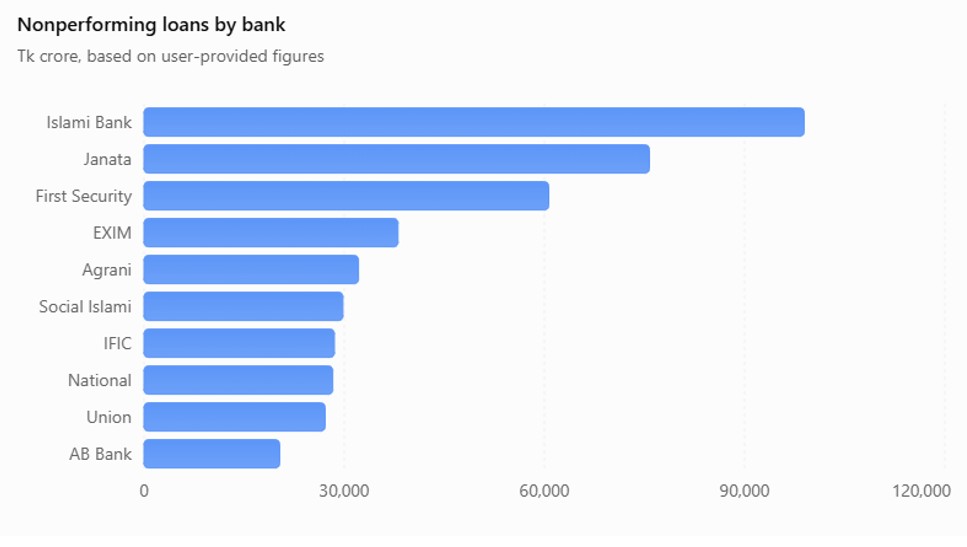
The following figures illustrate the concentration of impaired loans in ten major institutions, based on Bangladesh Bank data reported in September 2026.
Nonperforming Loans at Ten Major Bangladeshi Banks
The figures provided indicate a severe concentration of nonperforming loans (NPLs) within Bangladesh's banking sector, particularly among several Islamic banks and state-owned commercial banks.
|
Bank |
NPLs (Tk crore) |
Share of total loans |
|
Islami Bank Bangladesh |
98,914 |
52.15% |
|
Janata Bank |
75,728 |
75.05% |
|
First Security Islami Bank |
60,645 |
97.08% |
|
EXIM Bank |
38,053 |
70.81% |
|
Agrani Bank |
32,133 |
43.98% |
|
Social Islami Bank |
29,799 |
78.15% |
|
IFIC Bank |
28,520 |
63.38% |
|
National Bank |
28,276 |
~65% |
|
Union Bank |
27,134 |
96.78% |
|
AB Bank |
20,325 |
~56% |
|
Total |
439,527 |
— |
Combined nonperforming loans across the ten banks
Tk 4,39,527 crore
Principal findings
- Islami Bank Bangladesh has the largest absolute volume of NPLs at Tk 98,914 crore.
- First Security Islami Bank and Union Bank have exceptionally high NPL ratios, exceeding 96%, indicating that nearly their entire reported loan portfolios are classified as nonperforming.
- Janata Bank has Tk 75,728 crore in NPLs, representing more than three-quarters of its loan portfolio.
- The combined NPL figure is substantial, but it cannot automatically be treated as the amount of money lost or the amount required for a government bailout.
These figures have not yet been independently verified against Bangladesh Bank's latest disclosures. Their reporting date is particularly important because bank mergers, restructuring, write-offs, and changes in loan classification can materially affect comparisons.
Numbers are approximate based on classified loans as of June 2026. Not actual write-offs.
When a loan goes non-performing, it's not automatically considered a lost asset. There can be recoveries made on these. Whether it be through seizure of collateral, settlement, or court cases. But we are seeing extremely large non-performing loan figures. Meaning these banks have lost substantial portions of their income-generating assets.
Some of the privately owned banks have performed much better. Some have NPL ratios under 5% as of June 2026. So, something about these banks must be allowing them to perform so well during a nationwide crisis. Strong governance standards, customer due diligence, and freedom from government intervention.
Bailouts
Who did Bangladesh Bank help?
As of October 2026, Bangladesh Bank has given approx. Tk 84,945.71 crore in bailout money to various banks.
Bangladesh Bank Financial Assistance to Nine Major Banks
|
Bank |
Reported Assistance (Tk crore) |
|
Islami Bank Bangladesh |
17,000.00 |
|
First Security Islami Bank |
15,810.32 |
|
Social Islami Bank |
10,843.00 |
|
EXIM Bank |
10,568.00 |
|
National Bank |
10,508.00 |
|
Union Bank |
5,421.00 |
|
Premier Bank |
4,900.00 |
|
AB Bank |
4,270.00 |
|
Global Islami Bank |
3,003.00 |
|
Total for Nine Banks |
82,323.32 |
Total reported financial assistance: Tk 82,323.32 crore (approximately Tk 823.23 billion).
Note: The figures are based on the information provided and have not been independently verified. Confirm the reporting period, nature of assistance, and whether the amounts represent disbursements or approved facilities before publication.
A note of caution is warranted with these numbers. This is the total aid they received. Some of it may have been given before the BNP came into power in Feb 2026.
Proper records should be kept of how much was given in the past. How much is currently being given. How much they still owe. Payments made back. Collateral and government-backed loans, etc. It's impossible to assume all this aid was given under the current government.
Nevertheless, the scale of intervention raises a fundamental public-interest question: how much of this money can realistically be recovered?
Emergency assistance is ordinarily intended to address temporary liquidity shortages. When financial institutions have already suffered severe asset deterioration, however, repeated liquidity injections can become a way to postpone insolvency.
If borrowers fail to repay their loans, banks cannot recover the resources needed to repay the central bank. Ultimately, the financial burden may be transferred to taxpayers through recapitalization, government guarantees, or other forms of public support.
The Merger of Five Islamic Banks: Rescue or Transfer of Losses?
The consolidation of First Security Islami Bank, Social Islami Bank, EXIM Bank, Union Bank, and Global Islami Bank into Sammilito Islami Bank represents one of the largest restructuring initiatives in Bangladesh's banking history.
The five predecessor institutions reportedly had approximately Tk 165,779 crore in nonperforming loans by March 2026, representing 84.22 percent of their combined loan portfolios.
They had also received approximately Tk 45,645 crore in emergency financial support.
The merged institution was established with reported government capital support of Tk 20,000 crore and assumed responsibility for the predecessor banks' operations and depositor obligations.
The consolidation may provide administrative efficiencies and a framework for recovering distressed assets. But combining five severely impaired banks does not automatically produce one financially sound institution.
Their underlying losses remain.
Sammilito Islami Bank's management must demonstrate that it is approving new lending based on independently verified borrower cash flows, enforceable collateral, realistic repayment schedules, and effective controls over connected-party transactions.
Reports that the merged institution has begun approving new investment proposals do not prove these loans will ultimately be repaid.
The public deserves regular disclosure of how much inherited bad debt has been collected in cash, how much has been written off, and whether the bank's capital position is improving.
Without such transparency, the merger risks becoming an expensive transfer of private banking losses onto the public balance sheet.
National Bank and the Expanding Public Guarantee
National Bank illustrates another dimension of the crisis.
Reportedly, Sonali Bank sanctioned it a Tk 7000 crore facility against a Bangladesh Bank Guarantee in Oct 2026. On the condition that this money be given to depositors, not as a loan.
May need to step in to avoid panic among depositors who couldn't get their money back.
A bank guarantee doesn't mean there's no risk. It can shift or spread that risk among banks, or it may affect the government's pocket if the borrowed bank fails to repay.
The Tk 7,000 crore facility must also be accounted for separately from previously reported cumulative assistance unless the underlying transactions are reconciled.
Bangladesh cannot establish the true cost of its banking rescue without a consolidated statement showing direct assistance, guaranteed facilities, capital injections, recoveries, and contingent liabilities.
Political Patronage and the Recycling of Financial Power
Bangladesh's financial crisis cannot be separated from its political history.
Under successive governments, powerful business interests have developed relationships with political parties, regulators, senior bureaucrats, and financial institutions. Some of these relationships are legitimate commercial or professional associations. Others have been implicated in allegations of preferential lending, regulatory interference, and the accumulation of illicit wealth.
The danger is that such networks may survive political transitions because their loyalty is driven more by financial advantage than by political ideology.
A business group associated with one administration may maintain influential relationships with its political opponents. Senior officials may continue exercising informal influence after a change of government. Families connected through marriage, business partnerships, or shared investments may preserve commercial arrangements despite public political rivalries.
This creates the possibility that a political revolution can remove the visible leadership of an establishment while leaving its financial machinery largely intact.
Recent concerns about the possible restoration of former bank owners or shareholders associated with distressed institutions illustrate this danger.
No individual should be permanently excluded from commercial activity merely because of political association or unproven allegations. But individuals implicated in serious banking irregularities should not regain control over financial institutions without transparent investigation, appropriate legal findings, and credible safeguards against renewed misconduct.
The reported relaxation of certain loan-rescheduling requirements and large-borrower exposure limits also deserves scrutiny. Such concessions may sometimes support viable businesses facing temporary financial difficulty. But they can also benefit influential borrowers whose debts have become uncollectible.
The distinction depends on independent credit assessments and transparent regulatory decisions.
Ministers, Financial Influence, and the Responsibility of the Prime Minister
The concentration of authority over Bangladesh's financial institutions creates opportunities for political interference.
The finance ministry, Bangladesh Bank, state-owned banks, revenue authorities, and government procurement institutions collectively influence enormous flows of public and private money.
Senior ministers can affect regulator appointments, financial policy direction, government guarantees, public borrowing, and the restructuring of distressed institutions.
If this level of power is allowed without an institution to oversee these officials, there is a high risk of conflicts of interest.
Some claim these powerful ministers may use back channels to enrich themselves or close friends and family members. Evidence must support these claims. Bank statements, beneficial owner data, or even intervention and money being funneled out of a public institution could prove these allegations.
The evidence presently available does not establish that particular ministers are directing criminal banking syndicates.
Nevertheless, Prime Minister Tarique Rahman bears political responsibility for ensuring that the officials appointed under his administration do not exploit public financial institutions for private advantage.
The government cannot ensure any change in our banking sector when we allow our regulator to be under some sort of commercial tie we don't know about.
The job of a prime minister is not only to appoint ministers and officials, but to ensure they do not use their position for personal gain.
Do our Officials have Foreign Citizenship or Assets Overseas?
With Bangladesh's history of money being stolen from our nation, we have to ask. Do our officials who may come under investigation have assets abroad or foreign citizenship?
Having a foreign citizenship does not make you corrupt. Having assets abroad does not make you a criminal.
But when you're in charge of others' money, you should be transparent about your assets in other countries.
There have been claims of certain ministers having foreign citizenship. These claims should be made against citizens whose citizenship is public or who would violate their office. We should not jump to conclusions about all of our current and past finance ministers.
However, we should be concerned when our officials leave the country.
Too often, we see officials flee our country when money laundering charges are filed against them. We need to stop money from leaving our country illegally. This will require more than just stopping people from leaving our country.
Senior ministers, regulators, bank directors, and politically exposed borrowers should face transparent financial disclosure obligations.
The same standards must apply regardless of political affiliation.
Depositors: The Forgotten Victims of the Crisis
Ordinary depositors are the most immediate victims of banking failures.
Families deposit their savings in banks because they believe these institutions are regulated, financially sound, and can return money when required.
When depositors cannot withdraw their funds, the damage extends beyond personal hardship. Confidence in the entire financial system begins to deteriorate.
Businesses struggle to pay employees and suppliers. Retirees lose access to accumulated savings. Families face uncertainty over medical expenses, education costs, and ordinary household obligations.
The problem becomes particularly painful when depositors discover that banks entrusted with their money extended enormous loans to politically connected borrowers who subsequently failed to repay them.
The Islamic banking sector has faced an additional crisis of confidence because many customers selected these institutions partly on the basis of religious and ethical financial principles.
Reports of concentrated lending and governance failures have therefore undermined both commercial confidence and expectations of ethical stewardship.
Restoring trust will require more than public assurances. Depositors need credible evidence that regulators supervise banks independently and that those responsible for financial misconduct face appropriate legal consequences.
What the Future Holds for Bangladesh's Banking System
Bangladesh could have many scenarios.
If proper reforms were in place, an outside agency could assess banks' asset quality. Non-performing assets can be identified. Healthy banks will receive capital injections, and unhealthy banks can be liquidated or restructured.
Legal action will be taken against major defaulters without political bias. Commercial lending will be assessed properly, and the central bank can provide clear disclosure on its website.
Such reforms would be difficult and potentially expensive, but they could gradually restore depositor confidence and financial stability.
A second possibility is prolonged financial stagnation. Banks may continue operating through repeated loan rescheduling, regulatory concessions, and official liquidity assistance while failing to recover their underlying assets.
This would create institutions that survive administratively but contribute little to productive economic development.
A third, more dangerous possibility is the renewed politicization of banking supervision. If powerful borrowers regain influence over regulatory decisions, the country could experience another cycle of excessive lending, hidden losses, financial rescues, and public indebtedness.
The consequences would extend to inflation, investment, employment, government finances, and Bangladesh's international creditworthiness.
The distinction between these outcomes will depend primarily on political will and institutional independence.
The Accounting Bangladesh Must Demand
A credible public investigation should establish the precise financial position of every institution receiving emergency assistance.
It should disclose the amount of new assistance approved since February 2026, identify outstanding balances and repayments, and distinguish central bank lending from government capital injections and guaranteed interbank facilities.
It should also examine the beneficial owners of major defaulted loans, the commercial justification for recent rescheduling decisions, and the extent to which new lending has been directed toward politically connected borrowers.
Sammilito Islami Bank's performance deserves particular scrutiny because the institution has inherited an extraordinary concentration of impaired assets.
Quarterly reporting should disclose actual cash recovery from old loans, the repayment performance of new financing, capital adequacy, and changes in the value of government support.
These disclosures would allow Parliament, depositors, journalists, and independent economists to distinguish genuine financial recovery from accounting adjustments that merely postpone loss recognition.
The same scrutiny should extend to appointing bank directors, selecting regulators, and any policy changes that materially benefit major borrowers.
Transparency is not an obstacle to financial stability. In a system already damaged by secrecy and political influence, restoring confidence is essential.
The Unfinished Financial Revolution
Bangladesh's banking catastrophe is ultimately a crisis of political accountability.
The country's financial institutions were not destroyed by ordinary economic fluctuations alone. Their deterioration reflects years of concentrated lending, weak supervision, questionable governance, and a failure to hold powerful borrowers accountable.
It provided us a chance to stand up against these things. Although the Interim Government brought some positive changes, it is unclear how our Bank will fare under an elected government.
The removal of Ahsan H. Mansur and the appointment of Mostaqur Rahman have become symbols of these concerns. Whether the leadership change ultimately strengthens or undermines the banking system will be determined by measurable regulatory performance, not political declarations.
The question for PM Tarique Rahman's government is whether they will work to return the public's and depositors' money. Keep bank regulation away from politics and prove to loan defaulters with political connections that their time is over.
Or it can allow Bangladesh's financial institutions to remain vulnerable to the same relationships between political authority and private enrichment that contributed to the present crisis.
The country cannot afford another generation of banking losses disguised as development financing, regulatory accommodation, or emergency stabilization.
The billions already tied up in distressed loans represent resources that could have supported industry, agriculture, education, healthcare, and productive employment.
Every taka lost through politically protected financial misconduct ultimately diminishes the country's capacity to improve the lives of its citizens.
The revolution that removed an authoritarian government will remain incomplete if the economic structures that enabled the concentration of wealth and influence continue to operate without accountability.
Bangladesh's democratic future will depend not only on who governs the country, but on whether its banking institutions are finally liberated from the political interests that have repeatedly compromised them.


0 Comments
LEAVE A COMMENT
Your email address will not be published