

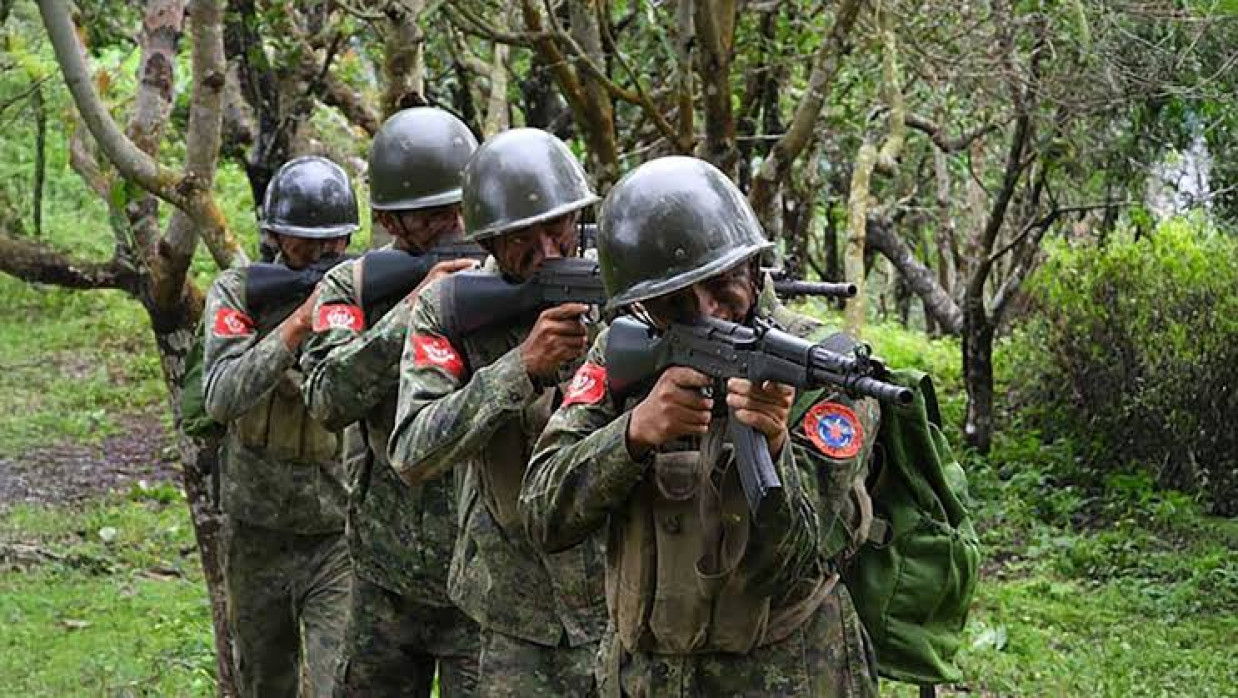
As Myanmar’s military cedes control of Rakhine State, Bangladesh’s geopolitical landscape shifts. Demands for an independent Rohingya homeland, Arakan Army land grabs, and next month’s International Court of Justice ruling have resurrected decades-old debates on questions of sovereignty, justice, and the future of more than one million refugees.
A New Political Reality on Bangladesh’s Eastern Frontier
Living as refugees for close to ten years now, the Rohingya crisis continues to be one of South Asia’s longest humanitarian disasters. Rohingyas are Muslims who have fled Myanmar after facing ethnic cleansing and decades of state-sponsored oppression in their homeland. Over a million Rohingya refugees currently live in Bangladesh, and their long-term presence in Bangladesh has taken a heavy toll on its economy, environment, society, and security. Despite international diplomatic efforts, no lasting solution has been reached yet.
Now, however, developments inside Myanmar are fundamentally changing the political equation.
The Myanmar military, which orchestrated the devastating 2017 campaign against the Rohingya, has lost control of much of Rakhine State to the Arakan Army (AA), an ethnic Rakhine armed organization seeking substantial autonomy or self-determination. The AA’s military victories have transformed it from an insurgent movement into a de facto governing authority across large areas of western Myanmar.
In response, Bangladesh Jamaat-e-Islami called for an independent Rohingya nation in northern Rakhine. The proposal was rejected by Myanmar's military junta as meddling in Myanmar's internal affairs. In another development, the ICJ is set to deliver its verdict on Myanmar's violation of the Genocide Convention against the Rohingya soon, on November 19, 2026.
Who rules Rakhine State? Can Rohingya go home safely? Should Bangladesh, China, India and the wider international community have a say in deciding Rakhine State’s future? The outcome of these questions will determine not just Myanmar’s sovereignty but the security dynamics of the entire northeastern Indian Ocean.
Jamaat-e-Islami’s Proposal: A Homeland for the Rohingya?
In April 2025, a group from Bangladesh Jamaat-e-Islami proposed this idea. A senior party leader, Syed Abdullah Mohammad Taher, led the group. They met with Chinese Communist Party officials who were visiting Dhaka at the time.
Syed Abdullah Mohammad Taher believed aid would not help. He wanted to create a separate state for the Rohingya who currently reside in Bangladesh. The Rohingyas number around 1.2 million people in Bangladesh, and they would have their own state in the area of Rakhine, also known as Arakan.
The delegation sought Chinese assistance, recognizing Beijing’s substantial diplomatic and economic influence over Myanmar.
Myanmar’s military authorities rejected the suggestion, accusing Jamaat of exploiting the Rohingya issue for political advantage and interfering in Myanmar’s sovereignty.
Let’s start by saying the suggestion is worth considering, regardless of who made it.
The Rohingya people have been marginalized, subjected to movement restrictions, denied citizenship, and periodically persecuted for decades. Myanmar’s 1982 Citizenship Law legalized many aspects of their statelessness. As a result, they lack any significant legal rights.
Granting the Rohingya people their own guaranteed homeland may well be the least that can be done.
Of course, realizing a separate Rohingya state would face significant challenges.
For one, Rakhine State, and particularly its northern region, is home to more than just Rohingya. Ethnic Rakhine Buddhists also have their own understanding of the area's history and political claims. Unilaterally declaring a new religious or ethnic-based state could raise further communal tensions.
Additionally, Jamaat- e- Islami is a political party in Bangladesh, not a democratically elected Rohingya body. If there is to be any serious discussion about the rights of self-determination for Rohingya, it must be with input from Rohingya and other affected communities.
Meaning guaranteeing that they can call Myanmar home safely. Not necessarily creating a new independent country that is recognized by the international community.
The Arakan Army: From Insurgency to Territorial Authority
The most consequential transformation in Rakhine has been the Arakan Army's emergence as the dominant military force across much of the state.
Since launching its major offensive in November 2023, the AA has captured numerous military installations, administrative centers, and strategically important border areas.
By mid-2025, reports indicated that the organization controlled 14 of Rakhine’s 17 townships, including the strategically significant Maungdaw and Buthidaung areas adjoining Bangladesh. The military retained important positions around Sittwe, Kyaukphyu, and Manaung.
This situation represents an extraordinary reversal for Myanmar’s armed forces, which once exercised almost unquestioned authority over the region.
Yet the AA's territorial achievements do not automatically translate into legitimate or inclusive governance.
The organization primarily represents ethnic Rakhine nationalism. Its leadership has discussed confederation and extensive autonomy, but the precise constitutional arrangements it ultimately seeks remain uncertain.
For the Rohingya, this creates a troubling paradox.
The military organization responsible for their mass displacement has lost much of its territorial authority. Nevertheless, the armed movement replacing it has not established a convincing framework guaranteeing Rohingya citizenship, political participation, freedom of movement, and protection from persecution.
Other reports have also highlighted restrictions on movement, forced recruitment, and abuse of Rohingya civilians in AA-controlled areas. These are among the reasons why Rohingya have this fear. A January 2026 UK report found that Rohingya face threats of serious harm from the AA and other armed groups.
So, it's important that the problem isn't just switching military control to an ethnic group that holds nationalistic ideals. The key is finding a way that everyone in Rakhine State can live with the same rights.
Without such guarantees, the transition from junta control to Arakan Army authority could merely reproduce older patterns of exclusion under a different political leadership.
Bangladesh’s Diplomatic Dilemma
Bangladesh faces a particularly difficult strategic predicament.
For years, Dhaka negotiated Rohingya repatriation primarily with Myanmar’s central authorities. Those discussions repeatedly produced agreements and announcements but little meaningful progress.
Today, the situation is even more complicated.
The Myanmar military government claims sovereign authority over Rakhine, while the Arakan Army exercises effective control over much of the territory to which the refugees would return.
Bangladesh cannot realistically organize repatriation without communicating with the authorities controlling the border and prospective return areas.
Consequently, Bangladeshi officials have acknowledged the need to maintain contacts with both Myanmar’s central government and the AA.
This is a pragmatic adjustment rather than diplomatic recognition of an independent Arakan.
Bangladesh must nevertheless proceed cautiously. Direct engagement with the AA could generate tensions with Myanmar’s military authorities and expose Dhaka to accusations of interference in its neighbor’s internal affairs.
Also, ignoring the AA would mean turning a blind eye to the situation on the ground with military and government operations.
Developing dialogue on border issues, allowing humanitarian aid to pass, and returning displaced persons home would be ideal. With the help of other countries.
Bangladesh must also prevent its territory from becoming a staging ground for competing armed organizations.
Reports that certain Rohingya militant groups have cooperated with Myanmar’s military against the AA illustrate the dangerous fragmentation of the conflict. Such allegations require careful examination and should never be used to stigmatize the wider Rohingya civilian population.
The Rohingya refugees are not a military organization. They are displaced civilians entitled to protection under international humanitarian principles.
China, India, and the Strategic Importance of Rakhine
Rakhine State occupies a strategically valuable position along the Bay of Bengal, connecting mainland Southeast Asia with the northeastern Indian Ocean.
China has invested heavily in infrastructure linked to the China-Myanmar Economic Corridor, including the Kyaukphyu deep-sea port project and related energy infrastructure.
These investments provide Beijing with access to the Indian Ocean and opportunities to diversify transportation routes.
For China, political instability in Rakhine threatens both commercial investments and long-term strategic objectives.
Beijing therefore has compelling reasons to maintain relations with Myanmar’s military authorities while developing practical contacts with the Arakan Army.
India faces a different but equally important challenge.
Its Kaladan Multi-Modal Transit Transport Project seeks to connect eastern Indian ports with northeastern India through Myanmar. The project depends on reliable transport links through conflict-affected areas.
New Delhi consequently has strong incentives to engage with the emerging authorities in Rakhine without formally endorsing territorial separation.
Bangladesh occupies the third corner of this strategic triangle.
Bangladesh faces a far different reality than China and India, which engage Myanmar primarily on economic and geopolitical grounds. Dhaka also deals with the humanitarian fallout of Myanmar’s internal strife. Bangladesh should let that fact shape its foreign policy. Instead of vying for influence with China and India, Bangladesh might pursue a shared regional framework focused first and foremost on humanitarian access, border stabilization, economic recovery, and repatriation.
However, China and India are unlikely to endorse an independent Rohingya state if doing so threatens their broader relationships with Myanmar or encourages separatist movements elsewhere.
Jamaat-e-Islami’s proposal must therefore be evaluated against the realities of regional diplomacy rather than humanitarian aspirations alone.
The International Court of Justice: A Historic Reckoning
The upcoming decision from the International Court of Justice may become a landmark moment for Rohingya efforts to hold Myanmar accountable on the global stage.
On November 3, 2026, the ICJ announced it will issue its ruling on November 19th in the Gambia v. Myanmar case filed under the 1948 Genocide Convention.
In November of 2019, The Gambia filed suit against Myanmar alleging that it had breached the Convention by conducting a military campaign against the Rohingya.
The ICJ ruled that Myanmar was guilty of committing genocide against the Rohingya people by carrying out military actions.
Myanmar continues to deny any act of genocide and claims that it was simply acting on military forces that attacked it.
On 24 January 2020, the ICJ issued provisional measures against Myanmar. This told Myanmar not to carry out any actions against the Rohingya people and to preserve evidence. Myanmar attempted to raise a preliminary objection, but the ICJ dismissed it on 6 July 2022.
Following hearings in January 2026, the judges began deliberating on the merits of the allegations.
The November judgment will concern Myanmar’s responsibility as a state, not the individual criminal liability of military commanders.
Separate proceedings at the ICC and national courts address charges against specific individuals.
A court ruling that would hold Myanmar guilty of genocide would have great moral and legal implications. It would also create a push for compensation and assurance from the international community to help the Rohingyas.
Nevertheless, even a favorable ruling would not automatically create a Rohingya state or secure the refugees’ return.
International judicial decisions cannot substitute for effective political arrangements on the ground.
The court has great power, but its ruling can be applied only with global cooperation and the will to do so.
This could lead to more rulings on the Genocide Convention and how it applies in court cases.
Can an Independent Rohingya State Become Reality?
The establishment of an independent Rohingya state remains politically improbable under present circumstances.
Such an arrangement would require agreement on territorial boundaries, governance, citizenship, security, economic sustainability, and relations with neighboring states.
The Rakhine National Movement, the Myanmar military, and possibly larger regional powers would likely push back.
Perhaps they could be granted autonomy within a newly established Myanmar federation. Along with internationally protected terms of citizenship and basic human rights.
They could have an agreement within Rakhine that includes the AA, Rohingya, and other groups.
However, these options will be difficult to achieve.
Moreover, recent military escalations indicate that the conflict is far from over. For instance, on November 1–2, 2026, Myanmar military forces reportedly conducted airstrikes in various townships, killing at least 14 civilians and injuring dozens. Targets include maternity clinics, civilian homes, and general civilian infrastructure. Civilians continue to live under attack even in areas governed by the AA. Despite taking control of much of Rakhine State, the AA has yet to defend against Myanmar military airstrikes. Territorial control will not equate to civilian protection.
People need to trust they will be safe when they return home. Safe from military attacks, have proper citizenship, rights to their land, and the ability to travel freely without persecution.
Returning people to territories where they remain stateless and vulnerable would not constitute a humanitarian solution.
It would merely transfer the refugee crisis back across the border.
A Regional Responsibility That Cannot Be Postponed
The Rohingya tragedy is no longer simply a dispute between Myanmar and Bangladesh.
It has become a regional security challenge involving ethnic nationalism, international law, geopolitical competition, and Myanmar's future constitutional structure.
Bangladesh has demonstrated extraordinary generosity by sheltering displaced Rohingya for years. Yet indefinite encampment cannot become the international community’s permanent answer.
The United Nations, ASEAN, China, India, and other influential actors must move beyond repeated declarations of concern toward a coordinated political framework.
It needs to ensure a peaceful solution in Rakhine with humanitarian access. The civilian population needs to be protected, and Rohingya representatives must have an input into any discussion on the return of people. A proper repatriation plan must also be put in place.
As the main territorial player in Rakhine State, the Arakan Army must be part of this conversation. However, they should not be given a free pass if they don't uphold the rights of all minority groups.
Myanmar's military government cannot use its claim to sovereignty to escape responsibility for what has been alleged.
When you hold sovereignty over certain territories, you have a responsibility to those people who live within your country's borders.
With the ICJ ruling around the corner, we need to hold this idea close.
Conclusion: Justice Before Geography
The creation of a separate state for the Rohingyas has sparked much discussion that governments have tried to stay away from. Can a persecuted group find safety if they are not allowed to have power over their lives?
The question deserves serious consideration, even if immediate independence is neither politically feasible nor necessarily the most equitable solution.
The collapse of Myanmar’s military authority across much of Rakhine has created a historic opening. Yet military victory by the Arakan Army does not, by itself, guarantee justice for the Rohingya.
It should take measured action towards its neighboring countries and remain true to its humanitarian values.
China and India should understand that they cannot keep looking away from their neighbors' problems for the sake of trade.
Above all, the Rohingya must cease being treated merely as refugees awaiting transportation across a border.
They are a people with a history, an identity, and legitimate claims to citizenship, security, and political participation.
Whether Rakhine becomes its own state, part of a federation, or something else entirely. The Rohingya will have to be a part of that decision for it to be deemed just.
When people are forced to leave their homes, then return and become citizens again, Rakhine will be at peace when they live freely and know they belong in the society they were pushed out of.


0 Comments
LEAVE A COMMENT
Your email address will not be published