

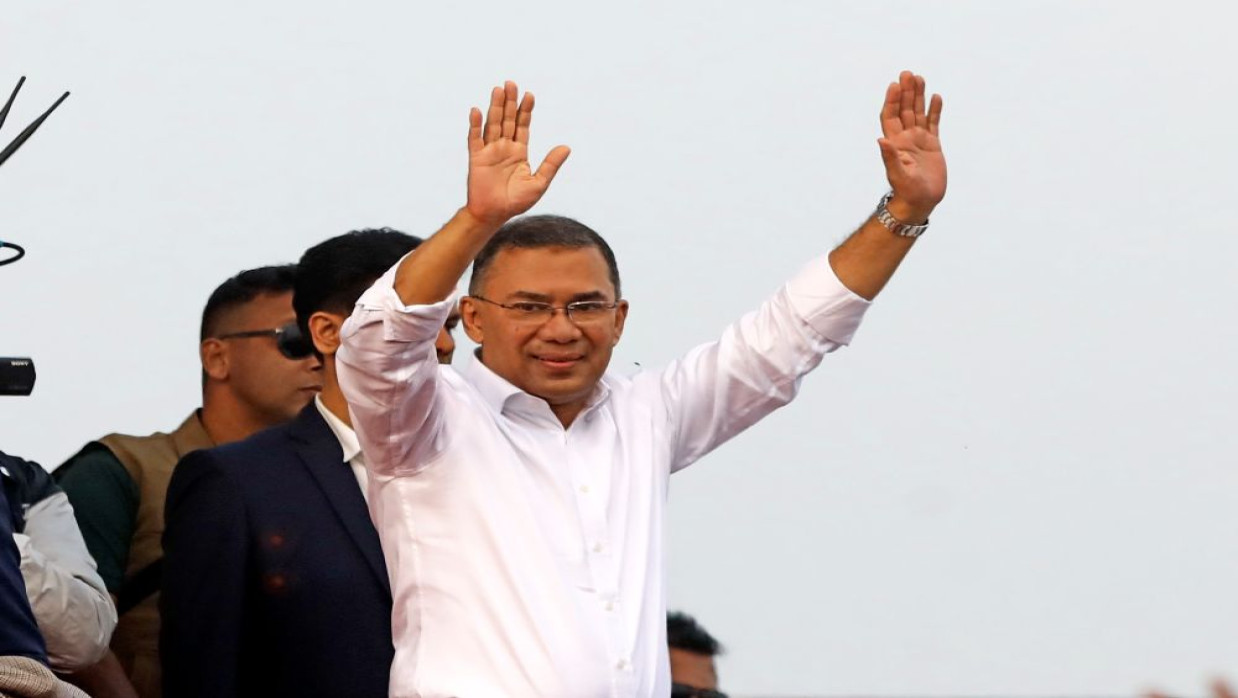
Prime Minister Tarique Rahman is, by any measure, a fortunate man.
Not simply because he has reached the highest elected office in Bangladesh, but because he has arrived there at a moment when history has placed an extraordinary opportunity before him. Few political leaders are given the chance to inherit a country so eager for change, so conscious of its past failures, and so hopeful about its future.
But history can be generous—and unforgiving.
The opportunity before Prime Minister Tarique Rahman is immense. So is the responsibility. He has been given something political leaders everywhere seek but rarely receive: a genuine opportunity to reshape a nation's direction.
He must not waste it.
His first address to the nation offered an important principle: that Bangladesh belongs to all its citizens, regardless of whom they voted for or whether they voted at all. He has also identified law and order and the fight against corruption as priorities, emphasizing that the rule of law—not political influence or coercion—should govern the state. Those are important words. The challenge now is to turn them into a genuine governing culture.
THE MOMENT BELONGS TO HIM—BUT IT REALLY BELONGS TO BANGLADESH
Prime Minister Tarique Rahman has inherited a country with enormous potential but equally formidable problems.
Bangladesh has a large, youthful population, an increasingly sophisticated private sector, an important manufacturing base, a globally significant diaspora, and a strategic geographic position.
But these advantages cannot be taken for granted.
The country needs stronger institutions, greater economic discipline, better governance, reliable energy, more productive investment, quality education, employment for its young people and a financial system in which citizens and investors can have confidence.
At the United Nations, the Prime Minister presented a vision built around “Recovery, Restoration and Reconstruction.” He spoke of transforming Bangladesh's working-age population into skilled human resources, creating employment, strengthening manufacturing, empowering women and building a more inclusive economy.
That is an ambitious agenda. But ambition alone will not transform Bangladesh.
THE GREATEST DANGER IS NOT FAILURE—IT IS DISTRACTION
Mr. Prime Minister, perhaps the greatest danger before your government is not that you lack ideas. It is that politics could consume the time and political capital required to implement them.
Every new government faces the temptation to reward supporters, accommodate political interests, settle old scores, and become preoccupied with the daily battles of politics.
You have an opportunity to resist that temptation.
The citizens of Bangladesh did not give you a mandate simply to change who occupies government offices. They gave you an opportunity to change how government works.
That distinction is fundamental.
If institutions remain vulnerable to political influence, if corruption merely changes hands, if bureaucratic decisions continue to depend upon connections, or if economic opportunity remains concentrated among the privileged, then Bangladesh will have changed governments without fundamentally changing governance. Your most important legacy could therefore be institutional rather than political.
Build institutions that are stronger than individuals.
Build a civil service that serves the state rather than whichever party happens to be in power.
Build a judiciary whose independence is respected.
Build a police force that citizens can trust.
Build an economic system in which entrepreneurs succeed because of innovation and productivity—not proximity to power.
And build a political culture in which disagreement is not treated as disloyalty.
GOVERN BEYOND BNP
There is another opportunity before you.
You have said that every Bangladeshi has equal rights under your government, whether they voted for the BNP, another party, or did not vote at all.
That principle should become a defining characteristic of your premiership.
You have won political power. Now you have the opportunity to transcend partisan power.
The Prime Minister of Bangladesh cannot govern only for the people who supported him. He must govern for the farmer in Rangpur, the garment worker in Gazipur, the entrepreneur in Dhaka, the student in Chattogram, the expatriate worker in the Middle East, and the Bangladeshi-American building a business in New York or Washington.
They may disagree politically. They may have voted differently. But they are all Bangladeshis.
A leader becomes truly national when those who did not vote for him nevertheless believe that the government belongs to them.
That is a much higher standard than winning an election.
THE ECONOMY MUST BECOME THE GREAT NATIONAL PROJECT
Bangladesh's economic transformation should now be treated as a national project, not simply a government program.
The Prime Minister's ambition of building a trillion-dollar economy over the coming decade is extraordinary. Achieving anything approaching that goal will require much more than government spending.
It will require private investment, foreign investment, technology, skilled workers, energy security, modern infrastructure, predictable regulation and—above all—confidence.
Confidence is an economic asset.
Investors must believe contracts will be honored. Entrepreneurs must believe rules will not suddenly change. Young Bangladeshis must believe that their future does not require leaving the country. And diaspora members must believe that investing in Bangladesh is an opportunity rather than a bureaucratic ordeal.
The diaspora, in particular, represents an enormous reservoir of capital, expertise and international connectivity. Use it.
Bangladeshis abroad should not be viewed merely as remittance providers. They can be investors, mentors, technology partners, educators, entrepreneurs and ambassadors for Bangladesh.
A government that successfully mobilizes its diaspora could create an entirely new dimension of Bangladesh's economic diplomacy.
DO NOT CONFUSE POLITICAL VICTORY WITH HISTORICAL ACHIEVEMENT
Mr. Prime Minister, political victory is temporary.
History is not.
Governments come and go. Political parties rise and fall. Elections are won and lost. But institutions endure—or fail generations of citizens.
Your UN address gave the international community a picture of the Bangladesh you want to build: democratic, prosperous, inclusive, economically confident and respected internationally.
The real test begins after the speeches.
Can Bangladesh become a country where a young person can build a successful career without political connections?
Can an entrepreneur start a company without navigating unnecessary bureaucracy?
Can a citizen obtain justice without influence?
Can a woman travel, work, and build a business with confidence?
Can an investor look at Bangladesh and see predictability rather than uncertainty?
Can a farmer receive a fair return for his labor?
Can a talented young Bangladeshi conclude that his or her future is better built at home than abroad?
These are the questions by which your administration will ultimately be judged.
You Have Been Given a Rare Chance at History
Something else makes your position unusual.
You have spent years outside the formal exercise of executive power, observing Bangladesh's political evolution from a distance. You therefore enter office with an understanding of both the possibilities and the costs of political power.
That experience can become an advantage if it produces humility.
Do not surround yourself only with people who agree with you.
Seek out people who will tell you uncomfortable truths.
Listen to economists who challenge your assumptions. Listen to young people who have no political connection. Listen to business leaders, workers, farmers, academics, women entrepreneurs and members of the diaspora.
A successful prime minister does not need to know everything.
He needs to know how to build a government that can find the right answers.
Mr. Prime Minister, Don't Waste this Opportunity.
You are fortunate, Prime Minister, because Bangladesh has given you an extraordinary opportunity.
But remember: Being fortunate is not the same as being successful.
Luck places a person at the right moment in history. Leadership determines what that person does with the moment.
You now have the opportunity to move Bangladesh beyond the politics of grievance and toward the politics of achievement.
You can make the rule of law more powerful than political influence.
You can make economic opportunity more widely available.
You can make the diaspora a strategic national asset.
You can make young Bangladeshis believe that their dreams can be realized at home.
And perhaps most importantly, you can leave behind institutions that do not depend upon the personality of Tarique Rahman—or any other political leader.
That would be a legacy worthy of the opportunity history has placed in your hands.
The world is watching Bangladesh again. Your appearance at the United Nations gave you the opportunity to tell the world what Bangladesh intends to become.
Now comes the harder task.
Turn the promise into performance.
Do not allow partisan politics, personal loyalties, or the habits of the past to consume the opportunity of the present.
You have been given a rare political moment.
Use it to build something larger than a government, larger than a party and larger than a political career.
Build a Bangladesh that, when your time in office is over, is stronger because you were there.
That is the opportunity.
And that is the responsibility.


0 Comments
LEAVE A COMMENT
Your email address will not be published