

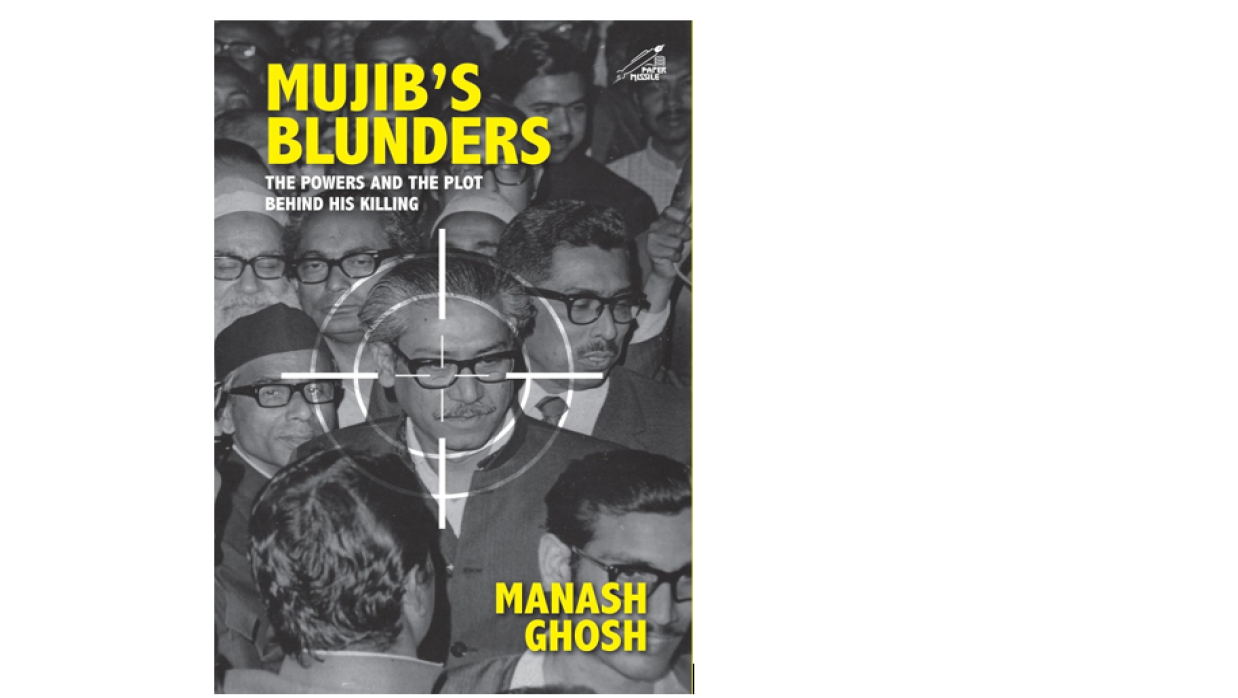
 Book: Mujib’s Blunders: The Power and the Plot Behind His Killing
Author: Manash Ghosh
Publisher: Niyogi Books, New Delhi
Publication: 2025
Pages: 476
Few figures in modern South Asian history have undergone such dramatic cycles of adulation, repudiation and rehabilitation as Sheikh Mujibur Rahman. To one generation of Bangladeshis, he was Bangabandhu, the charismatic nationalist whose voice mobilized a people and whose political struggle made Bangladesh's emergence possible. To his fiercest critics, he became an increasingly autocratic ruler whose government presided over corruption, economic disorder, famine, political repression and ultimately the destruction of multiparty democracy. Half a century after his assassination, Bangladesh is still struggling to reconcile these two Mujibs.
Veteran Indian journalist Manash Ghosh enters this contested terrain with Mujib’s Blunders: The Power and the Plot Behind His Killing. The title makes his purpose clear. This is not another reverential biography. Ghosh seeks to explain how a man who stood virtually unchallenged at the summit of Bengali nationalism in 1971 could, within less than four years, become isolated enough to be murdered with most of his family on 15 August 1975.
Ghosh has one considerable advantage over many writers on Bangladesh: he was there. A journalist with The Statesman, he covered the Liberation War and subsequently served as the newspaper’s Dhaka bureau chief. His recollections of politicians, soldiers, diplomats and conspirators therefore give the narrative an immediacy unavailable to historians working solely from archives. His earlier Bangladesh War: Report from Ground Zero dealt with the struggle for independence; Mujib’s Blunders is, in effect, its darker sequel.
Yet Bangladeshi readers should approach the book with caution. Indian writing about Bangladesh can sometimes interpret the country's history through Delhi’s strategic interests. That is different from suggesting that an author’s religion determines his historical judgment, or that criticism originating in India is necessarily government-inspired. No evidence shows that the Indian government commissioned Mujib's Blunders. Indeed, Ghosh is surprisingly critical of Mujib precisely because, in his telling, Mujib increasingly sought distance from India and accommodation with Pakistan. The book is better understood as an Indian journalist’s interpretation of a country he knew intimately, not as an official Indian account.
Ghosh’s strongest argument concerns Mujib’s disastrous judgment of people. He rehabilitated or promoted men whose commitment to Bangladesh was questionable while alienating some of those who had sustained the independence struggle during his imprisonment in Pakistan. None was more consequential than Tajuddin Ahmad. As prime minister of the provisional government, Tajuddin demonstrated the administrative temperament, discipline and political realism that the new country desperately needed. Yet after returning from Pakistan, Mujib gradually pushed him aside. Ghosh argues that Zulfikar Ali Bhutto and others encouraged Mujib’s suspicion that Tajuddin had become too powerful during his absence.
This points toward Mujib’s central tragedy. He was an extraordinary mobilizer but a much less accomplished administrator. His political genius had been forged on the streets, in mass agitation, imprisonment, negotiation, and confrontation with Pakistan. Those qualities were invaluable in leading an oppressed population. They were insufficient to build institutions, discipline a victorious political party, rebuild a devastated economy, and manage an unruly bureaucracy. The liberator discovered that creating a state was different from leading a movement.
This is often considered one of the biggest failings of his regime. Floods were responsible to some degree. But many factors contributed to the famine. Lack of jobs and money, and poor food distribution. Hoarding and corruption, as well as ineffective government measures. Studies on the famine have highlighted these facts along with political and managerial failings. However, you look at it. People were going hungry in Bangladesh just three years after gaining independence. People were outraged when they saw how much wealth some people were living in.
The Awami League itself became part of Mujib’s problem. Patronage, profiteering, and allegations of nepotism damaged the moral authority the party had earned in 1971. Members of Mujib’s extended political and familial circle acquired influence that was not always matched by competence. Ghosh is particularly interested in Sheikh Fazlul Haque Mani’s influence and his rivalry with Tajuddin. A balanced historical judgment, however, must distinguish documented corruption from the many rumors about Mujib’s family that circulated in the period's politically poisonous atmosphere.
Even more concerning was the use of state violence. Many accusations of torture, disappearance, and killing of political enemies were made against the Jatiya Rakkhi Bahini. The revolutionaries also carried out assassinations and attacks against the state. It has been said that around 30,000 political enemies were killed during the time of Mujib. However, we should not assume this to be true, as figures vary greatly and all political killings cannot be attributed to one source. However, there is no doubt that political violence grew and that the state resorted to force.
BAKSAL. This would be Mujib's most disastrous political decision. With the constitutional changes in 1975, Bangladesh became a one-party state, with the president controlling most things, including the free press. After coming to power from democracy and winning elections by such a large margin, this seemed odd. As Ghosh states, BAKSAL was a major mistake. Mujib thought that by tightening his control he could fix what was going wrong with his country. He only pushed people further underground into politics.
The relationship with India deserves equal scrutiny. Bangladesh unquestionably could not have achieved independence in 1971 in the manner and timeframe it did without decisive Indian military, diplomatic, and humanitarian assistance. But Bangladeshi nationalism was not manufactured in New Delhi. It grew from decades of political, linguistic, and economic grievances within Pakistan.
India's secret dealings did take place before independence, and those involved have said Bengal's freedom fighters were seeking India's help. So, we can't rule out the possibility that Pakistan completely made up the Agartala affair. It also doesn't mean that Mujib was just another Indian agent who was working against Pakistan. The documentary record shows that even in March 1971, Mujib carefully stopped short of an unequivocal declaration of independence while exercising de facto authority in East Pakistan.
What he doesn't do well is relate it to the modern day. There may have been some American and Pakistani involvement in Sheikh Hasina's downfall in 2024, but these are claims that need to be backed up by documents. Not used as a crutch when Bangladeshis were rising up en masse.
That uprising has profoundly altered Mujib’s reputation. Statues were toppled, Dhanmondi 32 was attacked, official honorifics were removed, and the personality cult constructed during Hasina’s long rule was challenged. Yet it would be equally mistaken to conclude that Generation Z has simply rejected Mujib. A large 2025 survey of eligible voters found Mujib receiving the highest top rating among Gen Z respondents, 20.8 percent, ahead of Ziaur Rahman at 15.5 percent, even while Hasina performed far worse. The distinction is important. Young Bangladeshis can reject Sheikh Hasina, dynastic politics, and compulsory reverence for Mujib without erasing Mujib from the history of independence.
That may ultimately be the greatest value of Mujib’s Blunders. It helps separate Sheikh Mujibur Rahman the historical man from Sheikh Mujibur Rahman the state-sponsored icon.
Mujib need not be immaculate to remain indispensable to Bangladesh’s history. He was impulsive, sometimes dangerously trusting, administratively inexperienced and ultimately authoritarian. His government failed catastrophically in important areas. Yet he was also an authentic Bengali nationalist who spent years in prison, repeatedly risked his life and transformed popular grievances into a mass political movement that Pakistan's rulers could no longer contain.
Bangladesh therefore does not have to choose between worshipping Mujib and destroying him. The mature judgment lies somewhere harder: recognizing that the leader who did more than any other politician to mobilize the Bengali nation was not necessarily the leader best equipped to govern the state that emerged.
That contradiction, not conspiracy alone, is the enduring tragedy at the heart of Manash Ghosh’s compelling book.


0 Comments
LEAVE A COMMENT
Your email address will not be published