

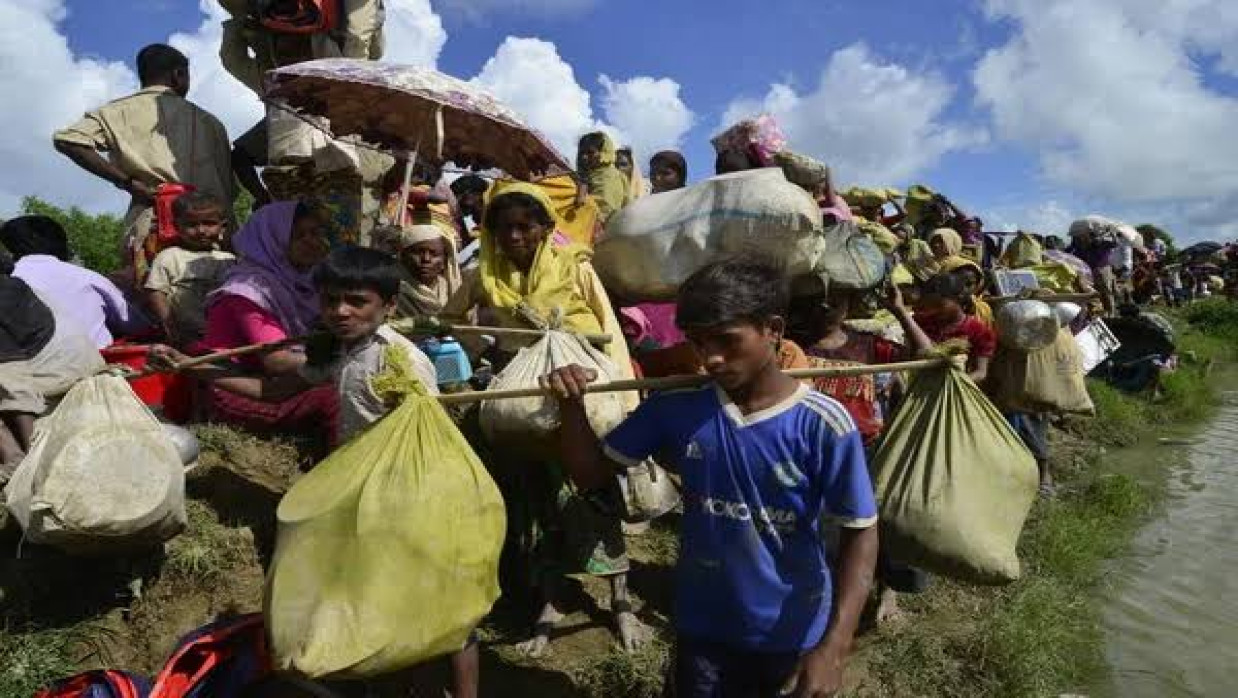
On August 25 each year, Rohingya Genocide Remembrance Day commemorates the start of Myanmar's military "clearance operations" that began in 2017. Troops arrived in Rohingya villages in Myanmar's Rakhine State and killed civilians, perpetrated mass sexual assault, and burned homes and schools to the ground. More than 750,000 Rohingya escaped into Bangladesh over the course of the main mass exodus in 2017. There they joined hundreds of thousands who had fled before them. Today, nearly one million Rohingya find refuge in Bangladesh, though more continue to arrive.
On its anniversary, we should use Rohingya Genocide Remembrance Day as more than a day for press releases and platitudes. We should use it as a prompt to ask ourselves why some cases of genocide elicit swift cries of "Never Again!" while others are met with hesitation or silence.
We have laws, investigative bodies, and political will to know when violence escalates into genocide. The Rohingya crisis has taught us that we will use those tools when we feel like it.
Recognizing the Rohingya Genocide
On March 21, 2022, the United States officially recognized that the Myanmar military had carried out genocide and crimes against humanity against Rohingya people. The announcement came after the U.S. conducted an 18-month factual and legal review that included interviews with over 1,000 Rohingya refugees. Buried in the details of that analysis was a collection of atrocities that shared a common theme. According to witnesses, Rohingya villages were set afire on orders from military units who were told to shoot anyone who fled. Rohingya women and girls were raped while witnesses reported hearing soldiers refer to people as Muslims, blacks, or terrorists. Rohingya mosques were destroyed, children were killed along with elderly men who couldn’t flee. State officials had publicly proclaimed Rohingya as a foreign race that would someday need to be finished off in Myanmar.”
This was not the act of rogue soldiers out of control. The scale, repetition, and frankly racist language used indicated something much more intentional: a campaign to drive Rohingya out of their homes.
The Myanmar government insisted that this was necessary counterterrorism work against a rebel group known as the Arakan Rohingya Salvation Army. But that claim still didn't explain the annihilation of hundreds of villages. Nor could it explain the slaughter of innocents. War doesn't give a country a free pass from the Genocide Convention. Neither does the existence of a militant organization absolve the wholesale oppression of a religious minority.
The Search for Justice
In November 2019, The Gambia filed a suit against Myanmar at the International Court of Justice. On January 23, 2020, the International Court of Justice unanimously ordered Myanmar to prevent genocidal actions against the Rohingya, preserve evidence of genocidal actions that have already occurred, and provide a report to the Court on its efforts. Although the order did not represent a determination on the merits of the case that genocide had been committed, it acknowledged that there was an urgent threat to the Rohingya people. Hearings on the merits have since taken place.
During the hearings, Canada, Denmark, France, Germany, the Netherlands and the United Kingdom joined together to intervene as third-party participants in the case in 2023. In their intervention, they underlined a significant legal point: Genocide need not amount to the whole or almost the whole of a people. If one of the phases set out in Article II is committed with intent to destroy, in whole or in part, a group, as a group, that is genocide. For example, genocide can be committed by intentionally imposing conditions of life calculated to bring about a group's physical destruction.
Starvation, forced expulsion, withholding life-sustaining medical care, and even disproportionately targeting children could therefore also contribute to genocide. Forced displacement, by itself, need not be genocidal. But if such dispersal causes serious injury or places the victims in conditions of life designed to bring about their destruction, it can constitute genocide.
That interpretation has significance far beyond Myanmar. If the Genocide Convention's obligations apply everywhere, as they should, they must apply to similar conduct wherever it occurs.
Gaza and the Crisis of Western Credibility
Consequently, comparisons to Gaza are inevitable.
South Africa has instituted proceedings against Israel alleging violations of the Genocide Convention at the ICJ. Israel forcefully disagrees with the claim, maintaining that its war on Hamas is a justified war fought in retaliation for the attacks on October 7, 2023. The Court has not yet ruled whether genocide occurred. It has, however, issued numerous rounds of binding provisional measures to be respected while a final judgment is pending. The case is still active as of August 2026. Read more from the International Court of Justice.
For clarity, the allegation of genocide in Gaza is one made at the Court. The Court has not determined that it occurred through its legal procedures. That being said, it doesn't relieve governments of the duty to prevent genocide and act when red flags are detected independently of the Court.
There are alarming factual parallels. In Gaza, we have witnessed civilian mass casualties; multiple instances of forced displacement; the indiscriminate destruction of homes and other institutions; severe deprivation of food and humanitarian supplies; and the breakdown of medical care. Over 64,000 children have been killed or injured by war violence, according to UNICEF. Hunger, homelessness, and psychological trauma have affected every facet of child development.
Statements by certain Israeli political and military figures have also raised questions about intent, the central and most difficult element in proving genocide. The same Western governments that urged the ICJ not to make genocidal intent nearly impossible to infer in the Myanmar case should not demand an unreachable evidentiary standard when examining Gaza.
Accountability cannot depend upon whether the accused government is an adversary or an ally.
One Law for Allies, Another for Adversaries
Western governments sanctioned Myanmar officials and supported international evidence-gathering mechanisms. Such measures were justified and necessary. But some of those governments have continued supplying Israel with military assistance while resisting or attacking international efforts to investigate alleged crimes in Gaza.
It was even further underscored when US officials sanctioned ICC staff members over prosecutions of Israeli figures. The ICC has never hesitated to condemn these sanctions as attacks on the court's independence. Weakens far more than America's or the West's legitimacy. It weakens the rule of law on the global stage. If tough countries can speak about international justice in the case of Russia or Myanmar, and then quash it when one of their own is targeted, international law begins to seem like a political weapon.
For Bangladesh, the consequences of international failure are not abstract. It has carried the human, economic and environmental burden of sheltering the Rohingya for nearly nine years. Repatriation cannot be safe, voluntary or dignified while the Rohingya remain stateless and exposed to persecution in Myanmar. Meanwhile, declining international funding threatens food, education and healthcare inside the camps.
For those reasons, Rohingya Genocide Remembrance Day should therefore focus on three asks: justice for atrocities committed, protection for Rohingya in danger, and continued support to Bangladesh until a sustainable solution is found.
It should also send a message to all people everywhere. The Genocide Convention was not drafted solely for failed states, vanquished enemies, or geopolitical rivals. Its requirements don't expire when the perpetrator is also an ally.
"Never Again" only has moral force if we mean never again for everyone.


0 Comments
LEAVE A COMMENT
Your email address will not be published