

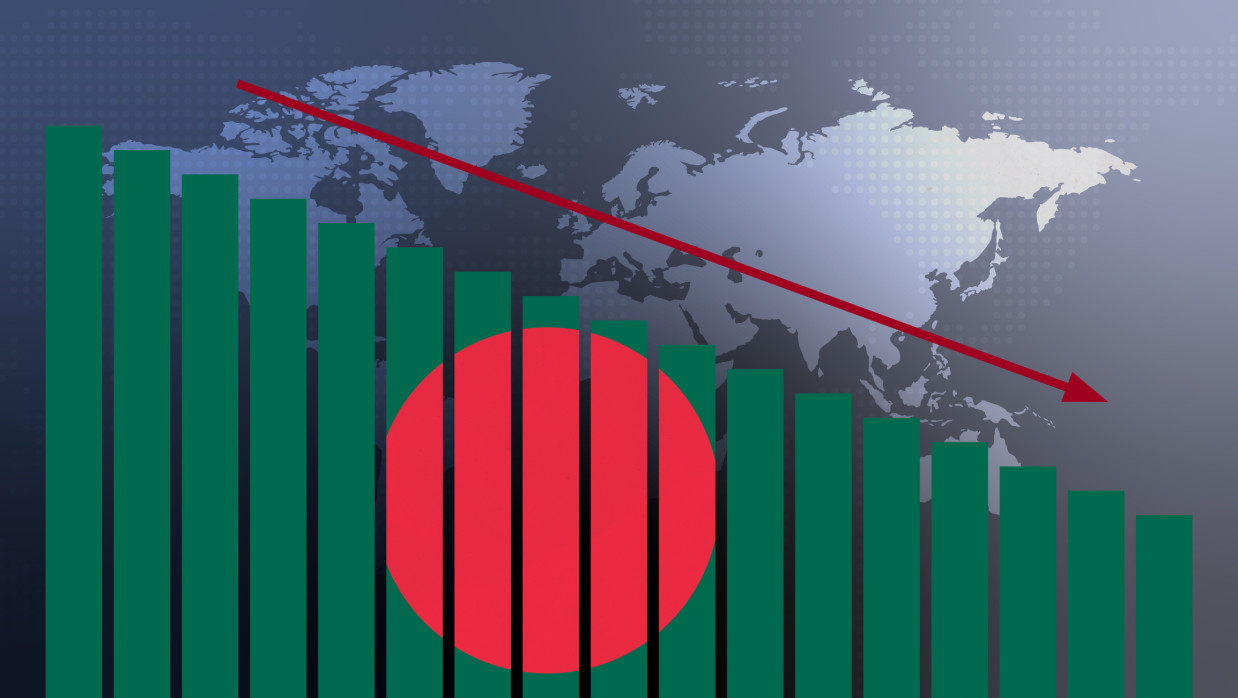
GDP the Same as ‘Development’?
There has long been a debate about what constitutes "development." Is GDP—economic growth—a valid measure of development? Probably not, for the evidence suggests otherwise.
With the exception of Sub-Saharan Africa, most countries have experienced significant economic growth and rising GDP during the last three decades. Yet a recent United Nations study revealed that, using a poverty threshold of just US$6.85 per person per day, 44 per cent of the world's population still lives in poverty. More troubling is that this proportion has changed little since 1990. Such findings raise fundamental questions about GDP as a meaningful measure of development.
Robert Kennedy on GDP
During a campaign speech in October 1968, Robert Kennedy exposed the limitations of GDP with remarkable clarity:
"Our Gross National Product... counts air pollution and cigarette advertising, and ambulances to clear our highways of carnage... special locks for our doors and the jails for the people who break them... the destruction of the redwoods and the loss of our natural wonder... napalm and nuclear warheads and armoured cars for the police to fight the riots in our cities... Yet it does not allow for the health of our children, the quality of their education, or the joy of their play."
Kennedy envisioned a less materialistic and more compassionate America—one that valued the well-being of its people more than the size of its economy. Tragically, his vision did not survive him. He was assassinated on June 6, 1968, and with his death, that vision of well-being-centred development lost one of its most powerful advocates, and as they say, the rest is history.
Bangladesh's "Unnoyon" Experience
Bangladesh's recent experience with "Unnoyon" (development), measured primarily through GDP growth, illustrates the shortcomings of this approach.
During the Hasina government (2009–2024), Bangladesh consistently recorded annual GDP growth of around 6.5-7 per cent. The government proudly showcased this performance as evidence of successful development. Yet the regime ultimately collapsed following a violent mass uprising.
Why?
Because the celebrated GDP growth also reflected expenditures on bullets and guns used to suppress dissent. The impressive infrastructure projects that dotted the country were, in many cases, accompanied by massive corruption and plunder. Rapid private-sector expansion included enormous volumes of defaulted loans that weakened the banking system. GDP captured all these activities as economic output, but it said little about justice, integrity, or people's well-being that were compromised vastly.
As Nobel Laureate Joseph Stiglitz aptly observed:
"Maximising GDP is not the same as maximising wellbeing."
Perhaps development is less about expanding national income than about creating a society in which people can genuinely flourish and live fulfilling lives – live in collective happiness.
An Encounter with Happiness
In the mid-1980s, while working as a consultant for an international development agency, I travelled to Vanuatu, a small Pacific Island nation, to advise on measures to promote economic development.
Early in my mission, a local colleague offered some simple but profound advice: "If you really want to understand our society," he said, "you need to go to the village and spend time with the community."
I accepted his advice.
On one of the islands, I was invited to join a traditional evening kava-drinking session attended by village elders.
Kava is a milky drink prepared from the fresh roots of a native plant and served in a dried coconut shell. It produces a gentle numbing sensation. More important than the drink itself, however, is the ritual surrounding it.
The gathering takes place outdoors, usually near the beach. The participants—traditionally men—sit together in a circle. One cardinal rule governs the occasion: complete silence. No conversation. Instead, everyone meditates, reflects, and listens to the sounds of nature. A typical session lasts about an hour, during which four or five bowls of kava are shared.
The evening I attended the kava session was illuminated by a brilliant full moon.
We sat silently, listening only to the rhythmic waves breaking on the shore, the songs of night birds, and the occasional distant cries of wild animals. Together they created an atmosphere of extraordinary peace and tranquillity.
When the kava session ended, a couple of young men walked to a nearby creek, caught several fish, lit a small campfire, and grilled them. We shared the fish with baked cassava before someone produced a guitar. Soon everyone was singing together.
There I was—an international development consultant in one of the world's poorest countries, supposedly helping people improve their economic future. Yet, as I sat among those villagers, I could not escape an uncomfortable question.
If development is ultimately about human happiness, these people already possessed something many affluent societies have lost. They all looked so happy and content.
So, I asked myself, what exactly was I doing there?
At that moment, I realised that although they were materially poor, they were immensely rich in contentment, community, and harmony with nature.
I have rarely felt so humbled. That evening taught me that true development cannot be measured solely by the wealth a society produces. It must also be measured by the happiness it creates, the strength of its human relationships, and the dignity with which people live their lives.
Qualities of a true leader
Ms Arundhati Roy once observed, "The problem with democracy these days is that people get the government they vote for, not the government they wish for." If that is true, where does the problem lie? Certainly not with democracy itself, nor with the people who cast their votes. The real problem lies in the quality of the leaders whom people elect.
Here is yet another enduring experience from a village in another Melanesian country—the Solomon Islands—that offers a valuable lesson on the qualities that define true leadership.
In the Solomon Islands, an individual's status has traditionally been determined by the number of pigs they own. The more pigs a person possesses, the greater the prestige and respect they command within the community.
This is similar to many parts of Africa, where a person's standing in the village has long been associated with the number of cattle they own.
Bangladesh, too, once had a comparable tradition. A person who owned many cows was regarded as a "big man" in the village. I vividly remember that, in the mid-1980s, when Hillary Clinton visited Bangladesh to observe the Grameen Bank's microcredit programme, she stopped at one of its village centres. An elderly village woman, assuming that Hillary must be wealthy, innocently asked her, "You must own many cows?"
The Solomon Islands, however, offer an important lesson that goes far beyond the accumulation of wealth. A village chief's leadership credentials are not judged merely by the number of pigs he owns. A respected leader is expected to share his prosperity. He distributes piglets to families in need, slaughters some of his mature pigs on important occasions, and shares the meat with the entire village. Wealth, therefore, is not simply a symbol of status; it carries with it an obligation to serve the community.
This simple Melanesian tradition reminds us of a profound truth: a leader is not someone who merely acquires wealth, but someone who uses it for the benefit of others. The capacity to create wealth is admirable; the willingness to share it is what makes a person worthy of genuine respect and enduring leadership.
One cannot help but compare this tradition with the conduct of many of today's wealthy and powerful whom we call leaders who accumulate wealth but seldom share it, and, much worse, some of these so-called leaders treat public office as a means of personal enrichment rather than public service. The contrast is hardly flattering.
Trust Beyond Religion: A Story of Faith, Friendship, and Humanity
Religion, regardless of which faith one follows, is expected to promote piety and nurture among human beings the virtues of compassion, empathy, and kindness. Yet, in reality, religion—having been politicised and weaponised in certain parts of the world—has at times produced the opposite effect. Instead of fostering peace, it has become one of the most dangerous sources of conflict, division, and bloodshed.
What truly binds people together is not religion alone, but trust. Trust has the remarkable ability to transcend religious boundaries and unite people of different beliefs through shared humanity.
A Story of Trust Transcending Religion
Recently, at a social gathering held a few days before Ramadan, the Muslim month of fasting, we met a Hindu couple. The husband was an engineer, while the wife, whom I shall call Kalpana, was a mother of three—two daughters and a son.
As discussions turned to the customs and practices of Ramadan, everyone present—except the Hindu couple—was Muslim. To our surprise, it became evident that Kalpana knew more about Ramadan than many of us. She even mentioned that during Ramadan she fasts every Friday.
Kalpana grew up in a village in Bangladesh's Mymensingh district. She married at the age of 18, while still in Grade 12, to an engineer. A few years later, the couple migrated to Australia.
Within her first year in Australia, Kalpana gave birth to her daughter. A few years later, she had another daughter. Like many parents influenced by cultural expectations, she longed to have a son.
She wrote to her father, the headmaster of the village school in Mymensingh, asking him to arrange a special puja so that she might be blessed with a baby boy.
What happened next was extraordinary.
Instead of approaching the local Hindu priest, Kalpana's father went to his closest friend—the Imam of the village mosque—and asked him to pray for his daughter.
According to Kalpana, the Imam requested that her father return after one week.
When he did, the Imam told him that during the previous week he had performed Tahajjud prayers—the voluntary midnight prayers—every night and had prayed to Allah to bless Kalpana with a baby boy.
The Imam also gave him a Tabiz (an amulet containing a Quranic verse) and a Dua (a Quranic supplication), handwritten in Bengali, with instructions that Kalpana should wear the Tabiz around her neck and recite the Dua at least once each week.
Kalpana's father promptly sent both the Tabiz and the Dua to Australia through DHL.
Kalpana faithfully followed the Imam's instructions. She wore the Tabiz around her neck and, instead of reciting the Dua once a week, she read it every day.
Within a year, she became pregnant and gave birth to a son, who is now a nineteen-year-old engineering student at a leading Australian university.
Sceptics may regard this as nothing more than coincidence, and perhaps it was. But for Kalpana, the experience strengthened a trust that has never faded.
She showed us the same Tabiz, which she still wears around her neck today. She also told us that whenever she encounters difficulties or prays for the well-being of her family, she recites the Dua given to her by her father's dearest friend, the village Imam, twenty-five years ago. As it turned out, that Dua is Sura Al Baqarah.
Both Kalpana's father and the Imam have since passed away.
Kalpana remains a devout Hindu. Yet the enduring legacy of her father's friendship with the Imam—and the trust they shared across religious boundaries—continues to inspire her and her family.
In a world increasingly divided by religious and political identities, this simple story reminds us of a profound truth: while religion can sometimes divide, trust, friendship, compassion, and shared humanity have the power to unite.
Perhaps that is the greatest lesson of all.
REFLECTIONS: LESSONS LEARNT
Based on these personal experiences and reflections, I have drawn three enduring lessons on the themes of development, leadership, and human bonding:
Lesson 1: Development is not measured solely by higher GDP or economic growth. Rather, it is about creating societies that are economically fulfilling, socially equitable, and environmentally sustainable, a society where people are happy collectively.
Lesson 2: A true leader is someone who possesses not only the ability to create wealth but also the generosity and commitment to share it for the benefit of others.
Lesson 3: Human trust and genuine friendship can transcend religious boundaries, forging bonds of mutual respect and understanding that endure across generations.


0 Comments
LEAVE A COMMENT
Your email address will not be published