

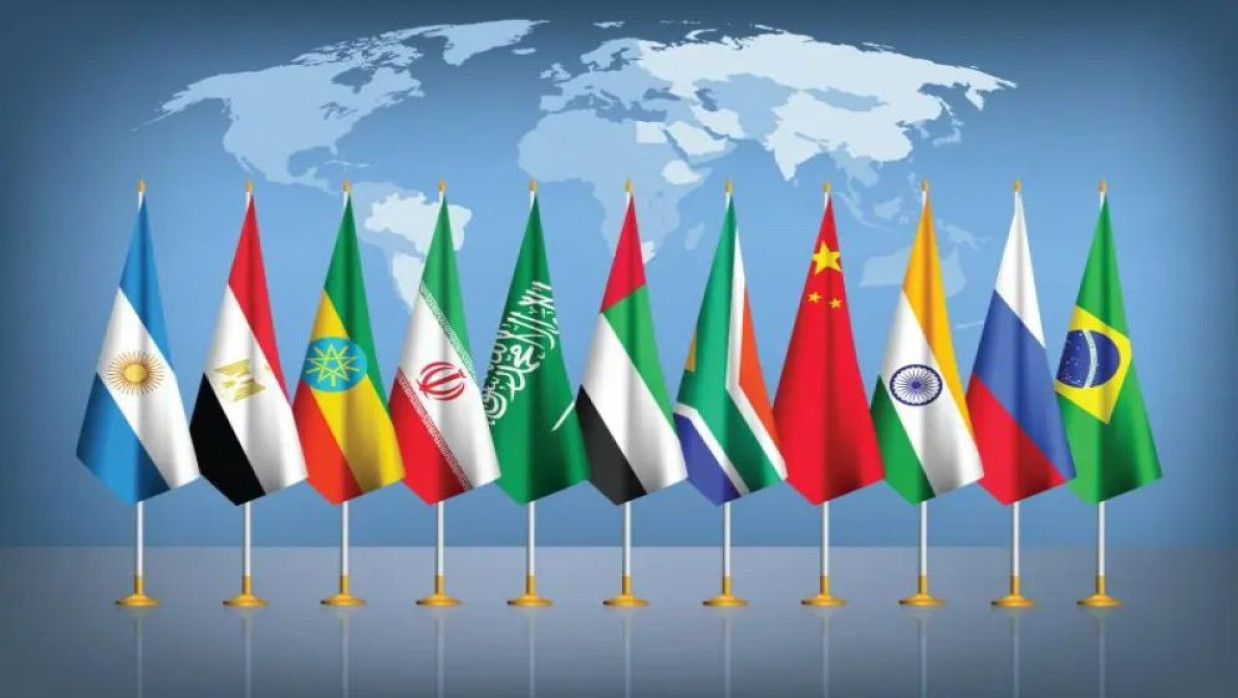
The debate over Bangladesh’s prospective membership in the BRICS grouping has emerged as one of the most consequential geopolitical discussions in South Asia. Originally established by Brazil, Russia, India, China, and South Africa, BRICS was conceived as a platform to amplify the voice of the Global South and provide a counterbalance to Western economic and political dominance. Over time, however, BRICS has evolved into a broader arena where major powers pursue competing strategic interests.
Bangladesh's participation in the BRICS summit caught the world’s eye due to New Delhi’s reaction, which has become the most debated international issue in recent months. BRICS is an international organization consisting of five member states, originally, namely Brazil, Russia, India, China, and South Africa. Founded as a union of developing countries in the Global South to collectively bargain against Western hegemony, BRICS has become more of a platform for superpowers to compete strategically today.
Bangladesh’s move to join the BRICS bloc, with China and Russia being vocal supporters of Dhaka, has excited Bangladesh but irked India. Bangladesh has been trying to make a mark for itself internationally and grow its stature with each passing day by building trade relations with countries around the world. This move might change the power dynamics between India and Bangladesh, which begs the question of how beneficial Bangladesh’s accession will prove to be.
History Behind BRICS Invitation to Bangladesh
BRICS was formed with the mission of creating partnerships for developing countries and promoting institutions that act as alternatives to those run by Western countries. This bloc of countries grew significantly by recently inducting six new members, all from the Middle East and Africa.
Bangladesh had applied to be a permanent member of BRICS a while ago. Being one of the fastest-growing Asian countries, with a population of nearly 180 million, offers many investment, trading, and diplomatic opportunities for BRICS. Not only that, but Bangladesh's strategic location in the Bay of Bengal makes it even more important to this group of countries and others in the Global South.
Bangladesh was denied despite having China and Russia in its back pocket because some current BRICS members didn’t want it to grow too fast. India has been vocal about putting a hold on inviting new countries to BRICS and wants to focus on bettering the organization as it is.
Why do China and Russia favor Bangladesh?
As mentioned above, Russia and China are the countries most in favor of Bangladesh joining the BRICS group. But why? Well, it is not only about the economics.
China wants more countries to join BRICS to further its agenda of building institutions over which it has significant control and influence. China hopes to get more developing countries from Asia, Africa, and Latin America on board with creating and using alternatives to Western-created economic and financial bodies.
Russia's motivations are somewhat different but complementary. Since the imposition of Western sanctions, Moscow has accelerated its pivot toward Asia and the Global South.
Bangladesh represents an attractive partner due to its expanding economy, growing consumer market, and strategic location connecting South and Southeast Asia. Strengthening ties with Bangladesh allows Russia to diversify its economic partnerships while reinforcing its influence in the region.
India's Strategic Concerns
India's reasons for opposing Bangladesh's inclusion are largely linked to concerns about BRICS' balance of power. Indian officials worry that admitting multiple pro-China states to BRICS could gradually make the group primarily reflect Chinese interests.
India has traditionally viewed BRICS as an alliance in which each member should hold a similar level of power relative to the others. Therefore, if BRICS continues to expand by bringing on states either reliant on Chinese investment or connected to China’s Belt and Road Initiative, India may fear that its voice could be overshadowed.
So while Bangladesh may not be the problem from India’s point of view, becoming too chock-full of pro-China states with each expansion can benefit China’s influence in BRICS. This would turn BRICS into something much more explicitly anti-Western and pro-China, which India does not want.
Deepening Bangladesh–Russia Cooperation
On 15 June 2021, Russian foreign minister Sergey Lavrov was on an official visit to Bangladesh. Bangladesh had earlier received Russian delegations led by Deputy Minister of Industry and Trade Aleksandr Ostromensky and Deputy Minister of Science and Higher Education Alexei Chekunkov. Bangladesh and Russia have agreed to boost cooperation beyond the energy and trade sectors with a new focus on artificial intelligence, technical cooperation including ICTs, labor mobility, and economic connectivity within Eurasian regions. Russia also invited Bangladesh to open an excellence center on artificial intelligence and agreed to bolster technical cooperation in several areas, including health and agriculture. Bangladesh and Russia also agreed to increase labor mobility and further economic cooperation in Eurasian regions. Bangladesh invited Russia to send millions of skilled and semi-skilled workers to address Russia's worker shortages. Bangladesh also sought to increase trade cooperation with the Eurasian Economic Commission to diversify its exports of garments, pharmaceuticals, and other products to Eurasian countries. Bangladesh said that trade with Eurasian countries would reduce its economic dependence on China.
Energy Security and Financial Transformation
Energy has long been a part of Bangladesh-Russian relations. Bangladesh's nuclear power plant, under construction with Russian assistance at Ruppur, is Bangladesh's largest infrastructure project yet. When complete, the nuclear power plant will meet Bangladesh's electricity requirements, increase its power generation capacity, and help ensure its long-term energy security.
Talks have also centered on alternative payment systems. Russia has advocated settling bilateral trade in local currencies. China, meanwhile, has offered fellow participants entrance to its Cross-Border Interbank Payment System (CIPS). Both initiatives are complementary to efforts by a coalition of emerging-market nations to conduct trade without reliance on the U.S. dollar or SWIFT payment system.
Bangladesh could benefit from having more trade options. Critics of decoupling from dollar-centric systems warn that it creates opportunities for foreign dependency.
Bangladesh’s Diplomatic Balancing Act
Bangladesh has developed a foreign policy based on competitive advantage. Bangladesh skillfully manages relations with rival great powers and successfully maintains working relations with India, China, Russia, the United States, and the European Union simultaneously.
Bangladesh leverages relationships with as many powerful partners as possible to reap the economic rewards it can offer while staying out of big power conflicts. By growing closer to China and Russia without alienating India and Western powers, Bangladesh only broadens its room to maneuver on the geopolitical stage.
Bangladesh has shown no signs of taking sides as new competitions between countries rise. Dhaka wants what it can get from everyone, be it economic deals, technology partnerships, or investment; a common strategy for middle- powers.
Conclusion
There are several parallels between the standoff over Bangladesh joining BRICS and developments in the emerging world order. Bangladesh now holds geostrategic value for China and Russia, who want to strengthen the Global South and provide new platforms of alternative economic interaction. India is concerned about BRICS being watered down and Chinese influence becoming overstretched.
The challenge for Bangladesh will be to sustain its policies of effective equilibration by capitalizing on opportunities presented by all partners without forfeiting sovereignty or endangering national interests. Regardless of whether it becomes a BRICS member state in the near future, one fact is becoming increasingly clear: Bangladesh will play a much larger role in geopolitical affairs.
With strategic competition heating up in South Asia and the Bay of Bengal, Dhaka can no longer afford to be a bystander in global power politics. Bangladesh is fast positioning itself as a maker rather than a shaper of the regional and international order.

0 Comments
LEAVE A COMMENT
Your email address will not be published