

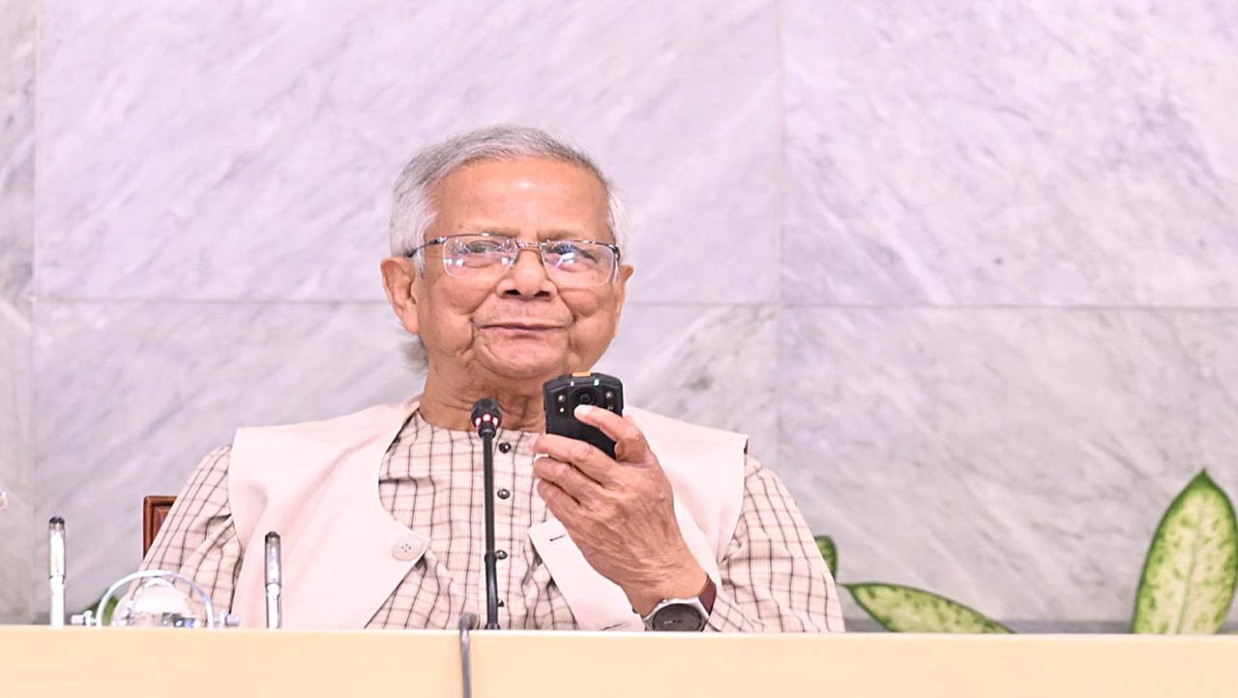
In recent times, there has been a sharp rise in badmouthing of Prof. Yunus, and it is not difficult to guess who these adversaries are and why they are doing this.
Thus, the time is ripe to do a bit of bookkeeping on the spectrum of Falling and the ‘Rising’ initiated by Prof. Muhammad Yunus, the Chief Advisor and his Interim Government (IG), and take account of the remaining challenges, unfulfilled tasks, etc.
The Falling
Prof Yunus and his IG, an incumbent who took over the reins of Bangladesh at one of the country’s most difficult periods.
In July 2024, at the time Hasina government got toppled by a mass-uprising, the economy of Bangladesh was at a dire strait - inflation was roughly 11.66% overall, with food inflation soaring to over 14% year-on-year, that severely strained household budgets; foreign exchange reserves plummeted to around $15 to $20 billion, down from a high of over $48 billion in 2021, forcing the deposed government to restrict imports of essential materials and capital goods.
The Banking Sector was in a mess – it was turned into a cash cow for the distribution of political patronage, leading to non-performing loans, poor liquidity, and offshore capital flight by the politically connected, becoming the norm and practised with impunity.
Hasina government’s three governance tools, namely corruption, patronage distribution and repression not only scarred the economy, fomented massive mass resentment - protests, curfews, and internet shutdowns paralysed the ready-made garment (RMG) sector, causing economic losses estimated at up to US$150 million per day; external debt mounting where the economy was already operating under a 42-month, US$4.7 billion IMF bailout program that began in January 2023.
Bangladesh was boiling. All it needed was a trigger, and as we already know, the ‘quota’ movement – Hasina government’s ‘jobs for boys’ - did it. It triggered the simmering resentments to boil over into a mass uprising, toppling her government.
In July 2024, a mass uprising deposed the decade-and-a-half-long autocratic and kleptocratic government of Sheikh Hasina, leaving Bangladesh in a state of virtual collapse, economically, socially, politically and more worryingly, administratively.
This is the Bangladesh – a falling nation – which the leadership of the mass uprising handed over to Prof. Yunus and his colleagues to rescue and fix.
The Rising
Prof. Yunus and his governing team, the IG that took over the reign of Bangladesh at that crucial juncture was given to defined mandate but aspirations – which included but not limited to regain trust in the government, secure the country, lift and stabilise the economy, and more importantly, present to the society a road map that help Bangladesh to move forward as an inclusive democratic, transparent and accountable polity.
Yunus and the IG did their utmost to fulfil some, but not all, the aspirations, and these include:
- Prevented a civil war: Had Prof. Yunus not taken charge at the time, on August 5, 2024, Bangladesh would have plunged into chaos; and the possibilities of Bangladesh descending into a civil war were real. Prof. Yunus has worked as a glue for Bangladesh. At that time, Bangladesh needed a leader who enjoyed both national and international appeal. Luckily for Bangladesh, Yunus is the only person who fulfilled both requirements and saved the country from collapsing.
- International recognition and protection of safety, security, and sovereignty of Bangladesh: The presence of Yunus as the leader earned instant international recognition and gave legitimacy to the Interim Government.
The presence of Yunus as leader also averted Indian intervention, possibilities of which were real and not speculative
- Stabilisation of the economy: Yunus and his Interim Government, which inherited a broken and debt-ridden economy and high inflation, especially food-inflation helped stabilise the economy (inflation was brought down from 11.6% to 8.49% and food inflation to 8.29%); restructured the IMF loans and prevented the IMF from declaring Bangladesh a defaulter; and had this happened, Bangladesh’s creditworthiness would have suffered, thereby repositioned Bangladesh’s credit-worthiness and ensuring that the country’s exports and imports flowed uninterrupted, within manageable costs.
- Restoration of law and order: Against many odds and challenges – disgruntled and politicised bureaucracy and the police -, the Yunus government restored a semblance of law and order. Admittedly, this has been one of his weakest areas of accomplishments
- Investment opportunities: The Yunus government explored several new investment opportunities, and there were many foreign investors who showed genuine interests to invest in Bangladesh but deeply entrenched corrupt and inefficient investment environment prevented these intents to turn into realities and indeed, only a full-fledged reform of the administrative and fiscal reforms that guarantee transparency, accountability, safety, security and sustainable return on capital would help bringing the potential investors back in Bangladesh.
For example, we recently saw in a news item that Mr Robin Huda, a Bangladesh-born Australian based in Sydney, Australia, has invested US$30.0 billion in India’s IT sector. His photo showing him shaking hands with Prime Minister Modi, who is not known as a great lover of Muslims or Bangladeshis, was all over Indian media, a testament to the fact that turning investment opportunities into reality requires investor confidence.
Indeed, a market economy is driven by the profit motive and assurances of market predictability, which guarantee safety, security, and the sustainability of return on investment. Neither patriotism nor parochialism has any place in investment decisions.
Luckily, in India, most businesses are politics-free, and existing laws guarantee their safety and security. Thus, unlike in Bangladesh, where power shifts fortunes, in India, regardless of power shifts, rivals never destroy national/private investments.
In Bangladesh, it is the complete opposite: most businessmen are patronage-based and political affiliates, and thus corrupt, which, with the change of governments, ushers in and replaces one group of plunderers with another.
In other words, there is no incentive for genuine businesses, local and foreign, to commit themselves to long-term investments in Bangladesh.
If I were the government now, I would ask Robin what made him invest in India rather than in his motherland, Bangladesh, adjust policies accordingly, hold a free and fair election, and transfer power to the elected representatives.
- Propose Reforms and hold a free and fair election: Finally, one of key tasks that Yunus and his IG took upon themselves was to propose reforms for rebuild Bangladesh’s democratic governance to make it more inclusive, transparent and accountable and accordingly, its reform commission, produced what has come to be known as July Sanad or July Charter and put it to referendum for endorsement by the citizens which the latter have done.
After a decade and a half, the IG held a free and fair election in February 2026, which the Bangladesh Nationalist Party (BNP), under the leadership of Tariq Rahman, won with an absolute majority and has formed the government since March 2026.
Summary: accomplishments, remaining challenges
In summary, Yunus and his Interim Government’s (IG) undeclared Terms of Reference that included among other things: (i) stabilisation of the economy, a job which they have done reasonably well; (ii) restoration of law and order, which they have accomplished not so badly though more could be done; (iii) suggest reforms of the political system to make Bangladesh’s democracy more inclusive and its governance more transparent, accountable and create investment-friendly environment for potential investors, local and foreign have been accomplished reasonably well.
The Interim Government commissioned several reform commissions that submitted their reports in time and prepared the July Charter that contained proposals for long-term and durable reforms conducive to making governance in Bangladesh inclusive, democratic and corruption-free, and to ensure that people endorse the July Charter apolitically, the IG got the Charter endorsed by the people through a referendum.
Successful implementation of these recommended reforms does have the potential to deepen democracy and improve transparency and accountability in governance, and curb corruption in Bangladesh
However, the newly elected BNP government does not seem to be following IG’s reform proposals and, more worryingly, has ignored and failed to sign the Charter, the citizen-Magna Carta of a sort, which would have helped usher in a new governance culture and build a better Bangladesh.
Tariq’s and his party, BNP’s failure to appreciate that change of guards without committing to changing the system, complete withdrawal from the July Sanad which promised a more inclusive, transparent and accountable governance in Bangladesh has been a big mistake for which Tariq Rahman, the party and indeed, Bangladesh itself may end up paying a heavy price in not too distant a future.
Finally, while it is true that Professor Yunus and his team of governance were not flawless, let us not hesitate to give them the credit where it is due. After all, and as Nelson Mandela once reminded us, " The glory of a nation is not so much in rising, it is rising from falling.”
Yunus' government did just that – they helped Bangladesh rise from falling!
The onus is now on the elected BNP government to turn the aspirations of the July 2024 Uprising – captured in the July Janad – into mandates and move Bangladesh forward economically, socially and politically through good governance.

0 Comments
LEAVE A COMMENT
Your email address will not be published